
Best Condensate Pot Manufacturer in India – High-Performance Solutions by Mcneil Instruments
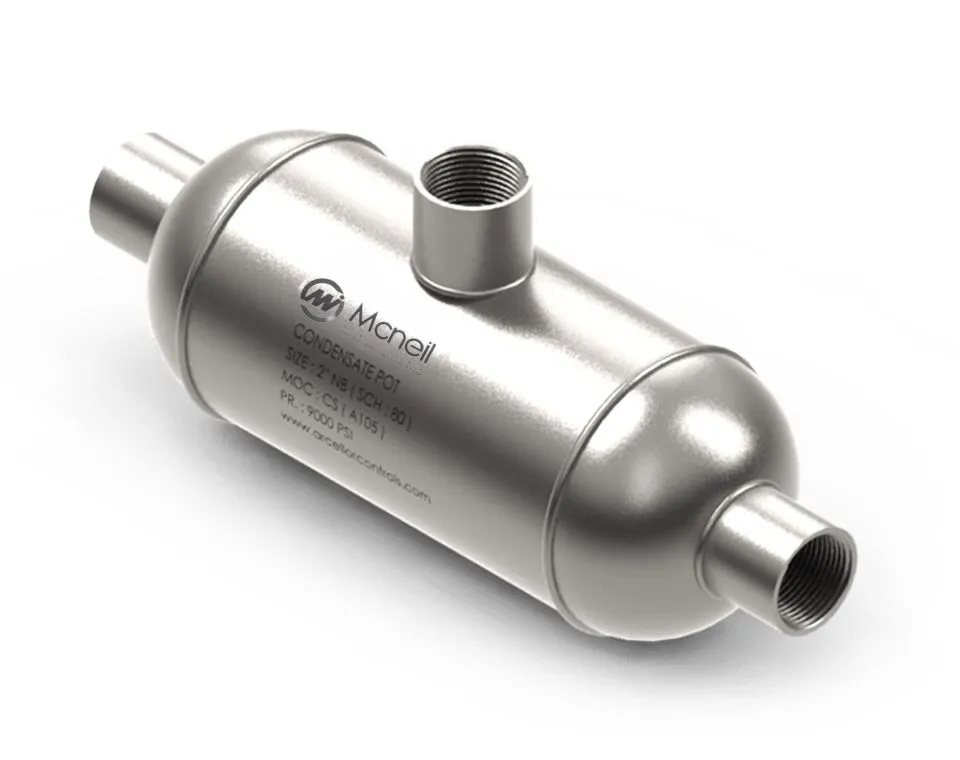
A Condensate Pot, also known as a Seal Pot, is an essential component used in steam and vapor measurement systems. Its primary function is to collect and retain condensate (liquid formed from vapor) and prevent it from reaching sensitive instruments such as pressure transmitters, flow meters, and gauges. By acting as a protective barrier between the main process line and the measuring device, the condensate pot ensures that only the required medium reaches the instrument, thereby maintaining measurement accuracy and system reliability.
Typically installed between the flow meter and gauge using a horizontal pipeline, condensate pots help stabilize the fluid column within impulse lines. This stability is crucial for maintaining equal pressure conditions and avoiding discrepancies caused by uneven liquid levels. Additionally, condensate pots are designed to capture not only liquid condensate but also foreign particles and impurities, which further enhances the protection of downstream equipment and extends the overall lifespan of the system.
Advantages of Condensate Pots
Condensate Pots play a critical role in protecting pressure transmitters, flow meters, and instrumentation systems from condensate, foreign particles, and process contaminants.
● Protects sensitive measuring instruments
● Improves measurement accuracy
● Maintains stable condensate levels
● Prevents damage caused by steam and vapor
● Reduces maintenance requirements
● Enhances process reliability
● Extends instrument service life
● Supports safe system operation
● Suitable for high-pressure applications
● Improves overall plant efficiency
The use of Condensate Pots ensures reliable operation of steam, vapor, and differential pressure measurement systems in industrial environments.
Types Of Condensate Seal Pot

Condensate Pot Type Two Ports
Mcneil Instruments Inc. Two Ports Condensate Pots Manufacturer, Supplier, & Exporter in India.

Condensate Pot Type Three Ports
Mcneil Instruments Inc. Three Ports Condensate Pots Manufacturer, Supplier, & Exporter in India.

Condensate Pot Type Four Ports
Mcneil Instruments Inc. Four Ports Condensate Pots Manufacturer, Supplier, & Exporter in India.
Advanced Condensate Pot Solutions
We offer a wide range of cost-effective condensate pots designed for efficient condensate capture and storage. These systems help keep internal orifices clean and free from blockages, ensuring uninterrupted operation.
Key Functional Advantages:
✔ Effective condensate collection and storage
✔ Protection of metering systems from damage
✔ Easy cleaning with bottom drain design
✔ Suitable for multiple industrial materials and environments
Strategically placed upstream of instruments, condensate pots maintain system cleanliness and improve operational accuracy.
Main Features Condensate Pot
- Volume: From 0.5 to 5 liters
- Number of Connections: Up to 6 taps
- Types of Connections: 1/4” female NPT, 1/2” female NPT, 1” female NPT, 1/4” BSPT, 1/2” BSPT, 1/2” 600# RF, 1/2” 600# RTJ, and other options available
- Material: Standard options include Stainless Steel 304L, 316L; other materials available upon request (e.g., Carbon Steel, 16Mo-F11/P11, 6Mo)
- Directive Compliance: Complies with the Pressure Equipment Directive (PED) 2014/68/EU depending on the volume. Condensation pots with a volume less than 1 liter are compliant with PED Article 4.3 and do not require specific testing.
Condensation Pots in Stock Condensate Pot
- 3″ Schedule 80, Volume 1.0 Liter: 4 connections with 1/2″ NPT-F, made from Carbon Steel
- 3″ Schedule 40, Volume 1.0 Liter: 4 connections with 1/2″ NPT-F, made from Stainless Steel 316L
These items are available in stock and can be delivered quickly. For more details, please contact us.
Condensate Pot Manufacturer, Supplier, and Exporter
Mcneil Instruments Inc. is the top Manufacturer, Supplier, and Exporter of condensate pots in India. We provide a wide range of inexpensive CONDENSATE POT. There is a capture and storage of condensate. As a result, the numerous orifices stay clean and clutter-free. They are upstream from the instrument, and a bottom drain makes cleaning possible. The condensate pots can be made of a variety of materials. The primary purpose of a condensate or seal pot is to hold both foreign items and any liquid that condenses from vapor. This guards against metering system damage.
Between the flow meter and gauge, a horizontal 4-inch diameter pipe leads to the condensate pot. It acts as a blocker between the primary line and the secondary mechanism to measure steam or any other vapors that may transition into a liquid state in order to assure compatibility with the secondary apparatus. To lessen the chance of error caused by an unequal fluid head in the associated pressure lines, units should be spaced uniformly.
Selection Criteria:
- Pipe Size: Available in 2″, 3″, 4″, 5”, and 6″, with larger sizes on request.
- Pipe Schedule: Options include 40, 80, 160, and XX seamless pipes.
- Number of Ports: Configurations range from 2 to 8 ports, with arrangements provided in the reference section.
- Pipe Length: Standard lengths include 8″, 10″, and 12″, with extended lengths available upon request.
- Material of Construction: Choose from Carbon Steel (ASTM A106, ASTM A105), Stainless Steel (316, 304), Alloy Steel (ASTM A335 P11, P22, P91), Monel 400, and Hastelloy C276. See below for visual references.
- Thread Connections: NPT (ANSI B1.20.1), Socket Weld (ANSI B16.11), and Butt Weld (ANSI B16.9).
- Additional Options: Titanium Fittings and Titanium Ferrule Compression Fittings are also available.
How to Install a Condensate Pot
Installing a condensate pot is crucial for accurate flow measurement. Here’s a simplified guide to help you install it correctly, either on vertical or horizontal lines, between the primary (Flow Meter) and the secondary (transmitter/gauge). This setup acts as a barrier to the line fluid and allows direct sensing of flow conditions.
- Plan Connections: Before ordering, determine the number of connections you need (e.g., inlets, outlets, fill port, drain port, gas vent port).
- Determine Specifications: Define the volume of the condensate pot in liters. Consider the system’s pressure and temperature requirements.
- Heat and Insulation: Think about whether you need to heat trace and insulate all the impulse lines to prevent freezing or temperature drops.
- Anti-Freeze Media: You might need to add anti-freeze media, like glycol, to the water lines to prevent freezing.
- Keep Lines Short: Keep the vapor impulse lines as short as possible to ensure accurate measurements.
- Mounting Level: Ensure both condensate pots are mounted at the same level to avoid measurement errors due to unequal fluid levels in the connecting lines. The highest connection point should be your reference. Consider both vertical and horizontal steam pipelines.
- Mounting Position: The differential pressure (DP) measuring device should be mounted below both condensate pots and the steam pipeline.
- Blowdown Facility: Ensure that both impulse lines from the condensate pot to the DP have a blowdown facility. Regularly blowing down these lines helps prevent debris from affecting measurement accuracy.
By following these steps, you can ensure accurate and reliable measurements from your condensate pot installation.
Uses and Application of Condensate Pot
Condensate pots are necessary for use with steam. They serve to protect the differential pressure transmitter from heat damage by condensing the fluid upstream of it. They provide precise measurement by keeping a consistent condensate height in the impulse lines above the differential pressure transmitter when installed at the same height.
In the event that a corrosive or aggressive fluid is being measured by the transmitter, the condensation pot may also be utilized to safeguard it. Here, we’re referring to separating pots.
Global Reach of Mcneil Instruments’s Condensate Pots
Mcneil Instruments has earned a reputation as a leading condensate pots manufacturer and exporter in Oman by delivering premium-quality products that cater to diverse industrial applications, our condensate pots.
Working Mechanism of Condensate Pot
The working principle of a condensate pot is based on separating steam vapor from liquid condensate before it reaches the measuring device.
- Steam vapor travels through impulse lines into the condensate pot
- Condensate collects inside the pot, forming a stable liquid column
- This liquid barrier prevents measurement errors caused by vapor-liquid mixing
- The system ensures accurate pressure and flow readings
Proper installation—either vertical or horizontal—ensures uniform fluid levels, reducing errors caused by uneven pressure distribution.
Types of Condensate Seal Pots
Two-Port Condensate Pot
Designed for basic applications requiring minimal connections, ensuring simple and efficient operation.
Three-Port Condensate Pot
Offers additional flexibility for intermediate systems with moderate complexity.
Four-Port Condensate Pot
Ideal for advanced industrial systems requiring multiple connection points and enhanced control.
Key Features of Condensate Pots
- Volume Range:5 to 5 liters
- Connections:Up to 6 ports
- Connection Types:NPT, BSPT, RF, RTJ, and more
- Materials:SS304, SS316L, Carbon Steel, Alloy Steel
- Compliance:PED 2014/68/EU standards
Available Stock Options:
✔ 3” Schedule 80 (Carbon Steel)
✔ 3” Schedule 40 (SS 316L)
These ready-to-dispatch products ensure fast delivery and minimal downtime.
Technical Specifications
- Pipe Sizes:2” to 6” (custom sizes available)
- Pipe Schedule:40, 80, 160, XXS
- Port Configurations:2 to 8 ports
- Pipe Lengths:8”, 10”, 12” (customizable)
- Connection Types:NPT, Socket Weld, Butt Weld
- Materials:CS, SS, Alloy Steel, Monel, Hastelloy
Additional options include Titanium fittings and compression ferrules.
Material of Construction
Mcneil Instruments manufactures Condensate Pots using a wide range of corrosion-resistant and high-performance materials suitable for different industrial applications.
● ASTM A106
● ASTM A105
● ASTM A234 WPB
● SS 304
● SS 304L
● SS 316
● SS 316L
● ASTM A335 P11
● ASTM A335 P22
● ASTM A335 P91
● UNS S31803
● UNS S32205
● UNS S32750
● UNS S32760
● Monel 400
● Monel K500
● Hastelloy C22
● Hastelloy C276
● Grade 1
● Grade 2
● Grade 5
These material options allow Condensate Pots to perform efficiently in high-temperature, corrosive, and high-pressure operating environments.
IBR Condensate Pot Specifications
- Size:3” OD x 300mm (custom available)
- Temperature Resistance:Up to 500°C
- Pressure Handling:High-pressure design
- Material Options:CS, SS, Duplex, Alloy Steel
- Finish:Epoxy coated, painted options
- Application:Boiler and steam systems
Material Grades Available
We offer a wide range of materials to suit different environments:
Choosing the right manufacturer for condensate pots is essential for ensuring accuracy, durability, and long-term system performance. Mcneil Instruments stands out as a trusted industry leader by consistently delivering high-quality, reliable, and customized solutions tailored to diverse industrial needs.
✔ Precision-Engineered Products
At Mcneil Instruments, every condensate pot is designed with advanced engineering techniques and strict dimensional accuracy. This ensures seamless integration with existing systems, optimal performance in steam and fluid applications, and precise measurement without errors or leakage.
✔ High Durability & Corrosion Resistance
Our condensate pots are manufactured using premium-grade materials such as stainless steel, carbon steel, and alloy steels. These materials provide excellent resistance against corrosion, high pressure, temperature fluctuations, and harsh industrial environments, ensuring a long service life with minimal maintenance.
✔ Global Export Expertise
With a strong international presence, Mcneil Instruments exports condensate pots to multiple countries across the USA, Europe, Middle East, Asia, and Africa. Our expertise in global logistics, secure packaging, and timely delivery makes us a reliable partner for clients worldwide.
✔ Custom Design Solutions
We understand that every industry has unique operational requirements. That’s why we offer fully customizable condensate pot solutions, including variations in size, material, port configuration, pressure rating, and connection types. This flexibility ensures the product fits perfectly into your system.
✔ Competitive Pricing
Despite maintaining high-quality standards, Mcneil Instruments offers cost-effective pricing to deliver maximum value. Our efficient manufacturing processes and strong supply chain allow us to provide premium products at competitive rates.
✔ Strong After-Sales Support
Our commitment doesn’t end with delivery. We provide dedicated after-sales support, including technical assistance, installation guidance, and maintenance support to ensure smooth and uninterrupted operation of your systems.
Quality Assurance & Testing
Every Condensate Pot manufactured by Mcneil Instruments undergoes strict quality inspections and testing procedures to ensure reliability and long-term performance.
● Hydrostatic Testing
● Pneumatic Testing
● Leak Detection Testing
● Dimensional Verification
● Material Identification Testing
● Weld Inspection
● Surface Finish Inspection
● Visual Examination
● ASTM Standards
● ASME Standards
● PED 2014/68/EU
● ISO Manufacturing Practices
Our quality assurance process guarantees safe and dependable operation in critical industrial applications.
Suitable for basic pressure measurement applications.
Provides additional flexibility for instrumentation systems.
Designed for complex industrial installations requiring multiple connections.
Used in large process systems and advanced instrumentation networks.
Manufactured according to customer drawings and project specifications.
Frequently Asked Questions (FAQs)
A Condensate Pot is a vessel used in steam and vapor applications to collect condensate and prevent it from reaching pressure transmitters and measuring instruments.
It protects instruments from high temperatures, condensate buildup, and measurement inaccuracies.
What materials are available for Condensate Pots?
We manufacture Condensate Pots in Carbon Steel, Stainless Steel, Alloy Steel, Duplex Steel, Monel, Hastelloy, and Titanium grades.
What industries use Condensate Pots?
Oil & Gas, Petrochemical, Power Plants, Refineries, Chemical Processing, Offshore, and Pharmaceutical industries.
Can Condensate Pots be customized?
Yes, we offer customized sizes, port configurations, materials, pressure ratings, and connection types.
Sizing of Condensate Pot
| P NPT – F | Capacity (Internal Vol.0)cm 3±5% | Pressure Rating PSIG | T mm | L mm | B mm |
| 1/4” | 150 | 1800 | 2.05 | 135 | 50.08 |
| 1/4” | 300 | 1800 | 2.05 | 225 | 50.08 |
| 1/4” | 400 | 1800 | 2.05 | 290 | 50.08 |
| 1/4” | 500 | 1800 | 2.05 | 350 | 50.08 |
| 1/4” | 1000 | 1800 | 4.06 | 275 | 88.09 |
| 1/4” | 2250 | 1800 | 5.02 | 435 | 120 |
| 1/4” | 3785 | 1800 | 5.02 | 680 | 120 |
| 1/2” | 1000 | 1800 | 4.06 | 275 | 88.09 |
| 1/2” | 2250 | 1800 | 5.02 | 435 | 102 |
| 1/2” | 3785 | 1800 | 5.02 | 680 | 102 |
| 3/4” | 1000 | 1800 | 4.06 | 275 | 88.09 |
| 3/4” | 2250 | 1800 | 5.02 | 435 | 102 |
| 3/4” | 3785 | 1800 | 5.02 | 680 | 102 |
Technical Specification
| Material | Shell | Cap | Pipe Schedule | Test Pressure |
| Carbon Steel | A-106 | A-105 | Sch.40 | 80 Kg / Cm2 |
| Sch.80 | 125 Kg / Cm2 | |||
| Sch.160 | 125 Kg / Cm2 | |||
| Stainless Steel | SS304 | SS304 | Sch.40 | 90 Kg / Cm2 |
| Sch.80 | 150 Kg / Cm2 | |||
| Sch.160 | NA | |||
| Stainless Steel | SS316 | SS316 | Sch.40 | 90 Kg / Cm2 |
| Sch.80 | 150 Kg / Cm2 | |||
| Sch.160 | NA | |||
| Alloy Steel | A-335 | A-182 | Sch.40 | NA |
| A-12 | F-12 | Sch.80 | 125 Kg / Cm2 | |
| Sch.160 | 210 Kg / Cm2 | |||
| Alloy Steel | A-335 | A-182 | Sch.40 | NA |
| A-12 | A-12 | Sch.80 | 125 Kg / Cm2 | |
| Sch.160 | 210 Kg / Cm2 | |||
| Special | Specify | Specify | – | – |
| Monel & Hastelloy | – | – | – | – |
Material of Construction
Monel :
Grade: Monel 400, Monel K500, Monel R-405
Nickel :
Grade: Nickel 200, Nickel 201
Inconel :
Grade: Inconel 600, Inconel 601, Inconel 625, Inconel 718
Incoloy :
Grade: Incoloy 800, Inconel 800H, 800HT
Hastalloy :
Grade: Hastalloy B2, Hastalloy B3, Hastalloy C22, Hastalloy C276, Hastalloy X
Titanium :
Grade: Gr1, Gr2, Gr3, Gr5, Gr7, Gr11
Stainless Steel :
Grade: ASME / ASTM SA / A403 SA / A 774 WP-S, WP-W, WP-WX, 304, 304L, 316, 316L, 304/304L, 304H, 316H, 316/316L, 321, 330, 347, 309/S, 310/S, 317/L, 333, 410/S, DIN 1.4301, DIN1.4306, DIN 1.4401, DIN 1.4404
Carbon Steel :
Grade: ASTM A 234 WPB , WPBW, WPHY 42, WPHY 46, WPHY 52, WPH 60, WPHY 65 & WPHY 70, SA105
Duplex Steel:
Grade: ASTM / ASME A/SA 182 UNS F44, F45, F51, F53, F55, F60, F61
Alloy Steel:
Grade : ASTM SA 182 – E25, E26, E27, E28, E29B, E30B, E39B, E40B, E36B, E36C, E41B, AISI4130, AISI4140, AISI4340, 42CRMO4, 16MNCR5, 20MNCR5, 21CrMoV57, EN353, EN354, F11, F22, F91, F9, P11, P22, P91, P9, P5, P92, EN42J, EN8, EN19