
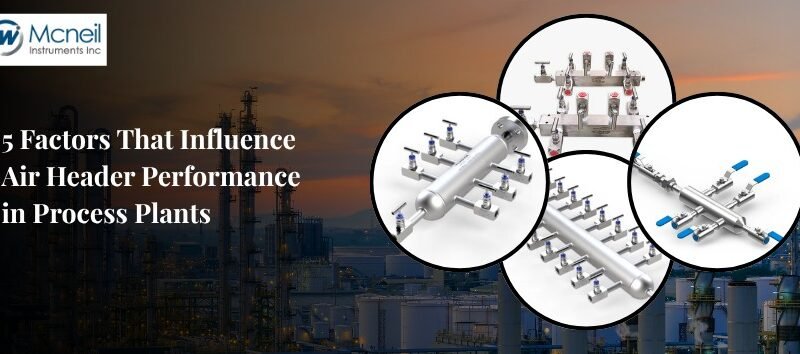
Compressed air is an essential utility in many process plants. It powers pneumatic control valves, actuators, instrumentation, automation equipment and other devices that support continuous industrial operations.
In these systems, an air header acts as a centralized distribution point. It receives compressed air from a common source and distributes it through multiple outlet connections to individual instruments or pneumatic equipment.
While an air header may appear to be a relatively simple component, its design and operating performance can directly affect the reliability of the entire compressed-air distribution network.
An improperly selected or poorly configured air header can contribute to pressure instability, leakage, corrosion, difficult maintenance and inefficient air distribution. Conversely, the correct combination of material, pressure rating, outlet configuration, connections and quality control can provide reliable service in demanding process environments.
Mcneil Air Header manufactures air distribution systems for applications including oil & gas, refineries, petrochemical plants, power generation, offshore platforms, chemical processing, water treatment and process automation. Its published air header range covers sizes from 1/2 inch to 4 inches, outlet configurations from 4-way through 16-way, and pressure ratings up to 6000 PSI.
What Is an Air Header?
An air header is a centralized compressed-air distribution system designed to supply multiple instruments or pneumatic devices from a common inlet.
A typical system consists of:
Main inlet connection
Header body
Multiple outlet ports
Outlet valves or fittings
Drain arrangement where required
Mounting arrangement
End connections
Compressed air enters through the main inlet and moves through the header body before being distributed through the individual outlets.
This centralized arrangement can simplify plant piping by reducing the need for separate connections from the primary air source to every instrument.
Why Air Header Performance Matters
A process plant may depend on compressed air for critical functions such as:
Pneumatic control valves
Actuators
Instrumentation
Process automation
Control systems
Safety-related pneumatic equipment
Sampling systems
Utility air networks
If the air distribution system does not maintain suitable pressure and flow conditions, downstream equipment may not operate as intended.
Potential consequences include:
Unstable pneumatic operation
Slow actuator response
Control-valve performance problems
Increased leakage
Higher maintenance requirements
Reduced system efficiency
Process interruptions
This makes air-header selection an important part of instrumentation and pneumatic system design.
5 Factors That Influence Air Header Performance
- Pressure Rating and Pressure Stability
The first major factor is the air header’s ability to handle the system’s operating pressure.
Mcneil Air Header publishes air headers with pressure ratings up to 6000 PSI, depending on the configuration and material.
However, pressure rating and pressure stability are not exactly the same thing.
Pressure Rating
Pressure rating indicates the pressure capability of the component under specified conditions.
When selecting an air header, engineers should consider:
Normal operating pressure
Maximum operating pressure
Design pressure
Pressure fluctuations
Temperature
Material
Connection type
Valve configuration
The selected air header should have an appropriate rating for the complete operating conditions.
Pressure Stability
The air header must also distribute compressed air consistently to its connected outlets.
An improperly designed distribution system can experience pressure variation when several downstream devices operate simultaneously.
This makes the following factors important:
Header size
Number of outlets
Inlet size
Outlet size
Air demand
Piping layout
Pressure drop
Simultaneous equipment operation
For high-demand systems, the air-header configuration should therefore be evaluated as part of the overall compressed-air network rather than as an isolated component. - Number and Configuration of Outlet Ports
The second major factor is the number and arrangement of outlets.
Mcneil Air Header publishes configurations including:
4-way
6-way
8-way
10-way
12-way
14-way
16-way
The main air header range covers these configurations depending on product design.
Why Outlet Configuration Matters
The number of connected instruments determines how many outlets are required.
For example:
4-way air header → 4 outlet connections
8-way air header → 8 outlet connections
16-way air header → 16 outlet connections
Selecting the appropriate number of outlets can simplify plant layout and reduce unnecessary branch connections.
Avoiding Overcapacity
An air header does not necessarily need the maximum possible number of outlets.
Excessive unused connections can:
Increase equipment size
Occupy additional installation space
Add unnecessary cost
Complicate maintenance
At the same time, selecting too few outlets can require additional distribution equipment later.
A practical design should therefore consider:
Current instrument count
Planned expansion
Available installation space
Maintenance accessibility
Required isolation points
Mcneil Air Header also provides customized configurations, including outlet quantity, inlet/outlet sizes, dimensions, pressure ratings, connection types and mounting arrangements. - Material Selection and Corrosion Resistance
The third factor is the material of construction.
Process plants can operate in environments containing:
Moisture
Chemicals
Hydrocarbons
Chlorides
Marine exposure
High temperatures
Corrosive atmospheric conditions
The air header material must therefore be compatible with its operating environment.
Mcneil Air Header publishes air headers in materials including carbon steel, stainless steel and alloy steel, with additional material options available for specialized configurations.
Carbon Steel Air Headers
Carbon steel can provide a practical combination of strength, durability and cost efficiency for appropriate industrial environments.
Mcneil Air Header lists ASTM A105 and ASTM A106 among its carbon-steel material options.
Carbon steel air headers can be considered for:
Refineries
Power plants
General industrial systems
Non-corrosive service environments
Instrumentation networks
Stainless Steel Air Headers
Stainless steel can be selected when increased corrosion resistance is required.
Mcneil Air Header offers:
SS 304
SS 304L
SS 316
SS 316L
Its published stainless-steel air header specifications include pressure ratings up to 6000 PSI and configurations from 4-way through 16-way.
SS 316 and 316L can be particularly useful in applications where chemical, chloride or marine exposure is a concern.
Alloy and Specialty Materials
For more demanding applications, Mcneil Air Header also lists alloy steel, duplex, super duplex, Monel, Inconel, Hastelloy and other specialized materials across its air-header product range.
The appropriate material should always be selected according to the actual process environment, temperature, pressure and project requirements. - End Connections and Outlet Valve Selection
The fourth factor is the connection arrangement.
Mcneil Air Header lists several air-header connection options, including:
NPT
BSPT
Socket weld
Flanged
Butt weld
Compression connections
Why End Connections Matter
The connection needs to match the downstream tubing or piping system.
An incorrectly selected connection can result in:
Leakage
Installation difficulties
Thread damage
Additional adapters
Increased maintenance
Reduced reliability
Connection selection should therefore be based on the plant piping specification and the connected instrumentation.
Outlet Valve Configuration
Air headers may also incorporate valves at individual outlets.
Common options include:
Ball valves
Needle valves
Isolation valves
Other specified outlet arrangements
Mcneil Air Header’s published air-header configurations and related products support ball-valve and needle-valve arrangements for industrial instrumentation systems.
Ball Valves
Ball valves are generally suited to quick isolation and shutoff applications.
They can be useful where an individual instrument or branch needs to be isolated from the common air supply.
Needle Valves
Needle valves can provide more controlled flow adjustment where throttling or precise flow regulation is required.
Mcneil Air Header publishes needle valves for instrumentation, process control, hydraulic and pneumatic applications, with configurations including NPT, BSPT, socket-weld, butt-weld and tube-fitting connections.
Selecting the correct outlet valve arrangement can make a significant difference to system operation and maintenance. - Testing, Leak Prevention and Maintenance
The fifth factor is manufacturing quality and ongoing maintenance.
Even a correctly designed air header can perform poorly if the finished component has leakage, dimensional problems, incorrect material or damaged connections.
Mcneil Air Header publishes hydrostatic and pneumatic testing for its air headers.
Its stainless-steel air header quality procedures also include:
Hydrostatic testing
Pneumatic testing
Leak detection
Material verification
Dimensional inspection
Thread inspection
Surface-finish inspection
Visual examination
Why Leak Testing Matters
Compressed-air leakage can reduce system efficiency and increase compressor demand.
Potential leakage locations include:
Threaded connections
Valve connections
Outlet ports
Flanged joints
Welded areas
Fittings
A properly tested air header helps identify leakage before the component is integrated into the plant system.
Why Material Verification Matters
Material verification is especially important when different alloys are used across a process plant.
Correct material identification helps confirm that the supplied component matches the specified material grade and project requirements.
Mcneil Air Header lists raw-material verification, PMI, pressure testing, dimensional inspection, thread inspection and material traceability among its quality procedures for carbon-steel air headers.
Air Header Performance: A Practical Comparison
Performance Factor What to Evaluate Effect on System
Pressure rating Maximum operating/design pressure Safe pressure containment
Header size Inlet and body dimensions Air distribution capacity
Outlet count Number of connected devices Distribution flexibility
Material CS, SS, alloy or specialty alloy Corrosion resistance and service life
Connections NPT, BSPT, socket weld, flanged, etc. Installation compatibility
Outlet valves Ball, needle or specified valve Isolation and flow control
Testing Hydrostatic, pneumatic and leak testing Connection integrity
Maintenance access Mounting and outlet arrangement Easier servicing
Surface finish Painted, pickled, passivated or polished Environmental protection
Customization Dimensions and configuration Application-specific performance
How Air Header Design Influences Process Plant Efficiency
A well-designed air header can simplify compressed-air distribution by creating a centralized connection point.
Instead of running separate lines from the primary source to every instrument, a header can provide multiple organized outlet connections.
This can help:
Simplify piping
Reduce installation complexity
Improve access to individual branches
Facilitate isolation
Organize instrumentation networks
Support plant expansion
Mcneil Air Header describes its air distribution systems as centralized solutions for instrumentation and pneumatic applications across oil & gas, refinery, petrochemical, power, offshore, chemical and water-treatment facilities.
Air Header Material Selection Guide
Choosing the correct material depends on the operating environment.
Material General Characteristics Potential Applications
Carbon Steel Strength, durability, cost efficiency Refineries, power and general industrial service
SS 304 General corrosion resistance Industrial instrumentation
SS 304L Low-carbon stainless steel Welded systems
SS 316 Enhanced corrosion resistance Chemical and demanding process environments
SS 316L Corrosion resistance and low-carbon construction Marine, offshore and chemical service
Alloy Steel Enhanced high-temperature/mechanical properties High-pressure/high-temperature applications
Duplex Strength and corrosion resistance Offshore and chemical service
Super Duplex High corrosion resistance in aggressive environments Chloride-rich and offshore service
Monel/Inconel/Hastelloy Specialized corrosion/high-temperature performance Severe process environments
This is a general selection guide. Actual material suitability should be determined from the process conditions and project specification.
How to Select an Air Header for a Process Plant
Before specifying an air header, consider the following steps.
Step 1: Determine the Air Source
Identify:
Compressor or air source
Supply pressure
Air quality
Normal operating pressure
Maximum pressure
Pressure fluctuations
Step 2: Determine the Number of Users
Count the instruments and pneumatic devices that require connections.
Consider future expansion if the plant design allows for additional equipment.
Step 3: Select the Header Configuration
Choose the appropriate number of outlets:
4-way
6-way
8-way
10-way
12-way
14-way
16-way
Custom configurations may be considered where standard configurations do not meet the project requirement.
Step 4: Select the Material
Evaluate:
Corrosion exposure
Temperature
Pressure
Chemical environment
Outdoor/offshore conditions
Required service life
Step 5: Select Connections
Confirm whether the system requires:
NPT
BSPT
Socket weld
Butt weld
Flanged
Compression connections
Step 6: Select Outlet Valves
Determine whether each branch requires:
Isolation
Flow regulation
Venting
Sampling
Drainage
Step 7: Confirm Testing Requirements
Depending on the application, specify:
Hydrostatic testing
Pneumatic testing
Leak testing
PMI
Dimensional inspection
Thread inspection
Material traceability
Common Air Header Performance Problems
Several issues can reduce air-header reliability.
Pressure Drop
Pressure drop can occur when the distribution system is not appropriately sized for the required air demand.
Leakage
Poor threads, damaged sealing surfaces, improperly assembled fittings or defective valves can create leakage.
Corrosion
Incorrect material selection can lead to premature degradation in corrosive environments.
Poor Outlet Configuration
Insufficient or poorly arranged outlets can complicate instrumentation connections and maintenance.
Inadequate Testing
Failure to properly inspect and test the air header can allow manufacturing or assembly problems to reach the plant.
Difficult Maintenance Access
An air header installed without considering accessibility can make isolation and maintenance more difficult.
5 Factors at a Glance
The performance of an air header in a process plant can be summarized through five major factors:
- Pressure Capability
The header must be appropriately rated for the operating and design pressure. - Outlet Configuration
The number and arrangement of outlets should match the plant’s instrumentation requirements. - Material Selection
Carbon steel, stainless steel, alloy and specialty materials should be selected according to the environment. - Connections and Valves
The correct connection and valve arrangement improves installation, isolation and maintenance. - Testing and Quality
Hydrostatic, pneumatic, leak, material and dimensional testing help verify the integrity of the finished air header.
Why Choose Mcneil Air Header?
Mcneil Air Header provides air distribution systems for instrumentation and pneumatic applications across several industrial sectors.
Its published air-header portfolio includes:
Carbon Steel Air Headers
Stainless Steel Air Headers
Instrument Air Headers
Air Distribution Headers
Air Distribution Manifolds
Bar Stock Air Headers
Multi-way Air Headers
Customized Air Header Systems
The general published range includes 1/2-inch to 4-inch sizes, 4-way to 16-way configurations and pressure ratings up to 6000 PSI, with NPT, BSPT, socket-weld and flanged connections.
Mcneil Air Header also offers customization covering outlet quantity, inlet and outlet sizes, pressure ratings, connection types, mounting arrangements, drain valves, surface coatings, material grades and identification marking.
This allows the air header to be configured according to the requirements of the individual instrumentation or pneumatic distribution system.
Applications of Air Headers in Process Plants
Air headers are used across several industries where centralized compressed-air distribution is required.
Oil & Gas
Used for pneumatic instrumentation, control systems and process equipment.
Refineries
Air headers can distribute instrument air to pneumatic control valves and related systems.
Petrochemical Plants
Centralized air distribution supports process automation and pneumatic equipment.
Power Generation
Air headers can supply instrumentation and pneumatic control systems associated with power-generation equipment.
Chemical Processing
Corrosion-resistant air-header materials can be selected for demanding chemical environments.
Offshore and Marine
Stainless steel, duplex and specialty-alloy configurations may be considered where marine exposure creates additional corrosion concerns.
Water Treatment
Air headers can support pneumatic valves and automated treatment systems.
Pharmaceutical Applications
Stainless steel configurations can be selected where corrosion resistance and controlled surface finishes are important.
Frequently Asked Questions
What is the main purpose of an air header?
An air header distributes compressed air from a common inlet to multiple instruments or pneumatic devices through several outlet connections.
What factors affect air header performance?
Five major factors are pressure capability, outlet configuration, material selection, connection and valve arrangement, and testing/maintenance.
What pressure rating is available for Mcneil Air Headers?
Mcneil Air Header publishes air headers with pressure ratings up to 6000 PSI, depending on the specific design and configuration.
What sizes are available?
The general Mcneil Air Header range is published from 1/2 inch to 4 inches, depending on the configuration.
How many outlets can an air header have?
Mcneil Air Header publishes configurations including 4, 6, 8, 10, 12, 14 and 16-way air headers. Custom configurations can also be manufactured according to project requirements.
Which materials are available for air headers?
Published options include carbon steel, stainless steel and alloy steel, with additional duplex, super duplex, Monel, Inconel, Hastelloy and other specialty materials available across the product range.
Which stainless steel grades are available?
Mcneil Air Header lists SS 304, SS 304L, SS 316 and SS 316L for its stainless-steel air headers.
How are air headers tested?
Mcneil Air Header publishes hydrostatic and pneumatic testing for its air headers. Its quality procedures can also include leak detection, material verification, dimensional inspection, thread inspection and visual examination.
Conclusion
Air header performance depends on much more than simply connecting a compressed-air source to multiple outlets.
The pressure rating, outlet configuration, material selection, connection and valve arrangement, and quality testing all influence how reliably an air header performs in a process plant.
A correctly selected air header can help organize compressed-air distribution, simplify instrumentation connections and provide accessible isolation points for maintenance. Mcneil Air Header offers standard and customized configurations for industrial instrumentation and pneumatic applications, with multiple materials, outlet arrangements, connection types and pressure ratings available.
For process plants, the most effective approach is to select an air header based on the complete operating requirement rather than a single specification. Evaluating air demand, pressure, number of outlets, environment, materials, connections and testing requirements together helps create a more reliable compressed-air distribution system.