
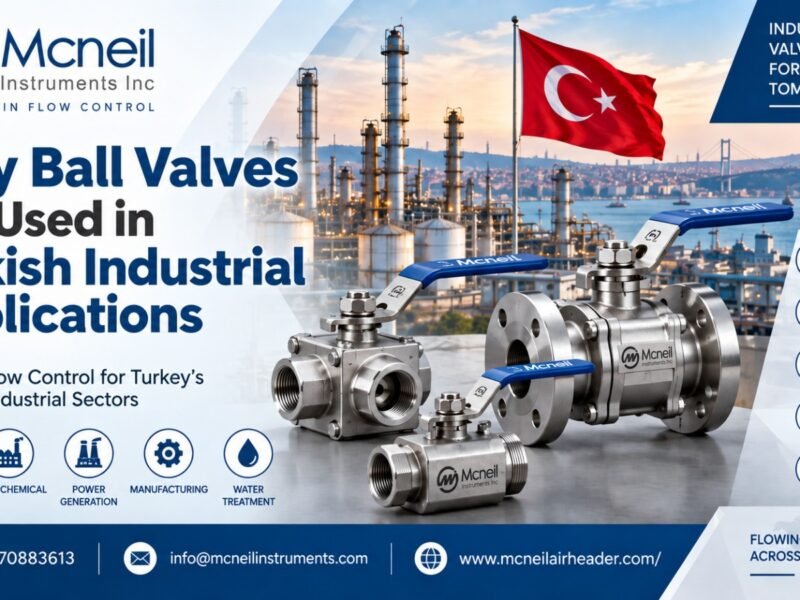
Turkey has a diverse industrial sector covering oil & gas, petrochemical processing, chemical manufacturing, power generation, water treatment, food processing, steel production and industrial automation. These industries require dependable flow-isolation and control components capable of operating across different pressure, temperature and process conditions.
A Ball Valve is widely used in industrial piping and instrumentation systems because its quarter-turn operating mechanism provides quick shut-off, compact construction and reliable isolation. Depending on the application, Ball Valves can be supplied in different materials, pressure ratings, port configurations and connection types.
Mcneil Air Header manufactures and supplies Ball Valves for Turkish industrial applications, including industrial, instrumentation, pneumatic and high-pressure configurations. The company’s Ball Valve range includes 2-way, 3-way and 4-way designs for applications requiring flow isolation, diversion and process-system integration.
Why Are Ball Valves Used in Turkey’s Industrial Sector?
The selection of a Ball Valve depends on the specific process requirements of an industrial facility. In Turkish manufacturing and process industries, several characteristics make Ball Valves suitable for industrial piping systems.
1. Quick Quarter-Turn Operation
A Ball Valve can generally be opened or closed through a quarter-turn rotation. This allows operators to isolate a process line quickly when maintenance, equipment replacement or emergency shutdown procedures require flow interruption.
2. Reliable Flow Isolation
The spherical closure mechanism and compatible seat arrangement allow a Ball Valve to provide effective shut-off when correctly selected for the process medium and operating conditions.
3. Compact Design
Industrial facilities often have complex piping and instrumentation layouts. A compact Ball Valve can be integrated into restricted installation areas where appropriate.
4. High-Pressure Applications
Certain High Pressure Ball Valve configurations are designed for demanding pressure conditions. Mcneil Air Header’s published Ball Valve range includes selected models rated up to 10,000 PSI.
5. Multiple Flow Configurations
Ball Valves are available in different configurations. 2-Way Ball Valves are commonly used for isolation, while 3-Way and 4-Way Ball Valves can provide flow-diversion and multi-directional flow arrangements.
6. Material Flexibility
Ball Valves can be manufactured from stainless steel, alloy steel and specialized nickel-based alloys. This allows material selection according to corrosion conditions, temperature and process-media compatibility.
Ball Valve Applications in Turkish Industries
Turkey’s industrial infrastructure includes a wide range of process and manufacturing operations. The appropriate Ball Valve configuration varies according to the application.
Oil & Gas Applications
Oil and gas facilities require valves for pipeline isolation, instrumentation and process systems.
Ball Valves can be used for:
- Process-line isolation
- Gas systems
- Instrumentation
- Pressure systems
- Flow diversion
- Pneumatic applications
For demanding oil and gas installations, a Ball Valve should be selected according to pressure, temperature, media compatibility and applicable project standards.
Petrochemical Industry
Petrochemical facilities contain interconnected process systems where reliable isolation is important.
Industrial Ball Valves can be incorporated into:
- Process piping
- Chemical-fluid systems
- Instrumentation lines
- Hydrocarbon handling systems
- Automation systems
Material selection is particularly important when Ball Valves are exposed to aggressive process media.
Chemical Processing
Turkey’s chemical manufacturing sector uses various fluids and gases that can require specialized valve materials.
A Stainless Steel Ball Valve or suitable alloy Ball Valve can be considered where corrosion resistance is an important design requirement.
Possible applications include:
- Chemical transfer
- Process isolation
- Fluid handling
- Instrumentation
- Dosing systems
- Process automation
The Ball Valve material should be compatible with the actual chemical composition and operating conditions.
Ball Valves for Turkish Power Plants
Power-generation facilities use valves throughout their process, utility and instrumentation systems.
Ball Valves can be used for compatible applications involving:
- Instrumentation
- Auxiliary systems
- Compressed air
- Water systems
- Fuel systems
- Process isolation
Where elevated temperatures or pressures are involved, the complete Ball Valve specification—including body material, seat material, pressure class and temperature rating—should be verified.
Ball Valves in Turkish Steel and Metal Industries
Turkey has substantial steel and metal-processing activity, where industrial fluid and pneumatic systems are used throughout production facilities.
Ball Valves can support:
- Cooling-water systems
- Hydraulic systems
- Pneumatic systems
- Instrumentation
- Process-fluid isolation
- Utility lines
A robust Industrial Ball Valve can provide convenient isolation for equipment and process sections requiring periodic maintenance.
Ball Valves for Water Treatment
Water-treatment facilities require valves for managing water, air and other compatible fluids.
Ball Valves can be used for:
- Water-line isolation
- Pump systems
- Filtration equipment
- Compressed-air systems
- Treatment equipment
- Instrumentation
Material and seal selection should account for the water chemistry and operating conditions.
Ball Valves in Turkish Manufacturing Plants
Manufacturing facilities use compressed air, water, hydraulic fluids and other process utilities.
A Ball Valve can provide isolation for:
- Pneumatic equipment
- Production machinery
- Utility lines
- Air distribution
- Hydraulic systems
- Automation equipment
The quarter-turn mechanism makes a Ball Valve convenient for applications where frequent isolation is required.
Ball Valve Configurations for Industrial Applications
Different industrial applications require different flow arrangements.
2-Way Ball Valve
A 2-Way Ball Valve provides a straightforward inlet-to-outlet flow path and is commonly selected for isolation and shut-off applications.
3-Way Ball Valve
A 3-Way Ball Valve can be used for flow diversion or routing between different process lines.
Depending on the port arrangement, L-port and T-port configurations can provide different flow paths.
4-Way Ball Valve
A 4-Way Ball Valve provides additional flow-routing possibilities through a single valve assembly and can be considered for specialized instrumentation and process applications.
Materials for Ball Valves Used in Turkey
Material selection is particularly important when Ball Valves are used in industrial environments.
Stainless Steel Ball Valve
Common stainless-steel options include:
- SS 304
- SS 304L
- SS 316
- SS 316L
These materials can be considered for applications requiring corrosion resistance.
Alloy Steel Ball Valve
Alloy steel grades can be selected for applications requiring particular mechanical and temperature-performance characteristics.
Published Mcneil Air Header options include:
- ASTM A182 F5
- ASTM A182 F11
- ASTM A182 F22
- ASTM A182 F91
Nickel-Based Alloy Ball Valve
For highly demanding environments, specialized materials can include:
- Monel 400
- Inconel 625
- Hastelloy C276
- Incoloy 825
The appropriate material depends on the actual process conditions rather than the geographic location alone.
Ball Valve Connection Options
Industrial piping systems in Turkey may use different connection standards depending on the project and equipment specification.
Mcneil Air Header’s published Ball Valve range includes:
NPT Ball Valve
Suitable for systems designed around compatible NPT threaded connections.
BSPT Ball Valve
BSPT configurations can be selected for compatible British Standard tapered-thread piping systems.
Socket Weld Ball Valve
Socket-weld connections can provide a welded integration method for compatible piping systems.
Flanged Ball Valve
Flanged Ball Valves can be used where the valve needs to connect to compatible flanged piping or equipment.
The connection should always match the applicable piping specification.
High Pressure Ball Valves for Turkish Industrial Applications
Some Turkish industrial facilities operate systems where high-pressure flow isolation is required.
Mcneil Air Header’s published range includes selected High Pressure Ball Valve configurations with pressure ratings reaching 10,000 PSI.
High-pressure Ball Valve selection should consider:
- Design pressure
- Operating pressure
- Temperature
- Process medium
- Body material
- Seat material
- Connection type
- Applicable standards
- Required testing
The maximum published pressure should not automatically be treated as applicable to every Ball Valve model.
Benefits of Using Ball Valves in Turkish Industrial Systems
| Ball Valve Characteristic | Industrial Benefit |
| Quarter-turn operation | Rapid opening and shut-off |
| Compact construction | Easier integration into piping systems |
| Multiple configurations | Supports different flow arrangements |
| High-pressure models | Suitable for selected demanding systems |
| Material choices | Allows application-specific selection |
| Threaded and welded connections | Flexible installation |
| Flanged options | Integration with compatible piping |
| Manual or pneumatic operation | Different operating requirements |
| Multiport designs | Flow diversion and routing |
How to Select a Ball Valve for a Turkish Industrial Project
Choosing a Ball Valve should be based on engineering requirements rather than simply selecting a valve by size.
1. Identify the Process Medium
Determine whether the Ball Valve will handle:
- Water
- Air
- Natural gas
- Oil
- Chemicals
- Hydraulic fluid
- Other compatible process media
2. Determine Pressure
Identify normal operating pressure and maximum design pressure.
3. Determine Temperature
Check the minimum and maximum operating temperatures and compare them with the Ball Valve’s published temperature rating.
4. Select the Material
Consider stainless steel, alloy steel or nickel-based alloys based on corrosion and compatibility requirements.
5. Choose the Valve Configuration
Determine whether the project requires:
- 2-Way Ball Valve
- 3-Way Ball Valve
- 4-Way Ball Valve
- Multiport Ball Valve
6. Select the Connection
Choose NPT, BSPT, socket weld or flanged connections according to the piping specification.
7. Determine Actuation
A manual Ball Valve may be appropriate for local isolation, while pneumatic actuation can be considered for automated systems.
8. Verify Testing Requirements
Confirm the required hydrostatic, pneumatic, shell, seat-leakage and other inspection requirements.
Why Choose Mcneil Air Header Ball Valves for Turkey?
Mcneil Air Header manufactures and supplies Ball Valve solutions for industrial flow-control and instrumentation applications. Its published range includes multiple sizes, pressure ratings, materials, connection types and flow configurations.
For Turkish industrial projects, Mcneil Air Header can provide Ball Valve configurations according to project-specific requirements involving:
- Industrial flow isolation
- Instrumentation
- Pneumatic systems
- High-pressure applications
- Oil & gas
- Petrochemical processing
- Chemical processing
- Power generation
- Water treatment
- Industrial automation
Customized Ball Valve specifications can be discussed according to application requirements, operating conditions and piping-system design.
Frequently Asked Questions
Why are Ball Valves used in Turkish industrial applications?
Ball Valves are used because they provide quarter-turn operation, effective isolation, compact construction and multiple configuration options for compatible industrial applications.
Are Ball Valves suitable for high-pressure applications in Turkey?
Selected High Pressure Ball Valve models can be suitable for high-pressure applications when their pressure, temperature, material and connection ratings match the system requirements.
Which Ball Valve materials are available?
Material options can include stainless steel, alloy steel and nickel-based alloys such as Monel, Inconel, Hastelloy and Incoloy.
Can Ball Valves be used in Turkish oil and gas facilities?
Yes. Ball Valves can be incorporated into compatible oil and gas applications including instrumentation, process isolation, gas systems and flow-diversion systems.
Are 3-Way Ball Valves available?
Yes. 3-Way Ball Valves can provide flow-diversion and routing functions, depending on the selected port configuration.
Can Ball Valves be customized?
Ball Valve specifications can be configured according to requirements such as material, size, pressure rating, connection, port arrangement and actuation.
Conclusion
Ball Valves are used across Turkish industrial applications because their quarter-turn operation, compact design, isolation capability, material flexibility and multiple flow configurations make them suitable for a broad range of compatible process systems.
In sectors including oil & gas, petrochemical, chemical processing, power generation, steel manufacturing, water treatment and industrial automation, the appropriate Ball Valve can be selected according to pressure, temperature, media compatibility, connection requirements and operating conditions.
Mcneil Air Header supplies Industrial Ball Valves, High Pressure Ball Valves, Instrument Ball Valves, Pneumatic Ball Valves, 2-Way Ball Valves, 3-Way Ball Valves and 4-Way Ball Valves for industrial flow-control requirements.
For Turkish projects, selecting the correct Ball Valve involves evaluating the complete application—including process medium, operating pressure, temperature, material, connection type, port configuration and required testing—to ensure compatibility with the intended system.