
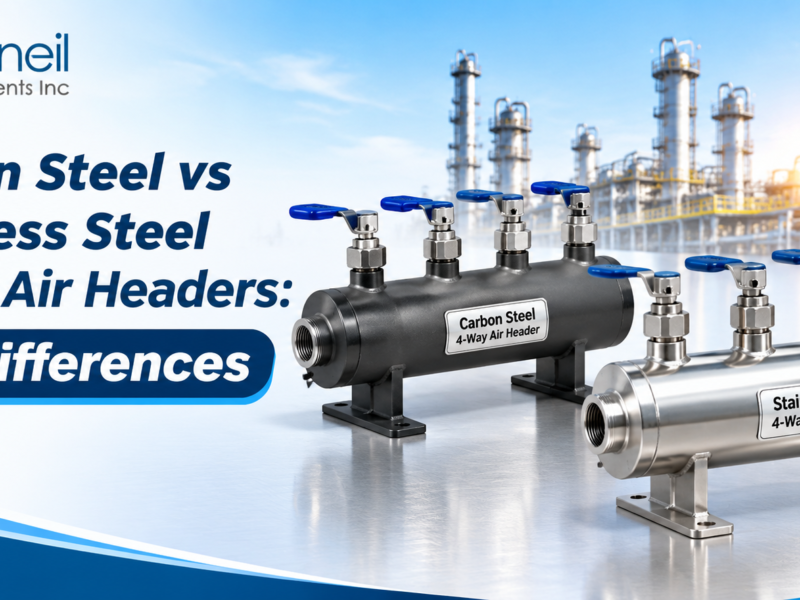
Introduction
Air headers are essential components in industrial instrumentation systems, providing a reliable way to distribute compressed air or other gases to multiple instruments and process equipment. They are widely used in oil and gas, petrochemical plants, power generation facilities, refineries, and process automation industries.
When selecting a 4-way air header, material selection plays an important role in determining its durability, corrosion resistance, maintenance requirements, and overall performance. Carbon steel and stainless steel are two commonly used materials for manufacturing industrial air headers. However, both materials offer different advantages depending on the operating environment and application requirements.
Understanding the differences between carbon steel and stainless steel 4-way air headers helps industries select the right solution for their instrumentation systems.
What Is a 4-Way Air Header?
A 4-way air header is an instrumentation component designed to distribute compressed air or gas through four individual outlet connections from a common inlet supply.
It helps organise pneumatic connections and provides a central distribution point for multiple instruments, control valves, and pneumatic devices.
Common applications include:
Oil and gas processing plants
Chemical and petrochemical industries
Power generation facilities
Refineries and industrial plants
Pneumatic control systems
Process automation applications
4-way air headers are available in different materials, configurations, and connection options to meet specific industrial requirements.
- Carbon Steel 4-Way Air Headers
Carbon steel air headers are manufactured using carbon steel materials known for their mechanical strength and durability. They are commonly selected for industrial environments where structural strength and cost-effectiveness are important considerations.
Key Features of Carbon Steel Air Headers:
Good mechanical strength and durability.
Suitable for various industrial air distribution applications.
Cost-effective compared to many stainless steel alternatives.
Suitable for applications with controlled environmental conditions.
Can be protected with suitable surface coatings to improve corrosion resistance.
Applications:
Carbon steel 4-way air headers are commonly used in general industrial facilities, manufacturing plants, utility systems, and applications where exposure to corrosive substances is limited. - Stainless Steel 4-Way Air Headers
Stainless steel air headers are designed for applications requiring improved corrosion resistance, durability, and long-term performance. Grades such as SS 304 and SS 316 are commonly considered for industrial instrumentation applications.
SS 316 is particularly suitable for environments where enhanced resistance to corrosion and chemical exposure is required.
Key Features of Stainless Steel Air Headers:
Excellent corrosion resistance.
Good resistance to moisture and harsh environments.
Durable construction and long service life.
Suitable for demanding industrial applications.
Reduced risk of surface deterioration in corrosive environments.
Available in different stainless steel grades.
Applications:
Stainless steel 4-way air headers are widely suitable for oil and gas facilities, chemical processing plants, petrochemical industries, offshore installations, and environments where corrosion resistance is important.
Carbon Steel vs Stainless Steel 4-Way Air Headers: Key Differences
Understanding the material differences helps engineers and procurement professionals select the right air header for their industrial requirements.
Comparison Factor Carbon Steel Stainless Steel
Material Composition Iron and carbon Iron, chromium and other alloying elements
Corrosion Resistance Generally lower Generally higher
Mechanical Strength Good mechanical strength Good mechanical strength
Maintenance May require protective coating and inspection Generally lower corrosion-related maintenance
Cost Usually more economical Generally more expensive
Chemical Exposure Depends on protective coating and environment Better suitability for many corrosive environments
Moisture Resistance Requires corrosion protection Better resistance
Applications General industrial environments Corrosive and demanding environments
The final selection should always depend on operating pressure, temperature, environmental exposure, material specifications, and project requirements. - Which Material Is Better for Industrial Applications?
Choosing between carbon steel and stainless steel depends on the operating environment and performance expectations.
Choose Carbon Steel When:
The operating environment has limited corrosive exposure.
Initial material cost is an important consideration.
Suitable corrosion protection can be provided.
The application involves general industrial air distribution.
Choose Stainless Steel When:
The installation is exposed to moisture or corrosive environments.
Long-term corrosion resistance is important.
The application involves chemical or petrochemical facilities.
Reduced corrosion-related maintenance is preferred.
For demanding industrial environments, stainless steel air headers, particularly SS 316, may offer advantages due to their enhanced corrosion resistance. - Important Factors to Consider Before Purchasing a 4-Way Air Header
Before selecting an air header for an industrial instrumentation system, consider these important factors: - Material Grade: Select carbon steel, SS 304, or SS 316 based on environmental conditions and application requirements.
- Operating Pressure: Ensure the air header is designed and rated for the required operating pressure.
- Number of Outlets: Confirm that four outlet connections meet the instrumentation system’s distribution requirements.
- Connection Type: Check inlet and outlet connection sizes, thread types, and compatibility with existing equipment.
- Environmental Conditions: Consider moisture, chemicals, temperature variations, and exposure to corrosive substances.
- Quality and Inspection: Check dimensional accuracy, material specifications, pressure ratings, and applicable quality requirements.
- Why Choose McNeil Air Header?
McNeil Air Header provides industrial air header solutions designed for instrumentation and process control applications.
With a focus on product quality, precision engineering, and industrial requirements, McNeil Air Header supports customers looking for dependable air distribution components.
Key Highlights:
Industrial air header solutions.
Multiple outlet configurations, including 4-way air headers.
Carbon steel and stainless steel material options, subject to product specifications.
Suitable solutions for industrial instrumentation applications.
Focus on precision, durability, and reliable performance.
Whether your requirement involves carbon steel or stainless steel air headers, selecting the right material and configuration is essential for maintaining efficient instrumentation operations.
Conclusion
Carbon steel and stainless steel 4-way air headers both serve important roles in industrial instrumentation systems. Carbon steel offers an economical solution for general industrial applications, while stainless steel provides enhanced corrosion resistance for demanding operating environments.
The right selection depends on factors such as environmental conditions, operating pressure, material compatibility, maintenance expectations, and project specifications.
McNeil Air Header offers industrial air header solutions designed to meet different instrumentation requirements. Choosing the appropriate material helps improve system reliability, operational efficiency, and long-term performance.
Frequently Asked Questions (FAQs)
Q1. What is a 4-way air header used for?
A 4-way air header distributes compressed air or gas from a common inlet to four separate outlet connections. It is commonly used in industrial instrumentation and pneumatic control systems.
Q2. What is the difference between carbon steel and stainless steel air headers?
Carbon steel air headers offer good mechanical strength and cost-effectiveness, while stainless steel air headers provide better corrosion resistance and are suitable for more demanding environments.
Q3. Which stainless steel grade is commonly used for air headers?
SS 304 and SS 316 are commonly considered for stainless steel air headers. SS 316 is generally preferred where enhanced corrosion resistance is required.
Q4. Are stainless steel air headers suitable for petrochemical plants?
Yes. Stainless steel air headers can be suitable for petrochemical applications because of their corrosion resistance and durability, subject to operating conditions and material compatibility.
Q5. Are carbon steel air headers suitable for industrial applications?
Yes. Carbon steel air headers are suitable for many general industrial applications where environmental conditions and corrosion protection requirements are properly managed.
Q6. How many outlets does a 4-way air header have?
A standard 4-way air header has four outlet connections along with a common inlet connection for distributing air to multiple instruments.
Q7. How do I select the right 4-way air header?
Consider material grade, operating pressure, outlet configuration, connection type, environmental conditions, and applicable industrial specifications.
Looking for Reliable 4-Way Air Headers for Industrial Applications?
Choose McNeil Air Header for quality-engineered carbon steel and stainless steel air header solutions.
Get in touch with our team for product specifications and industrial air header requirements.
McNeil Air Header
📞 Phone: +91 22 66518756
📧 Email: info@mcneilinstruments.com
🌐 Website: www.mcneilairheader.com