
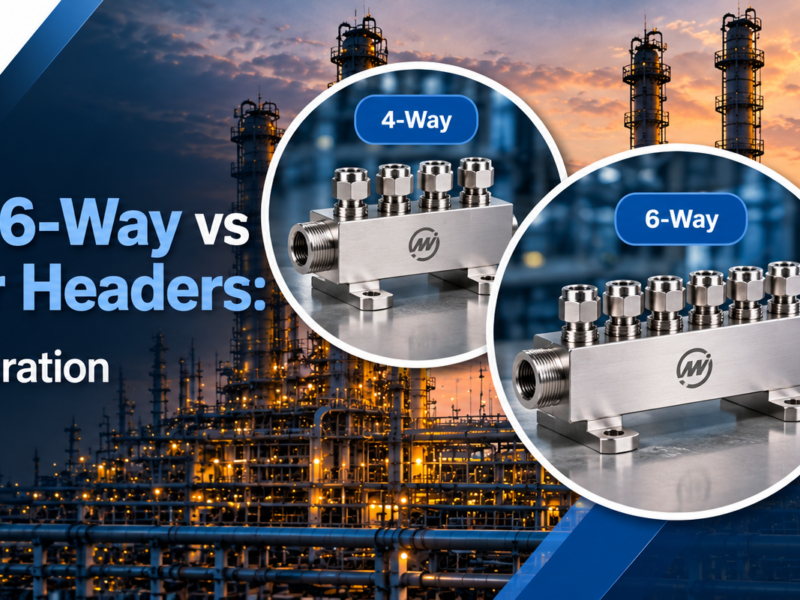
Industrial instrumentation systems rely on a dependable supply of instrument air to operate pneumatic instruments, control valves and other process equipment. Distributing this air efficiently requires suitable components that support the required connections, pressure conditions and installation layout.
An air header is used to distribute a common air supply to multiple outlets. Available configurations commonly include 4-way, 6-way and 8-way air headers, with the number referring to the outlet arrangement specified for the particular product.
Choosing between these configurations depends on the number of instruments to be connected, future expansion plans, available installation space and the requirements of the overall pneumatic system.
At Mcneil Air Header, we understand the importance of selecting the right air distribution components for industrial applications. In this guide, we compare 4-way, 6-way and 8-way air headers to help engineers, maintenance teams and procurement professionals make an informed decision.
What Is an Air Header?
An air header is a distribution component designed to receive a common compressed-air or instrument-air supply and distribute it through multiple outlet connections.
Air headers are used in industrial facilities where several pneumatic instruments or equipment connections need to be supplied from a common source. Depending on the design, they may be manufactured from stainless steel, carbon steel or other specified materials.
Typical applications include oil and gas facilities, petrochemical plants, refineries, power generation facilities and industrial process plants.
The correct air header should match the required number of outlets, connection sizes, pressure rating, material specification and installation requirements.
What Is a 4-Way Air Header?
A 4-way air header is a configuration designed with four designated outlet connections, subject to the manufacturer’s product design.
It can be suitable for smaller instrument-air distribution arrangements or locations where only a limited number of pneumatic connections are required.
Key Benefits of a 4-Way Air Header
Compact arrangement: Four outlets can simplify installations with a limited number of connections.
Efficient space utilization: A smaller outlet configuration may suit installations with restricted mounting space.
Simplified connection planning: Fewer outlets can make the arrangement easier to plan when the number of instruments is known.
Potentially lower initial cost: A smaller configuration may cost less than a larger equivalent, depending on material, dimensions and manufacturing requirements.
Where Is a 4-Way Air Header Used?
A 4-way air header may be considered for small pneumatic distribution points, instrument panels, equipment skids and installations requiring four designated outlet connections.
It is a practical option when the required number of connections is limited and future expansion is unlikely to require additional outlets.
What Is a 6-Way Air Header?
A 6-way air header provides six designated outlet connections and offers a middle-ground option between smaller and larger distribution arrangements.
It can be suitable for installations that require more connections than a 4-way configuration can accommodate but do not need the additional outlets of an 8-way design.
Key Benefits of a 6-Way Air Header
Greater connection capacity: Six outlets accommodate more designated connections than a 4-way model.
Flexible installation planning: It can support medium-sized instrument-air distribution arrangements.
Balanced configuration: It may provide a useful balance between outlet capacity, physical dimensions and project cost.
Expansion flexibility: Spare outlets may be available for future connections if they are included in the design and permitted by the system requirements.
Where Is a 6-Way Air Header Used?
A 6-way air header may be appropriate for process equipment skids, instrumentation assemblies and industrial installations that require six designated outlet connections.
Before selecting this configuration, engineers should verify that the header’s inlet capacity, outlet sizes and pressure rating meet the demands of all connected instruments.
What Is an 8-Way Air Header?
An 8-way air header provides eight designated outlet connections, making it suitable for distribution arrangements with a larger number of connection points.
It can help consolidate several instrument-air connections into one distribution component when the design, mounting arrangement and supply capacity permit.
Key Benefits of an 8-Way Air Header
Higher outlet count: Eight designated outlets can accommodate more connections within a single header.
Centralized distribution: Multiple connections can be arranged around a common distribution point.
Potential for planned expansion: Spare outlets can support future requirements when appropriately specified.
Reduced need for multiple smaller headers: Depending on the layout, one larger header may simplify installation compared with several separate units.
Where Is an 8-Way Air Header Used?
An 8-way air header may be considered for larger instrument panels, process skids and industrial installations requiring eight designated connections.
The suitability of this configuration depends on actual air demand, pressure drop, inlet size, outlet dimensions and the design requirements of the connected equipment.
4-Way vs 6-Way vs 8-Way Air Headers: Key Differences
The primary difference between these configurations is the number of designated outlet connections. However, outlet count alone does not determine overall system performance.
Feature 4-Way Air Header 6-Way Air Header 8-Way Air Header
Designated outlets 4 6 8
Typical use Smaller distribution arrangements Medium-sized arrangements Larger distribution arrangements
Connection capacity Lower Moderate Higher
Installation footprint Often smaller Depends on design May require more space
Expansion potential Limited unless redesigned Moderate if spare outlets are provided Potentially greater if spare outlets are provided
Cost considerations Depends on material and specifications Depends on material and specifications Depends on material and specifications
The table provides a general selection guide. Actual dimensions, pressure ratings, flow capacity and pricing vary by manufacturer and product specification.
How to Choose the Right Air Header Configuration
Selecting the correct configuration requires more than counting the instruments at the installation site. Consider the following factors before placing an order.
- Number of Required Connections
Start by identifying the number of instruments or pneumatic connections that need to be supplied.
A 4-way configuration may suit four required outlets, a 6-way configuration may suit six, and an 8-way configuration may suit eight, provided the product’s outlet arrangement matches the application.
If future connections are expected, include them in the initial design rather than relying on unplanned modifications. - Instrument Air Consumption
Each connected instrument may have different air consumption requirements. The total demand must be evaluated to determine whether the selected header and upstream supply system can provide adequate airflow.
A higher outlet count does not automatically mean greater flow capacity. The inlet size, internal passage dimensions, pressure conditions and connected equipment demand all affect performance. - Pressure Rating
Confirm the required design pressure and operating conditions for the instrument-air system.
The selected air header must have an appropriate pressure rating, and all connected components must be compatible with the system design. - Material Selection
Material selection depends on the installation environment, corrosion exposure, operating conditions and project specifications.
Stainless steel may be preferred in environments where corrosion resistance is important, while carbon steel may be suitable for applications where its properties meet the specified requirements.
The material grade should be confirmed against the project specification. - Inlet and Outlet Connections
Check the required inlet and outlet sizes, thread types and connection arrangements. Depending on the design, requirements may include NPT, BSP or other specified connections.
Compatibility with the existing piping and instruments helps prevent installation problems. - Available Installation Space
Compare the overall dimensions, mounting arrangement and access requirements of the proposed air header with the available installation space.
A larger outlet configuration may require a longer body or a different mounting arrangement, depending on the manufacturer. - Future Expansion
Consider whether additional instruments may be installed later. Specifying a suitable spare outlet can simplify future modifications, provided the selected header and air supply system have sufficient capacity. - Project Standards and Documentation
Review the applicable material requirements, pressure ratings, inspection requirements and documentation specified by the project or end user.
For critical industrial installations, confirm all technical details before approving the selected configuration.
Common Mistakes to Avoid When Selecting an Air Header
Choosing an air header solely by its outlet count can result in an unsuitable selection. Avoid these common mistakes:
Selecting a header without calculating the total instrument-air demand.
Assuming that more outlets automatically provide greater flow capacity.
Ignoring the required pressure rating and operating conditions.
Overlooking thread types and connection compatibility.
Selecting a material without reviewing the installation environment.
Forgetting to account for future instruments or maintenance access.
Ordering without confirming dimensions, specifications and documentation.
A properly specified air header helps support an organized installation and reliable instrument-air distribution.
Why Choose Mcneil Air Header?
At Mcneil Air Header, we recognize the importance of selecting instrument-air distribution components that match actual project requirements.
When evaluating 4-way, 6-way and 8-way air headers, buyers should confirm outlet count, inlet and outlet connections, material, pressure rating and dimensional requirements before making a final selection.
Our team can discuss your air header requirements and help you identify the relevant product specifications for your industrial application.
Conclusion
The choice between a 4-way, 6-way and 8-way air header depends primarily on the number of required connections, total air demand, installation space, pressure rating, material selection and future expansion plans.
A 4-way air header may suit smaller arrangements, a 6-way configuration may provide a practical middle option, and an 8-way design may be appropriate when more connections are required. The final decision should always be based on the system’s technical requirements rather than outlet count alone.
Mcneil Air Header helps industrial buyers evaluate air header configurations for their instrumentation systems. Contact our team to discuss your requirements and select a configuration suited to your application.
Looking for the Right Air Header for Your Instrumentation System?
Choose a suitable 4-way, 6-way or 8-way air header based on your connection requirements, operating conditions and installation design.
Mcneil Air Header can help you discuss the specifications required for your industrial application.
Contact our team today to enquire about air header configurations and request a quotation for your project.
Request a Quote Today
Frequently asked questions (FAQs)
- What is the difference between a 4-way, 6-way and 8-way air header?
The main difference is the number of designated outlet connections. A 4-way air header has four outlets, a 6-way air header has six, and an 8-way air header has eight, subject to the manufacturer’s design. - Which air header is best for industrial instrumentation?
The best configuration depends on the number of connections, total air consumption, pressure requirements, available space and potential future expansion. The selected header must meet the technical requirements of the installation. - Does an 8-way air header provide more airflow than a 4-way air header?
Not necessarily. The number of outlets does not determine the maximum flow capacity by itself. Inlet size, internal passage dimensions, pressure drop and total instrument-air demand must also be considered. - What materials are used to manufacture air headers?
Air headers may be manufactured from stainless steel, carbon steel or other specified materials, depending on the product design and application requirements. The appropriate material depends on corrosion exposure, operating conditions and project specifications. - Can an air header be customized for a specific application?
Customization may be possible depending on the manufacturer’s capabilities. Requirements can include outlet count, inlet size, connection type, material, dimensions and mounting arrangement. Confirm availability and technical feasibility with the supplier. - How do I select the correct pressure rating for an air header?
Determine the system’s design pressure and operating conditions, then verify that the air header and its connections meet the required pressure rating. All connected components must also be suitable for the system conditions. - Can I keep spare outlets for future expansion?
Yes, a configuration with spare outlets can simplify future expansion when the header is designed for that purpose. However, the upstream air supply must have sufficient capacity to support the additional demand. - What information should I provide when requesting an air header quotation?
Provide the required outlet count, inlet and outlet connection sizes, thread type, material grade, design pressure, installation requirements, quantity and any applicable project specifications or drawings.