
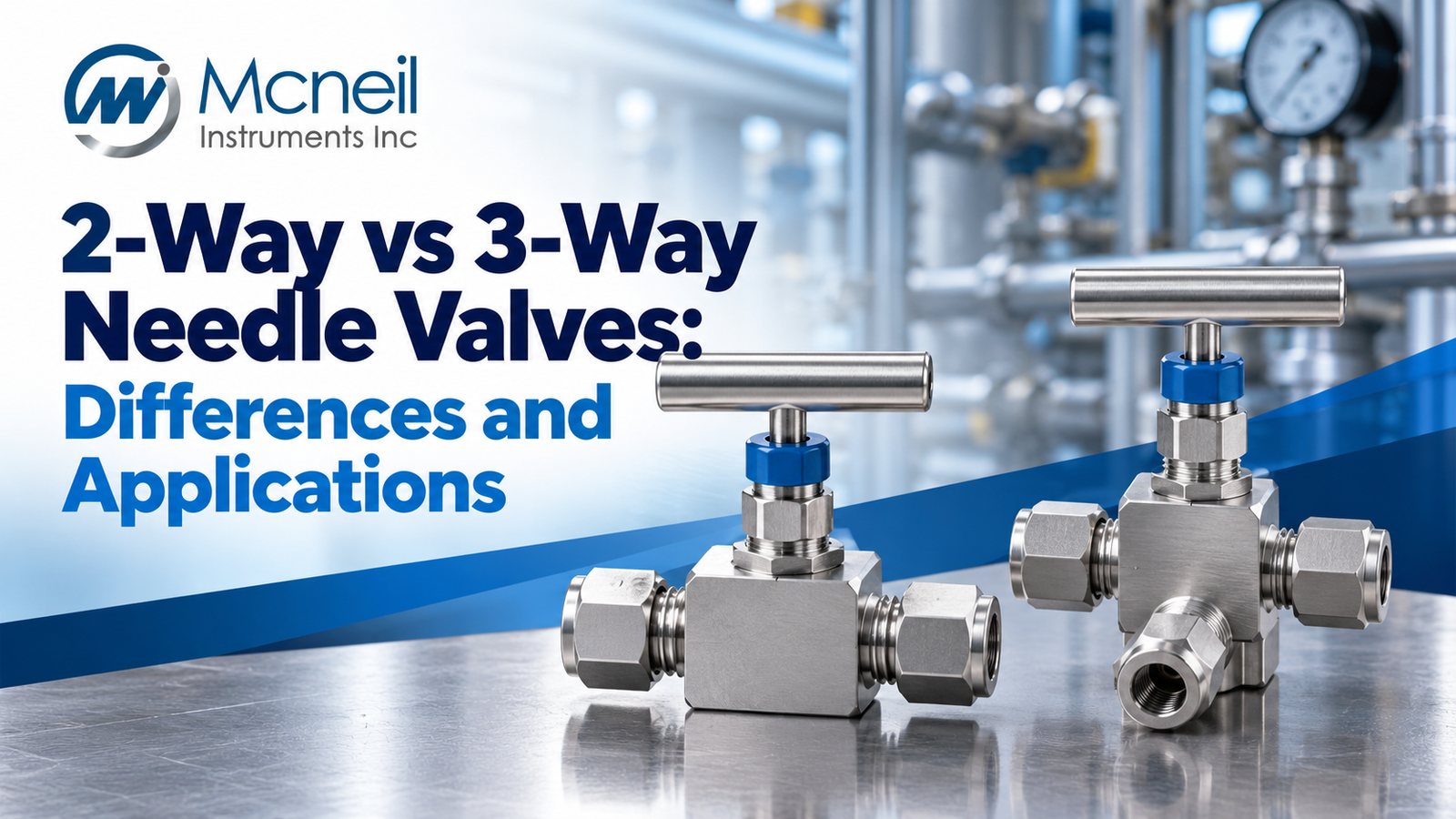
Introduction
Needle valves play an important role in industrial fluid control systems by regulating the flow of liquids and gases with precision. They are commonly used in instrumentation systems, pressure measurement lines, sampling systems, and industrial process applications where controlled flow and reliable shutoff are essential. Among the available options, 2-way and 3-way needle valves are widely used for different operational requirements.
Although both valve types use a needle-shaped stem to control flow, their port configurations and functions differ. A 2-way needle valve is generally used to regulate or isolate flow through a single passage, while a 3-way needle valve can direct, select, or connect flow between multiple ports, depending on its internal design.
Understanding these differences helps engineers, maintenance professionals, and procurement teams choose the right valve for their systems. Mcneil Air Header offers industrial instrumentation products and valve solutions for applications that require dependable flow control. This guide explains the features, differences, applications, and selection criteria for 2-way and 3-way needle valves.
What Is a 2-Way Needle Valve?
A 2-way needle valve typically has two ports: an inlet and an outlet. It uses a tapered needle-shaped stem that moves toward or away from a valve seat to regulate the flow passing through the valve.
Turning the valve handle adjusts the opening between the needle and the seat. This allows operators to make fine flow adjustments or close the passage when the valve is designed and rated for shutoff service.
Key Features of 2-Way Needle Valves
Precise Flow Regulation: The tapered needle allows fine adjustments to the flow passage, making the valve suitable for applications that require controlled flow.
Simple Design: With two primary ports and a straightforward flow path, the valve is generally easy to install and operate.
Compact Construction: Many 2-way needle valves are available in compact designs suitable for instrumentation panels and confined installation spaces.
Flow Isolation: Depending on the valve design and pressure rating, a 2-way needle valve can be used to shut off flow through the line.
Applications of 2-Way Needle Valves
2-way needle valves are commonly used in pressure gauge connections, instrument tubing, gas sampling lines, laboratory equipment, hydraulic systems, and process instrumentation.
They are particularly useful when an application requires controlled flow through a single passage or isolation of an instrument from the process line.
What Is a 3-Way Needle Valve?
A 3-way needle valve has three ports and is designed to manage flow between multiple connections. Depending on its internal configuration, it may direct flow from one inlet to either of two outlets, select between two sources, or connect different passages for specific instrumentation functions.
Not all 3-way needle valves operate in the same way. The available flow paths depend on the valve’s port arrangement and internal design, so the manufacturer’s flow diagram should always be checked before installation.
Key Features of 3-Way Needle Valves
Multiple Flow Paths: Three ports allow the valve to manage connections between different lines or instruments.
Flow Selection: Certain designs allow operators to select between alternative flow sources or destinations.
Instrumentation Flexibility: Three-port arrangements can support specific pressure measurement, testing, and sampling configurations.
Reduced Component Count: Where the design permits, a single 3-way valve may replace multiple separate valves and fittings, simplifying the installation.
Applications of 3-Way Needle Valves
3-way needle valves may be used in instrumentation systems, pressure testing arrangements, sampling systems, process measurement installations, and applications requiring the selection or redirection of flow.
They can also be used in systems where instruments need to be connected to different pressure sources or process lines. The exact application depends on the valve’s internal configuration and operating limits.
2-Way vs 3-Way Needle Valves: Key Differences
Choosing between a 2-way and a 3-way needle valve requires an understanding of their port arrangements, flow functions, and installation requirements.
- Number of Ports
A 2-way needle valve has two ports, typically an inlet and an outlet. A 3-way needle valve has three ports, allowing more than one possible flow connection. - Flow Control Function
A 2-way valve primarily regulates or shuts off flow through one passage. A 3-way valve can regulate flow while also providing additional flow-selection or routing functions, depending on its design. - System Configuration
A 2-way valve is suitable for straightforward flow control in a single line. A 3-way valve is more suitable when an instrumentation arrangement requires connections between multiple lines or ports. - Installation Requirements
A 2-way valve generally has a simpler connection arrangement. A 3-way valve requires careful identification of each port and verification of the intended flow path to avoid incorrect connections. - Space and Component Requirements
A 2-way valve may be the more straightforward option for a single-line application. A 3-way valve can simplify certain installations by combining multiple flow connections into one valve body, although this depends on the system design. - Cost Considerations
The purchase price depends on valve size, material, pressure rating, connection type, and manufacturer. A 3-way valve may cost more than a comparable 2-way valve, but the overall installation cost depends on the number of components required and the complexity of the system.
Comparison Table: 2-Way vs 3-Way Needle Valves
Feature: 2-Way Needle Valve: 3-Way Needle Valve:
Number of ports: Two: Three:
Primary function: Regulates or isolates flow through one passage: Manages flow between multiple ports
Flow arrangement: Single flow passage: Multiple possible flow paths
Design complexity: Generally simpler: Depends on internal port arrangement
Typical applications: Instrument lines, sampling, flow regulation: Flow selection, pressure testing, instrumentation routing
Installation: Straightforward two-port connection: Requires correct identification of all ports
Best suited for: Single-line flow control: Applications requiring additional flow connections
Advantages of 2-Way Needle Valves
2-way needle valves are a practical choice for applications requiring straightforward and precise flow regulation.
Their main advantages include simple operation, compact construction, easy integration into single-line systems, and fine adjustment of the flow passage. They can also provide shutoff when the particular valve is designed and rated for that purpose.
For applications that do not require additional flow paths, a 2-way needle valve can provide a straightforward solution.
Advantages of 3-Way Needle Valves
3-way needle valves offer greater flexibility in systems that require multiple connections.
Their advantages can include alternative flow routing, source selection, instrumentation flexibility, and reduced component count in suitable installations. These features can simplify specific pressure measurement and process control arrangements.
However, the valve must be selected according to its actual port configuration and operating requirements. A 3-way valve should not be assumed to provide every possible combination of flow regulation, diversion, and isolation.
How to Choose the Right Needle Valve
Selecting the right needle valve requires more than comparing the number of ports. Consider the following factors before purchasing.
- Identify the Application
Determine whether your system needs flow regulation through a single line or requires connections between multiple lines. This is the first step in deciding between a 2-way and a 3-way design. - Check Operating Pressure and Temperature
Confirm the maximum working pressure and operating temperature. The selected valve must remain within the manufacturer’s specified limits under the actual service conditions. - Select the Correct Material
Valve body and trim materials should be compatible with the process medium and operating environment. Stainless steel is commonly used in industrial instrumentation applications, but other materials may be suitable depending on the service. - Verify Port and Connection Types
Check the required port size, thread standard, tubing connection, and installation arrangement. For 3-way valves, verify the port markings and flow diagram before connecting the valve. - Consider Flow Requirements
Determine the required flow range and level of adjustment. Needle valves are designed for controlled flow, but their actual flow characteristics depend on the valve design, pressure differential, and fluid properties. - Review Leakage and Shutoff Requirements
If the application requires reliable isolation, confirm that the valve is specifically rated for the required shutoff duty. Do not assume that every needle valve is suitable for every isolation application. - Choose a Reliable Supplier
Work with a supplier that can provide accurate product specifications, material information, pressure and temperature ratings, and installation guidance.
Why Choose Mcneil Air Header for Needle Valves?
Selecting the right instrumentation valve helps support accurate measurements, reliable flow control, and dependable system operation. The correct choice depends on the application’s pressure, temperature, process medium, port arrangement, and installation requirements.
Mcneil Air Header provides industrial instrumentation products and valve solutions for customers across different industrial sectors. When sourcing 2-way or 3-way needle valves, buyers should confirm the available materials, connection sizes, pressure ratings, and technical specifications before placing an order.
Whether you require a valve for instrument tubing, pressure measurement, sampling, or another process application, clearly defining your requirements helps you identify a suitable solution.
Visit Mcneil Air Header to explore its product range and discuss your needle valve requirements with the team.
Conclusion
Both 2-way and 3-way needle valves are useful components in industrial instrumentation and fluid control systems, but they serve different purposes.
A 2-way needle valve is generally suitable for regulating or isolating flow through a single passage. A 3-way needle valve provides additional connection options for applications that require flow selection or routing between multiple ports.
The right choice depends on the required flow path, operating pressure, temperature, material compatibility, connection type, and shutoff requirements. Evaluating these factors before purchasing can help improve installation accuracy and long-term system reliability.
Looking for Reliable 2-Way or 3-Way Needle Valves?
Choose the right valve for your industrial instrumentation and flow control requirements. Mcneil Air Header can help you explore suitable valve options based on your application, material requirements, pressure rating, and connection type.
Website: https://mcneilairheader.com/
Phone: +91 22 6651 8756
Email: info@mcneilinstruments.com
Contact Mcneil Air Header today to discuss your requirements and request a quotation.
Frequently Asked Questions (FAQs)
- What is the main difference between a 2-way and a 3-way needle valve?
A 2-way needle valve has two ports and is generally used to regulate or isolate flow through a single passage. A 3-way needle valve has three ports and can provide additional flow-selection or routing functions, depending on its internal design. - What is a 2-way needle valve used for?
A 2-way needle valve is used for precise flow regulation in applications such as instrument tubing, pressure gauge connections, gas sampling lines, laboratory equipment, and industrial process systems. - What is a 3-way needle valve used for?
A 3-way needle valve is used in applications requiring connections between multiple ports, such as selected pressure measurement systems, sampling arrangements, and instrumentation setups that require flow selection or routing. - Which is better, a 2-way or a 3-way needle valve?
Neither valve is universally better. A 2-way valve is generally appropriate for single-passage flow control, while a 3-way valve is useful when additional flow connections are required. The correct choice depends on the application’s design. - Can a 3-way needle valve replace two 2-way valves?
In some applications, a 3-way valve can combine functions that would otherwise require multiple valves. However, this depends on its internal flow arrangement and the isolation requirements of the system. Always verify the manufacturer’s flow diagram before selecting a replacement. - Which materials are available for needle valves?
Needle valves may be manufactured from stainless steel, carbon steel, brass, and other materials, depending on the product range. Material selection should account for the process fluid, corrosion exposure, pressure, and temperature. - Are needle valves suitable for high-pressure applications?
Some needle valves are designed for high-pressure service. However, suitability depends on the specific valve’s pressure rating, materials, connections, temperature limits, and manufacturer specifications. - What factors should I consider when purchasing needle valves?
Consider the number of ports, required flow function, working pressure, operating temperature, material compatibility, connection type, flow characteristics, leakage requirements, and applicable industry standards. - Can needle valves be used for gas and liquid applications?
Yes, appropriately designed needle valves can be used with gases and liquids. The valve must be compatible with the fluid and suitable for the required pressure, temperature, and flow conditions. - How can I enquire about needle valves from Mcneil Air Header?
Visit the official Mcneil Air Header website to explore available products and contact the team regarding valve types, materials, dimensions, pressure ratings, and other technical requirements.