
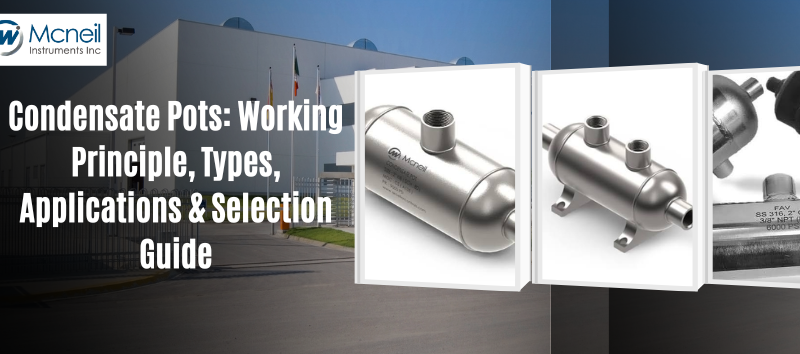
Condensate Pots, also known as Condensate Seal Pots, Seal Pots, or Condensing Pots, are important instrumentation accessories used primarily in steam and vapor measurement systems. Their main function is to collect and hold condensate while creating a stable liquid barrier between the process line and sensitive measuring instruments.
Mcneil Air Header offers condensate pot solutions for industrial instrumentation and process applications, including configurations designed for steam, vapor, and high-temperature services.
What Is a Condensate Pot?
A condensate pot is a small chamber installed between a process connection and an instrument such as a differential pressure transmitter, pressure gauge, or flow measurement system.
In steam service, vapor entering the condensate pot cools and forms liquid condensate. The pot captures this condensate and maintains a consistent liquid column in the impulse lines. This helps prevent direct exposure of sensitive instruments to high-temperature steam and supports more stable pressure measurement.
Main Functions of a Condensate Pot
- Collects and retains condensate
- Creates a liquid seal between process and instrument
- Protects instruments from direct steam exposure
- Helps maintain a consistent liquid head
- Improves differential pressure measurement accuracy
- Helps prevent foreign material from reaching instrumentation
- Provides a drain point for cleaning and maintenance
How Does a Condensate Pot Work?
The working principle is relatively simple.
When steam travels through a process pipeline, some of the vapor condenses as it loses heat. The condensate enters the condensate pot and accumulates inside the chamber.
The resulting liquid column acts as a barrier between the hot steam and the downstream instrument. In differential pressure applications, maintaining a consistent condensate level helps prevent measurement errors caused by changing liquid levels in the impulse lines.
For systems using two impulse lines, the condensate pots are generally installed at the same elevation so that unequal liquid heads do not introduce additional measurement error.
Why Are Condensate Pots Used in Steam Lines?
Steam can operate at temperatures significantly above the safe operating temperature of many pressure and differential pressure instruments.
A condensate pot provides a controlled liquid interface between the process steam and the instrument. This helps:
- Reduce thermal exposure
- Stabilize the pressure-transmission medium
- Protect transmitter components
- Maintain a predictable liquid head
- Improve measurement consistency
Parker also identifies increasing flow-measurement accuracy in steam pipelines as a primary purpose of condensate pots.
Condensate Pot Types
Condensate pots can be supplied in different configurations depending on the instrumentation arrangement and project requirements.
Two-Port Condensate Pot
A two-port condensate pot provides two process/instrument connections and can be used in suitable steam and vapor measurement arrangements.
Three-Port Condensate Pot
A three-port condensate pot provides an additional connection that can be useful for venting, draining, or specific instrumentation arrangements.
Four-Port Condensate Pot
Four-port condensate pots are commonly used where multiple connections are required for differential pressure and instrumentation systems.
Mcneil Instruments lists two-port, three-port, and four-port condensate pot configurations.
Condensate Pots for Differential Pressure Measurement
One of the most important applications of condensate pots is differential pressure measurement on steam systems.
In a steam measurement application, uncontrolled condensation inside the impulse lines can create different liquid heads on the high-pressure and low-pressure sides.
This can introduce an unwanted measurement error.
Condensate pots help create a more stable and predictable condensate column, improving the consistency of the pressure signal transmitted to the DP transmitter.
Condensate Pots for Pressure Transmitters
Pressure transmitters installed on steam or high-temperature vapor systems may require protection from direct process exposure.
A condensate pot can act as a thermal and process barrier by maintaining a liquid column between the hot process fluid and the transmitter.
This is particularly useful in:
- Steam pressure measurement
- Boiler instrumentation
- Process steam systems
- High-temperature vapor measurement
- Power plant instrumentation
- Refinery process systems
Condensate Pots for Power Plants
Power-generation facilities use steam extensively, making reliable steam measurement essential.
Condensate pots can be incorporated into instrumentation systems associated with:
- Boilers
- Steam headers
- Superheated steam
- Reheated steam
- Turbine systems
- Steam flow measurement
- Boiler pressure measurement
They are particularly useful where accurate measurement and protection of instrumentation are required.
Condensate Pots for Refineries
Refineries contain numerous high-temperature process and steam systems.
Condensate pots may be used in suitable instrumentation applications involving:
- Steam lines
- Process vapor
- Pressure measurement
- Flow measurement
- Differential pressure transmitters
- Boiler systems
- Heat-transfer systems
Parker lists refineries, power plants, chemical and petrochemical plants, and steel plants among typical condensate-pot applications.
Condensate Pots for Petrochemical Applications
Petrochemical plants often combine high temperatures, pressure, steam, and process vapors.
Condensate pots can help protect instrumentation and maintain reliable measurement in suitable applications involving:
- Process steam
- Vapor lines
- Pressure transmitters
- DP transmitters
- Flow measurement systems
- High-temperature process equipment
Material selection should be based on the process fluid, temperature, pressure, corrosion conditions, and project specification.
Condensate Pot Materials
Condensate pots can be manufactured from different materials depending on the service environment.
Common material options include:
- Carbon Steel
- Stainless Steel 304
- Stainless Steel 304L
- Stainless Steel 316
- Stainless Steel 316L
- Alloy Steel
- Duplex Stainless Steel
- Super Duplex
- Nickel Alloys
Mcneil Instruments specifically lists Stainless Steel 316 condensate pots, including options using UNS S31600 / AISI 316 material, and describes applications involving steam lines, chemical plants, and power stations.
For corrosive services, higher-alloy materials may be considered based on the actual process conditions.
Stainless Steel 316 Condensate Pots
SS 316 Condensate Pots are suitable for applications where corrosion resistance is an important consideration.
Potential applications include:
- Steam systems
- Chemical plants
- Power plants
- Process instrumentation
- Corrosive industrial environments
Mcneil Instruments identifies SS 316 condensate pots with options including NPT, BSP, and flanged connections, along with customization of thickness and port configuration.
Condensate Pot Connections
Condensate pots can be supplied with different connection arrangements depending on the piping and instrumentation design.
Common connection options include:
- NPT
- BSP
- Flanged connections
- Socket weld
- Screwed connections
The connection should be selected according to the instrument tubing, process piping, pressure rating, applicable standards, and project specification.
Condensate Pot Sizing
Correct sizing is important for maintaining an adequate condensate reservoir and ensuring compatibility with the instrumentation system.
Mcneil Instruments publishes condensate pot options with different internal volumes and connection sizes. Its listed configurations include 1/4″, 1/2″, and 3/4″ NPT connections, with internal volumes ranging from approximately 150 cm³ to 3785 cm³ in the published sizing table.
The required size depends on factors such as:
- Process conditions
- Steam temperature
- Operating pressure
- Impulse line arrangement
- Instrument connection
- Required condensate volume
- Installation configuration
Sizing should therefore be confirmed against the specific instrumentation design rather than selected solely by pipe diameter.
Condensate Pot Installation
Correct installation is essential for reliable measurement.
Depending on the application, condensate pots can be installed in vertical or horizontal configurations.
For differential pressure applications, paired units should generally be installed at the same elevation to minimize errors caused by unequal liquid heads in the connecting impulse lines.
The installation should also provide appropriate access for:
- Draining
- Cleaning
- Inspection
- Maintenance
Condensate Pots vs Seal Pots
The terms condensate pot and seal pot are sometimes used interchangeably, particularly in instrumentation applications.
A condensate pot used on steam service collects condensate and maintains a liquid seal between the process and instrument.
A seal pot can also be used to maintain a liquid barrier between an instrument and a process fluid, especially where direct contact with the process fluid could cause measurement or equipment problems.
The exact terminology can vary between manufacturers and applications. Mcneil Instruments refers to its products as Condensate Seal Pots as well as condensate pots.
Advantages of Condensate Pots
The major benefits include:
Instrument Protection
The liquid barrier helps protect instruments from direct exposure to hot steam and high-temperature vapor.
Improved Measurement Stability
A consistent condensate column helps provide a more stable pressure reference.
Reduced Measurement Errors
Maintaining equal liquid heads in paired impulse lines can reduce errors associated with unequal fluid columns.
Condensate Collection
The chamber captures and stores condensate before it can interfere with instrumentation.
Easy Maintenance
Drain arrangements allow accumulated material and condensate to be removed where the design provides for it.
Applications of Condensate Pots
Condensate pots are used across several industrial sectors, including:
- Power Generation
- Oil & Gas
- Refineries
- Petrochemical
- Chemical Processing
- Steel Plants
- Fertilizer Plants
- Pharmaceuticals
- Instrumentation Systems
- Marine Applications
Their suitability depends on the process conditions and material compatibility.
How to Select the Right Condensate Pot
Before ordering a condensate pot, consider the following:
1. Process Fluid
Identify whether the service involves steam, vapor, gas, condensate, or another process fluid.
2. Temperature
Confirm normal and maximum operating temperatures.
3. Pressure
Specify the operating and design pressure.
4. Material
Select carbon steel, stainless steel, alloy steel, or another material based on corrosion and temperature requirements.
5. Number of Ports
Determine whether the application requires two, three, or four ports.
6. Connection Type
Specify NPT, BSP, flanged, socket-weld, or another required connection.
7. Installation Orientation
Confirm whether the design calls for vertical or horizontal installation.
8. Certification
For regulated or critical applications, specify the required inspection and certification, such as project-specific third-party inspection or IBR requirements where applicable.
Why Choose Mcneil Air Header for Condensate Pots?
Mcneil’s condensate pot range is designed for industrial instrumentation applications where condensate collection, instrument protection, and stable measurement are important.
Available options can include different:
- Materials
- Port configurations
- Connection types
- Dimensions
- Pressure requirements
- Customized specifications
For projects involving steam, vapor, power generation, petrochemical, refinery, and process instrumentation, the condensate pot should be selected according to the project’s temperature, pressure, process medium, instrument arrangement, material specification, and applicable standards.
Conclusion
Condensate Pots are important components in steam and vapor instrumentation systems. By collecting condensate and maintaining a stable liquid barrier, they help protect sensitive instruments and support reliable differential pressure and flow measurement.
They are available in configurations such as two-port, three-port, and four-port designs, with material options including carbon steel, stainless steel, alloy steel, and other corrosion-resistant alloys.
For demanding industrial applications, the correct condensate pot should be selected based on process conditions, pressure, temperature, material compatibility, port configuration, connection type, installation arrangement, and certification requirements.
Mcneil Air Header can be positioned as a supplier of condensate pots for industrial instrumentation and process applications, including steam, power, refinery, petrochemical, chemical, and other high-temperature services.