
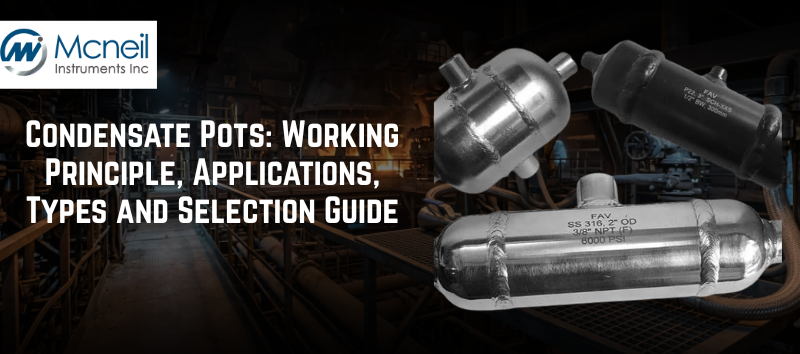
In steam, vapor, and differential pressure measurement systems, condensate management is critical for protecting instrumentation and maintaining measurement accuracy. A condensate pot, also known as a seal pot, is designed to collect and retain condensate before it reaches sensitive measuring instruments such as pressure transmitters, flow meters, and gauges.
Mcneil Air Header manufactures and supplies condensate pots in different sizes, materials, port configurations, and connection types for industrial applications.
What Is a Condensate Pot?
A condensate pot is a vessel installed between the process line and a measuring instrument. Its primary purpose is to collect liquid formed when steam or vapor condenses and create a stable liquid column in the impulse lines.
This helps:
- Protect pressure transmitters and gauges from high-temperature steam
- Maintain stable condensate levels
- Reduce measurement errors
- Prevent condensate and contaminants from reaching instruments
- Improve instrument service life
- Reduce maintenance requirements
The condensate pot also acts as a barrier between the primary process line and the measuring device.
How Does a Condensate Pot Work?
The working principle is relatively straightforward.
- Steam or vapor travels through the impulse lines.
- Condensate collects inside the condensate pot.
- The collected liquid forms a stable liquid column.
- This liquid barrier protects the downstream measuring device.
- Maintaining equal condensate levels helps provide consistent pressure conditions at the instrument.
For differential pressure measurement, both condensate pots should be installed at the same level to reduce errors caused by unequal liquid heads.
Why Are Condensate Pots Used?
A condensate pot performs an important protective function in steam measurement systems.
Without appropriate condensate management, high-temperature steam or unstable vapor-liquid conditions can affect sensitive instrumentation.
Key benefits include:
Instrument Protection
The condensate pot helps protect pressure transmitters, gauges, and other measuring devices from direct exposure to high-temperature steam.
Improved Measurement Accuracy
A stable condensate column helps maintain consistent pressure conditions in the impulse lines.
Contaminant Collection
The pot can collect foreign particles and process contaminants before they reach downstream instrumentation.
Reduced Maintenance
A bottom drain facilitates cleaning and removal of accumulated material.
Longer Instrument Life
By providing a protective barrier between the process and the instrument, condensate pots can reduce thermal and contamination-related stress on measuring equipment.
Types of Condensate Pots
Mcneil Air Header offers different condensate pot configurations depending on the number of required connections.
Two-Port Condensate Pot
A two-port condensate pot is designed for basic applications requiring a limited number of connections.
It provides a straightforward arrangement for condensate collection and pressure measurement.
Three-Port Condensate Pot
A three-port condensate pot provides an additional connection for applications requiring greater flexibility in the instrumentation arrangement.
Four-Port Condensate Pot
A four-port condensate pot is suitable for more complex instrumentation systems requiring multiple connection points.
Six-Port Condensate Pot
Six-port configurations can be used for larger or more complex process and instrumentation arrangements.
Custom Condensate Pots
Mcneil Air Header also manufactures customized condensate pots according to customer drawings and project specifications. Customization can include size, material, port configuration, pressure rating, and connection type.
Materials Used for Condensate Pots
Different operating environments require different materials of construction.
Mcneil Air Header lists several material options for its condensate pots.
Carbon Steel
Common carbon steel options include:
- ASTM A106
- ASTM A105
- ASTM A234 WPB
Stainless Steel
Available stainless steel options include:
- SS 304
- SS 304L
- SS 316
- SS 316L
Alloy Steel
The published range includes:
- ASTM A335 P11
- ASTM A335 P22
- ASTM A335 P91
Duplex and Super Duplex Steel
Options include:
- UNS S31803
- UNS S32205
- UNS S32750
- UNS S32760
Monel
Available grades include:
- Monel 400
- Monel K500
Hastelloy
Options include:
- Hastelloy C22
- Hastelloy C276
Titanium
Available grades include:
- Grade 1
- Grade 2
- Grade 5
The material should be selected according to the process fluid, pressure, temperature, corrosion environment, and applicable project specification.
Condensate Pot Sizes and Configurations
Mcneil Air Header’s published specifications provide several options for industrial applications.
The product range includes:
- Pipe sizes from 2″ to 6″
- Larger sizes available on request
- Schedule 40
- Schedule 80
- Schedule 160
- XXS
- 2 to 8 port configurations
- Standard pipe lengths of 8″, 10″, and 12″
- Custom lengths on request
Connection options include NPT, socket weld, and butt weld.
The company also lists connection options such as 1/4″ and 1/2″ female NPT and BSPT, along with 600# RF and 600# RTJ options for certain configurations.
Condensate Pots for Steam Applications
Steam measurement is one of the most important applications for condensate pots.
Steam can condense as it travels through impulse lines. The resulting liquid must be managed properly to protect the measuring instrument and maintain a stable reference condition.
A condensate pot allows condensate to accumulate before the fluid reaches the differential pressure transmitter.
The manufacturer’s product information identifies condensate pots as necessary for steam applications and states that they help maintain a consistent condensate height in impulse lines when installed correctly.
Condensate Pots for Differential Pressure Measurement
Differential pressure measurement systems can be particularly sensitive to unequal liquid levels.
For reliable measurement, the condensate pots should be positioned at the same elevation.
The differential pressure measuring device should be positioned below both condensate pots and the steam pipeline according to the installation guidance provided by Mcneil Air Header.
Proper installation helps minimize errors caused by unequal fluid heads in the impulse lines.
Condensate Pots for Oil & Gas Applications
Oil and gas facilities use pressure and differential pressure instrumentation throughout their processing and utility systems.
Condensate pots can be used in appropriate applications involving:
- Steam measurement
- Pressure measurement
- Differential pressure measurement
- Process instrumentation
- High-temperature services
The required material and configuration should be selected according to the actual process conditions.
Condensate Pots for Refineries and Petrochemical Plants
Refineries and petrochemical facilities commonly operate steam and process systems under elevated temperature and pressure conditions.
Condensate pots can help protect instrumentation used in:
- Steam lines
- Boiler systems
- Heat-transfer systems
- Process measurement
- Differential pressure measurement
Material options such as stainless steel, alloy steel, Monel, and Hastelloy allow condensate pots to be specified for different environmental and process requirements.
Condensate Pots for Power Plants
Power plants use extensive steam systems where accurate pressure and differential pressure measurement is essential.
Condensate pots can be used with suitable instrumentation systems in:
- Boiler systems
- Steam pipelines
- Steam measurement
- Differential pressure measurement
- High-temperature process systems
Mcneil Air Header also publishes IBR condensate pot specifications including a 3″ OD × 300 mm configuration, custom availability, high-pressure design, and temperature resistance up to 500°C.
How to Select a Condensate Pot
Several technical factors should be considered before selecting a condensate pot.
1. Pipe Size
Mcneil Air Header lists sizes from 2″ to 6″, with larger sizes available upon request.
2. Pipe Schedule
Available schedules include:
- Schedule 40
- Schedule 80
- Schedule 160
- XXS
3. Number of Ports
Configurations can range from 2 to 8 ports depending on the required arrangement.
4. Material
Select carbon steel, stainless steel, alloy steel, duplex, Monel, Hastelloy, titanium, or another suitable material according to service conditions.
5. Connection Type
Common options include:
- NPT
- Socket weld
- Butt weld
6. Pressure and Temperature
The condensate pot must be appropriate for the system’s design pressure and operating temperature.
7. Volume
Mcneil Air Header lists condensate pot volumes ranging from 0.5 to 5 liters in its product information, with specific sizing options also provided in the technical data.
Condensate Pot Installation
Correct installation is essential for measurement accuracy.
Mcneil Air Header recommends considering several factors during installation:
- Determine the required number of connections.
- Specify the required condensate pot volume.
- Consider system pressure and temperature.
- Evaluate heat tracing and insulation requirements.
- Keep vapor impulse lines as short as practical.
- Install both condensate pots at the same level for differential pressure applications.
- Position the DP measuring device below both condensate pots.
- Provide blowdown facilities for impulse lines where required.
These installation practices help maintain stable fluid conditions and reduce measurement errors.
Quality Testing of Condensate Pots
For industrial applications, quality testing helps verify the integrity and dimensional accuracy of the finished product.
Mcneil Air Header lists testing procedures including:
- Hydrostatic testing
- Pneumatic testing
- Leak detection testing
- Dimensional verification
- Material identification testing
- Weld inspection
- Surface finish inspection
- Visual examination
The company also lists ASTM, ASME, PED 2014/68/EU, and ISO manufacturing practices among its compliance and quality references.
Why Choose Mcneil Air Header for Condensate Pots?
Mcneil Air Header offers condensate pots in multiple materials, configurations, and sizes for industrial instrumentation applications.
According to its published product information, the company provides:
- Multiple port configurations
- Custom dimensions
- Multiple material options
- Different connection types
- Custom pressure ratings
- Project-specific designs
- Ready-stock options for selected configurations
- Testing and inspection support
The company also states that it exports condensate pots to markets across the USA, Europe, Middle East, Asia, and Africa.
Conclusion
Condensate pots play an important role in steam, vapor, and differential pressure measurement systems by collecting condensate and helping protect sensitive instrumentation.
They can improve measurement stability, protect pressure transmitters and gauges from high-temperature steam, reduce contamination, and support longer instrument service life.
Mcneil Air Header offers two-port, three-port, four-port, six-port, and customized condensate pots in materials including carbon steel, stainless steel, alloy steel, duplex steel, Monel, Hastelloy, and titanium.
For industrial applications, the correct condensate pot should be selected based on pipe size, volume, number of ports, material, connection type, pressure, temperature, and installation arrangement.
Frequently Asked Questions
What is a condensate pot?
A condensate pot is a vessel used in steam and vapor measurement systems to collect condensate and help protect pressure transmitters and other measuring instruments.
Why is a condensate pot used?
It helps maintain a stable liquid column, protect instrumentation from high-temperature steam, reduce measurement errors, and collect contaminants before they reach sensitive equipment.
What materials are available?
Mcneil Air Header lists carbon steel, stainless steel, alloy steel, duplex and super duplex steel, Monel, Hastelloy, and titanium options.
What sizes are available?
The published range covers 2″ to 6″ pipe sizes, with larger sizes available on request.
How many ports can a condensate pot have?
Configurations range from 2 to 8 ports, depending on the application and required connections.
Can condensate pots be customized?
Yes. Mcneil Air Header states that condensate pots can be customized for size, material, port configuration, pressure rating, connection type, and customer drawings.
What industries use condensate pots?
Applications include oil and gas, petrochemical, power generation, refineries, chemical processing, offshore, and pharmaceutical industries.
What connections are available?
Published options include NPT, BSPT, socket weld, butt weld, RF, and RTJ connections, depending on the configuration.