
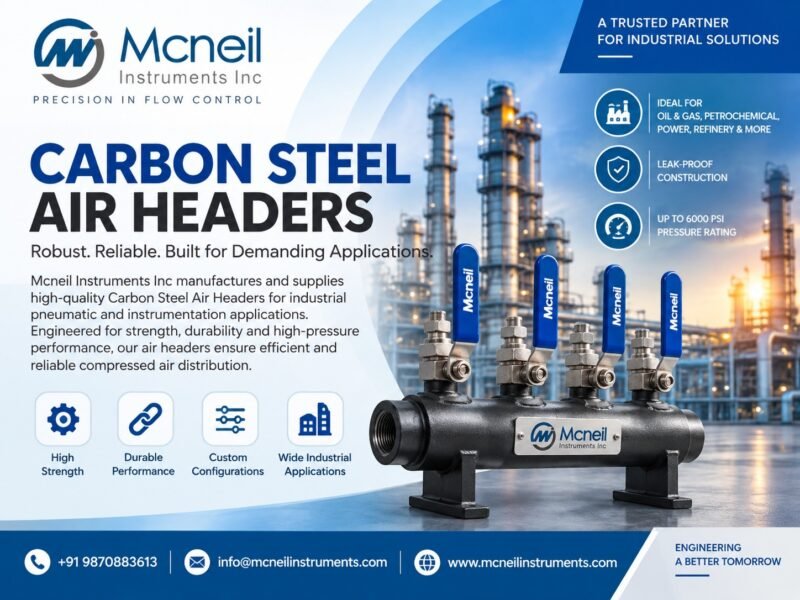
Industrial pneumatic and instrumentation systems require dependable compressed-air distribution to supply control valves, pneumatic instruments, actuators and process-control equipment. In such systems, the material used for the air header plays an important role in determining mechanical strength, pressure capability, durability and overall service life.
A Carbon Steel Air Header is a centralized compressed-air distribution system manufactured from carbon steel and designed to distribute air from a common inlet to multiple outlet connections. Carbon steel is widely selected for industrial air distribution because of its combination of mechanical strength, pressure-handling capability, durability and cost-effective performance.
Mcneil Air Header manufactures and supplies Carbon Steel Air Headers, Carbon Steel Instrument Air Headers, Carbon Steel Air Distribution Manifolds, Carbon Steel Air Distribution Headers, Carbon Steel Air Manifolds and Carbon Steel Pneumatic Air Headers for industrial instrumentation, pneumatic and process-control applications. The available configurations include multiple outlet arrangements, connection types, sizes, materials and customized designs.
What Is a Carbon Steel Air Header?
A Carbon Steel Air Header is a compressed-air distribution manifold manufactured from carbon steel and used to distribute air from one common inlet to multiple downstream outlets.
Instead of routing individual air lines independently from the main compressed-air source, an air header provides a centralized distribution point. This arrangement can simplify piping layouts and provide organized connections for pneumatic and instrumentation systems.
Carbon Steel Air Headers are also commonly referred to as:
● Carbon Steel Instrument Air Header
● Carbon Steel Air Distribution Header
● Carbon Steel Air Distribution Manifold
● Carbon Steel Air Manifold
● Carbon Steel Pneumatic Air Header
● Carbon Steel Instrumentation Air Header
● Carbon Steel Multi-Port Air Header
The configuration can be designed according to the number of required outlets, operating pressure, connection type, material grade and installation requirements.
How Does a Carbon Steel Air Header Work?
The operating principle of a Carbon Steel Air Header is relatively straightforward:
- Compressed air enters through the main inlet.
- The air enters the internal header passage.
- The common passage distributes compressed air toward multiple outlet connections.
- Individual outlet valves or connections supply air to downstream equipment.
- Pneumatic instruments, control valves, actuators or other air-operated equipment receive compressed air through their respective connections.
This centralized arrangement can reduce the need for multiple independent branches from the primary compressed-air supply.
Depending on the design, individual outlets may incorporate needle valves, ball valves, threaded connections, socket-weld connections or flanged connections for isolation and system integration.
Why Is Carbon Steel Used for Air Headers?
Carbon steel remains a widely used material for industrial air headers because it provides a useful combination of mechanical and economic properties.
High Mechanical Strength
Carbon steel provides the structural strength required for industrial compressed-air distribution systems and demanding operating environments.
Pressure-Handling Capability
Suitable carbon steel grades can be used for high-pressure applications when the complete header design, dimensions, connections and operating conditions are appropriately specified.
Cost-Effective Construction
Compared with many high-alloy materials, carbon steel can provide an economical solution where extreme corrosion resistance is not the primary requirement.
Durable Industrial Construction
Carbon steel provides robust construction suitable for process plants, refineries, power facilities and other industrial environments.
Fabrication Versatility
Carbon steel can be machined, welded and fabricated into different header configurations, allowing manufacturers to produce customized designs.
Long Service Life
When correctly selected, manufactured, protected and maintained, carbon steel air headers can provide reliable long-term service.
Key Advantages of Carbon Steel Air Headers
A properly engineered Carbon Steel Air Header can provide several operational and economic advantages.
Centralized Air Distribution
One common inlet can distribute compressed air to several downstream instruments and pneumatic systems.
Reduced Piping Complexity
A centralized manifold can simplify the arrangement of individual air lines and connections.
Strong Construction
Carbon steel provides the mechanical strength required for demanding industrial applications.
High-Pressure Capability
The published Mcneil Air Header product range specifies pressure capability of up to 6000 PSI, depending on configuration.
Cost-Effective Solution
Carbon steel is often selected where high mechanical performance is required without the additional material cost associated with more corrosion-resistant alloys.
Easy Maintenance
Centralizing multiple connections at one location can make inspection, isolation and maintenance more convenient.
Flexible Configuration
Carbon Steel Air Headers can be supplied in different outlet configurations, sizes, connection arrangements and material grades.
Types of Carbon Steel Air Headers
Mcneil Air Header manufactures Carbon Steel Air Headers in different configurations to meet varying industrial distribution requirements.
Carbon Steel Instrument Air Header
A Carbon Steel Instrument Air Header is designed to distribute compressed air to instrumentation and process-control systems.
Typical connected equipment can include:
● Pneumatic control valves
● Instrumentation systems
● Pneumatic actuators
● Regulators
● Process-control equipment
Carbon Steel Air Distribution Manifold
A Carbon Steel Air Distribution Manifold provides a centralized point for distributing compressed air to multiple downstream connections.
It can be incorporated into industrial pneumatic and instrumentation networks where several air connections are required.
Carbon Steel Air Distribution Header
This configuration is intended for centralized air distribution throughout industrial process systems.
Carbon Steel Air Manifold
A Carbon Steel Air Manifold provides multiple outlet connections from a common air source and is suitable for pneumatic and automation systems.
Carbon Steel Pneumatic Air Header
A pneumatic air header is designed for systems in which compressed air operates pneumatic equipment, actuators, valves and automation components.
Carbon Steel Bar Stock Air Header
Bar stock construction involves machining the header from solid material. This type of construction can provide a compact and robust configuration for demanding applications.
Carbon Steel Air Header Configurations
The required number of outlets depends on the number of downstream pneumatic or instrumentation connections.
Mcneil Air Header lists the following configurations:
| Configuration | Number of Outlets | Typical Requirement |
| 4 Way Carbon Steel Air Header | 4 | Compact instrumentation systems |
| 6 Way Carbon Steel Air Header | 6 | Medium air distribution |
| 8 Way Carbon Steel Air Header | 8 | Multiple process connections |
| 10 Way Carbon Steel Air Header | 10 | Larger instrumentation systems |
| 12 Way Carbon Steel Air Header | 12 | Process plants with multiple outlets |
| 14 Way Carbon Steel Air Header | 14 | Extensive industrial distribution |
| 16 Way Carbon Steel Air Header | 16 | High-capacity distribution systems |
Customized outlet configurations can also be manufactured according to project requirements.
Carbon Steel Grades Used for Air Headers
Material selection directly influences the mechanical and pressure capabilities of an air header.
ASTM A105 Carbon Steel Air Header
ASTM A105 is listed by Mcneil Air Header among its carbon steel material options. It can be selected for industrial pressure-containing components where the required design conditions are compatible with the material specification.
ASTM A106 Carbon Steel Air Header
ASTM A106 is another listed material option and is commonly associated with carbon steel piping applications involving elevated temperature and pressure.
The product page specifically identifies ASTM A106 Grade B in its product details.
Carbon Steel Bar Stock Air Header
Carbon steel bar stock can be machined to produce compact manifold-style air headers with robust construction.
The appropriate material grade should always be selected according to the applicable design code, pressure, temperature, fluid service and project specification.
Technical Specifications of Carbon Steel Air Headers
The published Mcneil Air Header product information provides the following specifications:
| Parameter | Specification |
| Product Type | Carbon Steel Air Header |
| Size Range | 1/2″ to 4″ |
| Outlet Configurations | 4, 6, 8, 10, 12, 14, 16 Way |
| Pressure Rating | Up to 6000 PSI |
| End Connections | NPT, BSPT, Socket Weld, Flanged |
| Material Grades | ASTM A105, ASTM A106 |
| Testing | Hydrostatic & Pneumatic Testing |
| Surface Finish | Painted, Pickled, Passivated |
The exact pressure capability, temperature range and configuration should be verified against the selected design and purchase specification rather than treating the maximum published value as applicable to every configuration.
Inlet and Outlet Connections
Connection selection is essential because the air header must integrate correctly with the existing compressed-air piping system.
Mcneil Air Header lists several connection options.
NPT Connections
NPT threaded connections can be selected for compatible industrial piping and instrumentation installations.
BSPT Connections
BSPT connections provide an alternative threaded configuration for systems designed around British Standard pipe threads.
Socket Weld Connections
Socket weld connections can be used where a welded connection is required for the installation.
Flanged Connections
Flanged ends can be selected where the air header needs to connect with compatible flanged piping or equipment.
Valve Arrangements
Depending on the project design, air headers can incorporate:
● Ball valves
● Needle valves
● Isolation arrangements
● Customized outlet configurations
Needle valves are particularly relevant where individual outlet isolation and controlled flow adjustment are required.
Surface Finishes for Carbon Steel Air Headers
Surface treatment can be important for protecting carbon steel from environmental exposure.
The published product information identifies:
Painted Finish
Painted surfaces can provide a protective barrier against environmental exposure and can be selected according to project coating requirements.
Pickled Finish
Pickling is a surface treatment used to remove surface oxides and contaminants following applicable manufacturing processes.
Passivated Finish
Passivation is more commonly associated with stainless steel and alloy materials. Where listed for a particular product configuration, the exact treatment should be confirmed with the manufacturer.
For carbon steel installations exposed to corrosive environments, the coating system should be selected according to the service environment and project specification.
Applications of Carbon Steel Air Headers
Carbon Steel Air Headers are used across industries where centralized compressed-air distribution is required.
Oil & Gas Industry
Carbon Steel Air Headers can be used for:
● Instrument air distribution
● Pneumatic instrumentation
● Control valve operation
● Process automation
● Compressed-air systems
Refineries
Refineries use pneumatic and instrumentation systems throughout process units. Carbon Steel Air Headers can provide localized distribution for:
● Pneumatic valves
● Instrumentation systems
● Process-control equipment
● Automation systems
Petrochemical Plants
Petrochemical facilities require compressed air for numerous instrumentation and pneumatic applications. Carbon steel manifolds can provide centralized distribution where the operating environment is suitable for carbon steel.
Power Generation
Power plants use pneumatic systems for instrumentation, control and auxiliary equipment. Carbon Steel Air Headers can support compressed-air distribution around suitable process and control systems.
Fertilizer Plants
Fertilizer production facilities use pneumatic instrumentation and automated process-control systems that require reliable compressed-air supply.
Chemical Processing
Carbon Steel Air Headers can be used in chemical-processing facilities where the operating environment and corrosion conditions are compatible with carbon steel.
Offshore & Marine Applications
Carbon steel configurations may be considered for selected offshore and marine installations when appropriate corrosion protection and material selection are incorporated into the design.
Water Treatment
Air headers can supply compressed air to pneumatic actuators, automation equipment and process-control systems used in water-treatment facilities.
Features of Carbon Steel Air Headers
Mcneil Air Header identifies several features associated with its Carbon Steel Air Header range.
High-Strength Construction
Carbon steel provides robust mechanical construction for industrial applications.
Reliable Air Distribution
Multiple outlet configurations allow compressed air to be distributed from a common source.
High-Pressure Capability
The published range supports pressure ratings up to 6000 PSI, depending on the selected configuration.
Leak-Resistant Construction
Precision manufacturing and appropriate connection design help minimize leakage risks.
Compact Arrangement
A centralized manifold can reduce the space and piping required for multiple individual branches.
Long Service Life
Proper material selection, surface protection and maintenance can support long-term industrial operation.
Multiple Configurations
Headers can be manufactured with different outlet counts, sizes, connections and valve arrangements.
Carbon Steel Air Header vs Stainless Steel Air Header
Material selection should be based on the operating environment rather than simply choosing the strongest or least expensive option.
| Factor | Carbon Steel Air Header | Stainless Steel Air Header |
| Mechanical Strength | High | High |
| Relative Material Cost | Generally lower | Generally higher |
| Corrosion Resistance | Requires suitable protection in corrosive environments | Generally superior |
| Industrial Applications | Broad | Broad, especially corrosive environments |
| Coating Requirement | Often important depending on environment | Usually less dependent on external coating |
| High-Pressure Applications | Suitable with appropriate design | Suitable with appropriate design |
| Marine/Chloride Exposure | Requires careful protection and selection | Often preferred |
| General Industrial Use | Highly practical | Used where corrosion resistance is prioritized |
The correct choice depends on pressure, temperature, moisture, chemical exposure, corrosion conditions, applicable standards and project specifications.
Quality Testing of Carbon Steel Air Headers
Testing is an important part of manufacturing pressure-containing air distribution equipment.
Mcneil Air Header identifies quality-control activities including:
● Raw material verification
● Positive Material Identification (PMI)
● Hydrostatic pressure testing
● Pneumatic leak testing
● Dimensional inspection
● Thread inspection
● Visual examination
● Surface-finish inspection
● Material traceability verification
Material Test Certificates and inspection documentation can also be supplied according to project requirements.
How to Select a Carbon Steel Air Header
Before purchasing a Carbon Steel Air Header, engineers and procurement teams should evaluate several parameters.
1. Required Number of Outlets
Determine how many pneumatic or instrumentation lines must be supplied.
Available configurations range from smaller multi-way arrangements to larger systems, with customized outlet counts also possible.
2. Operating Pressure
Identify the normal operating pressure, design pressure and applicable pressure-test requirements.
The published Mcneil range specifies up to 6000 PSI, but the applicable rating must be confirmed for the selected configuration.
3. Operating Temperature
Temperature affects material selection, seals, valves and the overall design rating.
4. Carbon Steel Grade
Select the appropriate grade based on the applicable design requirements. Listed options include ASTM A105 and ASTM A106.
5. Connection Type
Determine whether the installation requires:
● NPT
● BSPT
● Socket weld
● Flanged connections
6. Header Size
The published size range is 1/2″ to 4″.
7. Environmental Conditions
Consider:
● Humidity
● Moisture
● Chemical exposure
● Marine atmosphere
● External corrosion
● Ambient temperature
8. Surface Protection
For exposed carbon steel systems, determine whether painting, coating or another protective treatment is required.
9. Testing and Documentation
Confirm requirements for:
● Hydrostatic testing
● Pneumatic testing
● PMI
● Material certificates
● Dimensional inspection
● Third-party inspection
Custom Carbon Steel Air Headers
Industrial projects often have different piping layouts and instrumentation requirements. A standard air header may therefore not always provide the required combination of outlets, dimensions and connections.
Mcneil Air Header offers customization options including:
● Number of outlet connections
● Inlet and outlet sizes
● Pipe dimensions
● Pressure ratings
● End connection types
● Mounting arrangements
● Drain valve arrangements
● Surface coating
● Material grades
● Identification marking
● Project-specific configurations
Customized manufacturing allows the air header to be designed around the existing piping and instrumentation arrangement.
Carbon Steel Air Header Maintenance
Proper maintenance helps preserve the performance and service life of carbon steel air distribution equipment.
Regular Visual Inspection
Inspect the header body, valves, connections, supports and external surfaces for visible damage or deterioration.
Leak Inspection
Check threaded, welded and flanged connections for signs of compressed-air leakage.
Coating Inspection
Where protective coatings are used, inspect for damaged, cracked, peeling or exposed areas.
Pressure Monitoring
Operate the header within its specified pressure limits and investigate abnormal pressure fluctuations.
Valve Inspection
Check individual isolation or control valves for leakage and proper operation.
Scheduled Testing
Follow the plant’s inspection and maintenance program for pressure testing and equipment integrity verification.
Why Choose Mcneil Air Header for Carbon Steel Air Headers?
Mcneil Air Header manufactures and supplies Carbon Steel Air Headers for industrial instrumentation, pneumatic and compressed-air distribution applications. The company identifies manufacturing capabilities, precision engineering, quality control and customized solutions among its key offerings.
Key Capabilities
● Carbon steel air header manufacturing
● Multiple outlet configurations
● ASTM A105 and ASTM A106 options
● High-pressure air distribution solutions
● Customized designs
● Multiple connection types
● Quality inspection procedures
● Technical support
● Export packaging and international supply
The product range is intended for applications across oil & gas, petrochemical, refinery, power-generation, fertilizer, chemical-processing, offshore and industrial automation facilities.
Frequently Asked Questions
What is a Carbon Steel Air Header?
A Carbon Steel Air Header is a compressed-air distribution manifold manufactured from carbon steel and used to distribute air from one inlet to multiple downstream connections.
What are the benefits of carbon steel air headers?
Carbon Steel Air Headers provide high mechanical strength, pressure-handling capability, durability, cost-effective construction and centralized compressed-air distribution.
What carbon steel grades are available?
Mcneil Air Header lists ASTM A105 and ASTM A106 among its carbon steel material grades. The product information also specifically identifies ASTM A106 Grade B for one product configuration.
What pressure rating is available?
The published product specification lists pressure ratings of up to 6000 PSI, depending on the configuration.
What sizes are available?
The published Carbon Steel Air Header range is 1/2″ to 4″.
Which outlet configurations are available?
Mcneil Air Header lists 4 Way, 6 Way, 8 Way, 10 Way, 12 Way, 14 Way and 16 Way configurations, with customized arrangements also available.
Which connections can be supplied?
The listed connection options include NPT, BSPT, socket weld and flanged connections.
Are Carbon Steel Air Headers suitable for high-pressure applications?
They can be suitable for high-pressure applications when the material grade, dimensions, connections, valves and complete design are appropriately rated. Mcneil’s published range specifies up to 6000 PSI for its product range.
Where are Carbon Steel Air Headers used?
They are used in oil & gas, refineries, petrochemical plants, power-generation facilities, fertilizer plants, chemical-processing facilities, offshore and marine systems, water-treatment plants and industrial automation applications.
Can Carbon Steel Air Headers be customized?
Yes. Customization can include outlet count, dimensions, connection types, pressure ratings, mounting arrangements, valves, coatings and material grades.
Conclusion
A Carbon Steel Air Header provides a centralized and robust solution for distributing compressed air to multiple pneumatic and instrumentation connections. Its combination of mechanical strength, pressure capability, durability and cost-effective construction makes carbon steel a practical material for many industrial air-distribution systems.
Mcneil Air Header manufactures Carbon Steel Instrument Air Headers, Carbon Steel Air Distribution Manifolds, Carbon Steel Air Distribution Headers, Carbon Steel Air Manifolds, Carbon Steel Pneumatic Air Headers and Multi-Port Carbon Steel Air Headers in multiple outlet configurations and connection arrangements.
The published range includes 1/2″ to 4″ sizes, 4-way through 16-way configurations, pressure ratings up to 6000 PSI, NPT, BSPT, socket-weld and flanged connections, and ASTM A105 and ASTM A106 carbon steel options.
For industrial projects, the appropriate Carbon Steel Air Header should be selected according to operating pressure, temperature, number of outlets, material grade, connection type, environmental conditions, corrosion protection and applicable testing requirements.