
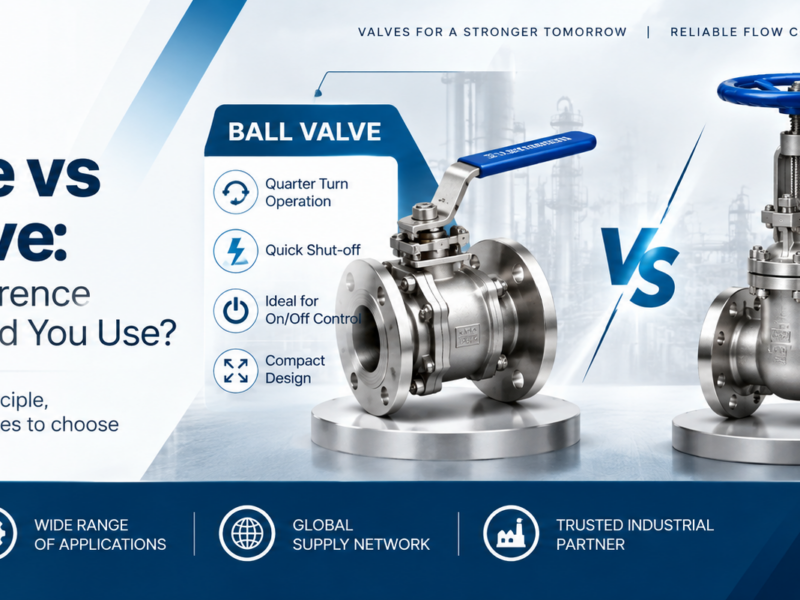
A Ball Valve is a quarter-turn industrial valve used to control, isolate, divert, or shut off the flow of liquids, gases, steam, and compressed air. Its simple operating mechanism, compact construction, reliable sealing, and fast shut-off capability make it an important component in industrial piping and instrumentation systems.
Ball valves are widely used across oil and gas, petrochemical, chemical processing, refineries, power generation, offshore and marine systems, water treatment, and industrial automation. Depending on the design, they can be used in low-pressure instrumentation systems as well as demanding high-pressure applications.
Mcneil Air Header manufactures, supplies, and exports industrial Ball Valves, Instrument Ball Valves, High Pressure Ball Valves, Pneumatic Ball Valves, Ball Valve Manifolds, and multi-port ball valve configurations for industrial flow-control applications.
What Is a Ball Valve?
A Ball Valve is a quarter-turn valve that uses a spherical ball with a central bore to control fluid flow.
When the bore is aligned with the pipeline, the valve allows flow to pass. Rotating the ball by approximately 90 degrees positions the bore perpendicular to the flow path and shuts off the system.
This operating principle provides:
- Fast on/off operation
- Reliable shut-off
- Compact construction
- Low operating effort
- Reduced pressure drop in suitable full-port designs
- Easy operation
- Long service life
Ball valves are commonly referred to as:
- Industrial Ball Valve
- Instrument Ball Valve
- High Pressure Ball Valve
- Pneumatic Ball Valve
- Process Control Ball Valve
- Threaded Ball Valve
- Air Ball Valve
- Instrumentation Ball Valve
- Ball Valve Manifold
How Does a Ball Valve Work?
The operation of a ball valve is based on the rotation of a drilled spherical ball inside the valve body.
Valve Open
When the ball’s bore aligns with the inlet and outlet, fluid flows through the valve.
Valve Closed
When the handle or actuator rotates the ball approximately 90 degrees, the bore moves away from the flow path and the ball seals against the seats.
Quarter-Turn Operation
The 90-degree operating movement allows rapid isolation compared with multi-turn valve designs.
This makes ball valves particularly useful where quick shut-off is required.
Types of Ball Valves
Mcneil Air Header publishes a broad range of ball valve configurations designed for different pressure, temperature, installation, and flow-control requirements.
Type A Ball Valve
The Type A ball valve is a one-piece bar-stock design intended for low- to medium-pressure applications.
Published specifications:
- Connection size: 1/4″ to 2″
- Pressure rating: Up to 2,000 psi
- Temperature range: −40°C to 230°C
Its compact construction makes it suitable for industrial and instrumentation applications.
Type B Ball Valve
The Type B is a three-piece screw-together bar-stock ball valve.
Published specifications:
- Connection size: 1/4″ to 2″
- Pressure rating: 1,000–3,000 psi
- Temperature range: −40°C to 150°C
The three-piece design provides flexibility in end-connection combinations and maintenance.
Type SB Ball Valve
The SB series is a panel-mount adaptation of the B-series design.
Published specifications:
- Connection size: 1/4″ to 1″
- Pressure rating: 1,000–3,000 psi
- Temperature range: −20°C to 110°C
Its panel-mounting arrangement allows installation on a control panel or actuator system.
Type S Ball Valve
The S series uses a bolt-together design that allows the center section to be removed for maintenance.
Published specifications:
- Connection size: 1/4″ to 2 1/2″
- Pressure rating: 1,000–3,000 psi
- Temperature range: −20°C to 110°C
The design allows seat and seal replacement and can be adapted for actuator control.
Type PB High Pressure Ball Valve
The PB series is a three-piece high-pressure ball valve.
Published specifications:
- Connection size: 1/4″ to 2″
- Pressure rating: Up to 6,000 psi
- Temperature range: −40°C to 150°C
It is designed for compact isolation and high-pressure industrial applications.
Type SN Ball Valve
The SN series is a single-nut-mounted ball valve designed for compact installations.
Published specifications:
- Connection size: 1/4″ to 1″
- Pressure rating: Up to 6,000 psi
- Temperature range: −40°C to 150°C
The single-nut design supports quick panel mounting, with published panel thickness capability up to 11 mm depending on valve size.
Type 3 Ball Valve
The Type 3 is a multi-port gauge ball valve designed to facilitate gauge attachment, testing, and calibration.
Published specifications:
- Connection size: 1/4″ to 2 1/2″
- Pressure rating: 1,000–6,000 psi
- Temperature range: −20°C to 110°C
Centurion™ Ball Valve
The Centurion™ series is designed as an isolation valve for natural-gas vehicle-fueling applications.
Published specifications:
- Connection size: 1/2″ to 1″
- Pressure rating: 6,000 psi
- Temperature range: −20°C to +70°C
Type UE Ball Valve
The UE series is a compact ball valve design combining features of the A and B series.
Published specifications:
- Connection size: 1/4″ to 1″
- Pressure rating: 10,000 psi
- Temperature range: −40°C to 230°C
Type UB Ball Valve
The UB series is designed for demanding high-pressure applications.
Published specifications:
- Connection size: 1/4″ to 3/4″
- Pressure rating: 10,000 psi
- Temperature range: −40°C to 230°C
The series can also be panel mounted.
Multi-Port Ball Valves
Ball valves can also be configured with multiple ports to provide flow diversion, venting, sampling, or other specialized flow paths.
3-Way Ball Valve
Three-way ball valves are available in configurations designed for diverting flow.
Mcneil Air Header publishes:
- 3-Way SB
- 3-Way PSB
- 3T
- 3-Way USB
Depending on the design, these valves can provide L-port or T-port flow arrangements.
Published pressure ratings extend up to 10,000 psi for the 3-Way USB series.
4-Way Ball Valve
The X4 series is a four-way multi-diverter ball valve designed to redirect high-pressure lines.
It can be useful for:
- Flow diversion
- Venting
- Dumping
- Sampling
- Multi-directional flow control
The published X4 specifications include 1/4″ to 1″ connection sizes, up to 6,000 psi pressure rating, and a temperature range of −40°C to 150°C.
2-Way vs 3-Way vs 4-Way Ball Valve
| Configuration | Main Function | Typical Application |
| 2-Way | Flow isolation and shut-off | Process and instrumentation |
| 3-Way | Flow diversion or mixing | Process routing and sampling |
| 4-Way | Multi-directional diversion | Venting, dumping and complex flow systems |
The correct configuration depends on the required flow path and process-control arrangement.
Materials Used for Ball Valves
Material selection is an important part of valve engineering because the valve body, ball, stem, and sealing components must withstand the operating environment.
Mcneil Air Header publishes ball valves manufactured from stainless steel, alloy steel, and exotic alloys.
Stainless Steel Ball Valves
Published stainless-steel options include:
- SS 304
- SS 304L
- SS 316
- SS 316L
Stainless steel can provide corrosion resistance for many industrial, chemical, marine, and instrumentation applications.
Alloy Steel Ball Valves
Published alloy-steel options include:
- ASTM A182 F5
- ASTM A182 F11
- ASTM A182 F22
- ASTM A182 F91
These materials can be considered for suitable high-temperature and demanding industrial applications.
Exotic Alloy Ball Valves
Mcneil Air Header also lists:
- Monel 400
- Inconel 625
- Hastelloy C276
- Incoloy 825
These alloys can be selected for specialized applications involving demanding corrosion, temperature, or mechanical requirements.
Technical Specifications of Ball Valves
Mcneil Air Header’s general published technical specifications include:
| Parameter | Published Specification |
| Valve Type | Ball Valve / Instrument Ball Valve |
| General Size Range | 1/4″ to 4″ |
| Pressure Rating | Up to 10,000 PSI |
| End Connections | NPT, BSPT, Socket Weld, Flanged |
| Materials | Stainless Steel, Alloy Steel, Exotic Alloys |
| Operation | Manual / Pneumatic |
| Testing | Hydrostatic & Pneumatic Testing |
Actual pressure and temperature ratings vary by valve series, size, seat material, and configuration. The individual product series should therefore be checked before specifying a valve.
Full Port and Reduced Port Ball Valves
Ball valves can be designed with different bore configurations.
Full Port Ball Valve
A full-port design has a flow passage that closely matches the connected pipe bore.
Potential advantages include:
- Lower flow restriction
- Reduced pressure loss
- Easier passage through the valve
- Suitability for applications where flow capacity is important
Reduced Port Ball Valve
A reduced-port design has a smaller flow passage than the connected pipe.
It can provide:
- More compact construction
- Lower material requirements
- Suitable flow-control characteristics for specific applications
The appropriate bore should be selected according to the process design rather than assuming full port is required for every system.
Ball Valve End Connections
Mcneil Air Header lists multiple end-connection options.
NPT
NPT threaded connections are widely used in instrumentation and industrial piping.
BSPT
BSPT connections are used in systems designed around British Standard Pipe taper threads.
Socket Weld
Socket-weld connections provide a welded connection suitable for applicable high-pressure piping and instrumentation systems.
Flanged
Flanged connections are useful where valves need to be installed or removed from larger piping systems.
Applications of Industrial Ball Valves
Oil and Gas Industry
Ball valves are extensively used for isolation and flow management in oil and gas systems.
Applications can include:
- Process piping
- Instrumentation
- Pressure control
- Gas systems
- Hydraulic systems
- Offshore equipment
Petrochemical Industry
Petrochemical plants require dependable isolation and flow-control components.
Ball valves can be used in:
- Process lines
- Chemical transfer
- Instrumentation
- Utility systems
- Process-control systems
Refineries
Refineries use valves throughout process units, utilities, pressure systems, and instrumentation networks.
Ball valves can provide rapid isolation and reliable shut-off where appropriate.
Power Generation
Power plants use industrial valves across process, instrumentation, utility, and auxiliary systems.
Applications may include:
- Instrumentation
- Steam-related systems
- Fuel systems
- Hydraulic systems
- Process isolation
The valve’s pressure, temperature, seat, and material selection must match the actual service.
Chemical Processing
Chemical plants may handle corrosive liquids and gases under pressure.
Appropriately selected stainless steel or exotic-alloy ball valves can be used for suitable chemical-processing applications.
Offshore and Marine
Offshore systems expose equipment to demanding environmental conditions, including saltwater and humidity.
Corrosion-resistant valve materials can be selected where required.
Water Treatment
Ball valves can be used for isolation and flow management in water-treatment and fluid-handling systems.
Pneumatic and Instrumentation Systems
Compact ball valves are useful for compressed-air systems, instrument isolation, sampling, and process-control applications. Mcneil Air Header specifically positions its ball valves for instrumentation and compressed-air systems.
Benefits of Ball Valves
Quick Shut-Off
The quarter-turn mechanism allows rapid opening and closing.
Reliable Sealing
Properly selected seats and sealing components provide effective isolation.
Compact Design
Many ball valve configurations offer a compact alternative to larger multi-turn valve designs.
High-Pressure Capability
Mcneil Air Header’s product range includes configurations rated up to 10,000 psi.
Low Pressure Drop
Full-port designs can provide a relatively unrestricted flow passage.
Easy Operation
Manual handles or compatible actuators allow straightforward operation.
Versatile Configurations
Two-way, three-way, four-way, panel-mounted, high-pressure, and multi-port designs support different applications.
Maintenance Flexibility
Certain three-piece and bolt-together configurations allow access to internal components for maintenance.
Ball Valve Testing
Testing is important for ensuring valve integrity and leakage performance.
Mcneil Air Header publishes hydrostatic and pneumatic testing for its ball valve products. Its detailed product information also states that hydrostatic testing can be performed using pure water at 1.5 times the working pressure and identifies seat/seal leakage testing with a published leakage criterion of 0.1 std. cm³.
Additional tests such as helium and seismic testing are stated to be available on request.
Testing requirements should be confirmed according to the specific valve model and project specification.
How to Select the Right Ball Valve
Before selecting an industrial ball valve, consider:
1. Process Medium
Determine whether the valve will handle:
- Water
- Gas
- Steam
- Hydrocarbons
- Chemicals
- Compressed air
- Hydraulic fluids
2. Operating Pressure
Select a valve with an appropriate pressure rating for the system.
3. Operating Temperature
Check the valve’s temperature rating, including the effect of seat and seal materials.
4. Valve Configuration
Choose between:
- 2-way
- 3-way
- 4-way
- Multi-port
- Panel-mounted
5. Material
Select stainless steel, alloy steel, or an exotic alloy according to corrosion and temperature requirements.
6. Port Design
Determine whether a full-port or reduced-port valve is appropriate.
7. End Connection
Confirm whether the system requires:
- NPT
- BSPT
- Socket weld
- Flanged
8. Operation
Determine whether manual or pneumatic operation is required.
9. Installation Environment
Consider vibration, accessibility, corrosive atmosphere, and available installation space.
Why Choose Mcneil Air Header for Ball Valves?
Mcneil Air Header positions itself as a Ball Valve Manufacturer, Supplier, and Exporter, offering industrial ball valves for flow control, isolation, instrumentation, and process applications.
Its published product range includes:
- Instrument Ball Valves
- Industrial Ball Valves
- High Pressure Ball Valves
- Pneumatic Ball Valves
- Ball Valve Manifolds
- 2-Way Ball Valves
- 3-Way Ball Valves
- 4-Way Ball Valves
- Multi-Port Ball Valves
- Panel-Mount Ball Valves
The company also publishes material options, multiple pressure classes, different end connections, and hydrostatic and pneumatic testing capabilities.
Frequently Asked Questions
What is a Ball Valve?
A Ball Valve is a quarter-turn valve that uses a rotating ball with a central bore to control or shut off the flow of liquids, gases, steam, or compressed air.
What types of Ball Valves does Mcneil Air Header manufacture?
Mcneil Air Header publishes Type A, B, SB, S, PB, SN, Type 3, Centurion™, UE, UB, 3-Way, 3T, USB, and X4 ball valve configurations.
What is the pressure rating of Mcneil Air Header Ball Valves?
Pressure ratings vary by series. The published range includes configurations from 1,000 psi up to 10,000 psi.
What materials are available?
Published material options include SS 304, SS 304L, SS 316, SS 316L, ASTM A182 F5/F11/F22/F91, Monel 400, Inconel 625, Hastelloy C276, and Incoloy 825.
What are 3-way Ball Valves used for?
Three-way ball valves can be used for flow diversion, routing, mixing, venting, or sampling depending on the port arrangement and application.
Are Ball Valves suitable for high-pressure applications?
Yes. Specific Mcneil Air Header ball valve series are published with pressure ratings up to 10,000 psi. The appropriate series must be selected according to the actual pressure, temperature, size, seat material, and service conditions.
Are Ball Valves suitable for instrumentation systems?
Yes. Mcneil Air Header specifically offers Instrument Ball Valves and compact configurations for instrumentation and process-control applications.
How does a Ball Valve operate?
A ball valve normally operates through approximately 90 degrees of rotation. The ball’s bore aligns with the flow path when open and moves perpendicular to it when closed.
Conclusion
A Ball Valve provides a compact and efficient solution for flow isolation, shut-off, diversion, and selected flow-control applications across industrial piping and instrumentation systems.
The wide range of configurations offered by Mcneil Air Header, including 2-way, 3-way, 4-way, high-pressure, panel-mounted, multi-port, and instrument ball valves, allows the valve to be selected according to different pressure, temperature, flow-path, and installation requirements.
With published pressure capabilities reaching 10,000 psi for selected models, material options ranging from stainless steel to alloy and exotic alloys, and multiple connection configurations, Mcneil Air Header’s Ball Valve range is designed for applications across oil and gas, petrochemical, chemical, power generation, offshore, marine, water treatment, and instrumentation systems.