
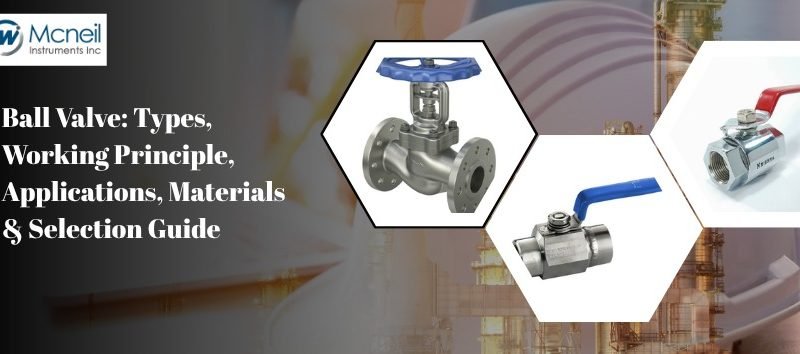
A ball valve is a quarter-turn valve used to control or isolate the flow of liquids, gases, steam, compressed air, and other process media. Its simple operating mechanism, compact construction, fast shut-off capability, and reliable sealing make it a widely used component in industrial flow-control and instrumentation systems.
Mcneil Air Header manufactures and supplies ball valves, instrument ball valves, industrial ball valves, high-pressure ball valves, pneumatic ball valves, threaded ball valves, and ball valve manifolds for applications across oil & gas, petrochemical, refinery, power generation, water treatment, and process automation industries.
What Is a Ball Valve?
A ball valve controls flow using a rotating ball with a central bore. When the bore aligns with the pipeline, the valve is open. Rotating the ball approximately 90 degrees positions the solid portion across the flow path, closing the valve.
This quarter-turn operation allows fast and effective flow isolation.
Ball valves are also commonly referred to as:
Instrument Ball Valve
Industrial Ball Valve
High Pressure Ball Valve
Pneumatic Ball Valve
Process Control Ball Valve
Threaded Ball Valve
Air Ball Valve
Instrumentation Ball Valve
Ball Valve Manifold
Mcneil Air Header describes its ball valves as suitable for reliable shut-off, flow control, instrumentation, compressed-air systems, and industrial process applications.
How Does a Ball Valve Work?
The operating principle is straightforward.
Valve Open
The internal bore of the ball is aligned with the pipeline. Fluid can pass through the valve with minimal restriction.
Valve Closed
The handle rotates the ball approximately 90 degrees. The bore moves perpendicular to the flow path, stopping the flow.
Quarter-Turn Operation
The short operating movement is one of the main advantages of ball valves. It enables quick isolation compared with multi-turn valve designs.
For industrial applications, the exact valve configuration, seat material, pressure rating, temperature range, and end connection should be selected according to the service conditions.
Main Types of Ball Valves
Mcneil Air Header’s product range includes multiple ball valve designs for different pressure, mounting, diversion, and instrumentation requirements.
Type A Ball Valve
The Type A series is manufactured from high-integrity one-piece bar stock and is intended for low- to medium-pressure applications.
Published specifications:
Connection size: 1/4″ to 2″
Pressure rating: Up to 2,000 psi
Temperature range: -40°C to 230°C
The internal components are loaded through the threads.
Type B Ball Valve
The Type B series is a three-piece screw-together bar-stock design.
Published specifications:
Connection size: 1/4″ to 2″
Pressure rating: 1,000–3,000 psi
Temperature range: -40°C to 150°C
Its flexible construction allows different end-connector combinations.
Type SB Ball Valve
The SB series is designed for panel mounting.
Published specifications:
Connection size: 1/4″ to 1″
Pressure rating: 1,000–3,000 psi
Temperature range: -20°C to 110°C
Its flat mounting face allows installation on control panels or connection to actuators.
Type S Ball Valve
The S series uses a bolt-together architecture that provides interchangeability and maintenance flexibility.
Published specifications:
Connection size: 1/4″ to 2 1/2″
Pressure rating: 1,000–3,000 psi
Temperature range: -20°C to 110°C
The center section can be removed for replacement of seats and seals, according to the manufacturer’s product information.
High-Pressure Ball Valves
For demanding pressure applications, Mcneil Air Header offers several high-pressure ball valve configurations.
Type PB
The PB series is a three-piece high-pressure isolation ball valve.
Connection size: 1/4″ to 2″
Pressure rating: Up to 6,000 psi
Temperature range: -40°C to 150°C
The manufacturer describes it as a compact and flexible design with multiple end-connector combinations.
Type SN
The SN series is a compact single-nut mounted ball valve.
Connection size: 1/4″ to 1″
Pressure rating: Up to 6,000 psi
Temperature range: -40°C to 150°C
It is designed for fast panel mounting, with a maximum panel thickness of 11 mm depending on valve size.
Type UE
The UE series combines features from the A and B series in a compact design.
Connection size: 1/4″ to 1″
Pressure rating: Up to 10,000 psi
Temperature range: -40°C to 230°C
The manufacturer’s specifications state that the UE series cannot be panel mounted.
Type UB
The UB series is another high-pressure option designed for increasing working-pressure requirements.
Connection size: 1/4″ to 3/4″
Pressure rating: Up to 10,000 psi
Temperature range: -40°C to 230°C
The UB series can be mounted on a panel.
3-Way and Multiport Ball Valves
Not every application requires simple on/off isolation. Some systems need to redirect, vent, sample, or distribute process media.
For these applications, multiport ball valves provide additional flow paths.
3-Way SB
Size: 1/4″ to 1″
Pressure: 1,000–3,000 psi
Temperature: -20°C to 110°C
The L-port design provides a way to divert high-pressure lines.
3-Way PSB
Size: 1/4″ to 1″
Pressure: Up to 6,000 psi
Temperature: -40°C to 150°C
It provides high-pressure flow diversion using an L-port configuration.
3T Series
The 3T series is a high-pressure T-port diverting ball valve designed for applications involving regulation, venting, or sampling of liquid and gas media.
Size: 1/4″ to 1″
Pressure: Up to 6,000 psi
Temperature: -40°C to 150°C
3-Way USB
The USB series is a high-pressure L-port diverting ball valve.
Size: 1/4″ to 1/2″
Pressure: Up to 10,000 psi
Temperature: -40°C to 150°C
The manufacturer specifies features including floating-seat construction, low torque, and trunnion-mounted ball construction.
X4 Series
The X4 is a four-way multi-diverter ball valve.
Size: 1/4″ to 1″
Pressure: Up to 6,000 psi
Temperature: -40°C to 150°C
It can be used for applications such as venting and dumping where multiple flow paths are required.
Ball Valve Materials
Material selection is critical because the valve body, ball, stem, seats, and seals must withstand the operating environment.
Mcneil Air Header lists several material options for its ball valve range.
Stainless Steel Ball Valves
Available stainless steel materials include:
SS 304
SS 304L
SS 316
SS 316L
Stainless steel is widely selected where corrosion resistance and durability are important.
Alloy Steel Ball Valves
The listed alloy steel options include:
ASTM A182 F5
ASTM A182 F11
ASTM A182 F22
ASTM A182 F91
These materials can be considered for applications involving elevated temperatures and demanding mechanical conditions, subject to the specific design requirements.
Exotic Alloy Ball Valves
Mcneil Air Header also lists:
Monel 400
Inconel 625
Hastelloy C276
Incoloy 825
These materials provide additional options for specialized corrosive, high-temperature, or otherwise demanding environments.
2-Piece vs 3-Piece Ball Valves
Ball valve construction is another important selection factor.
2-Piece Ball Valve
A two-piece construction provides a relatively compact valve arrangement and is suitable for many general industrial flow-control applications.
3-Piece Ball Valve
A three-piece design allows the central valve section to be removed more easily for maintenance in suitable configurations.
This can be particularly useful when minimizing maintenance downtime is important.
Mcneil Air Header lists both 2-piece and 3-piece configurations within its industrial ball valve range.
Full-Port vs Reduced-Port Ball Valves
Ball valves can also be differentiated by the size of their internal flow passage.
Full-Port Ball Valve
A full-port design provides a flow passage that closely matches the connected pipe’s internal diameter.
Benefits can include:
Lower flow restriction
Reduced pressure loss
Easier line cleaning in suitable systems
Reduced-Port Ball Valve
A reduced-port design uses a smaller internal passage.
It can provide a compact valve arrangement and may be appropriate where the application does not require a full-bore flow path.
Mcneil Air Header lists both full-port and reduced-port ball valve configurations.
Ball Valve End Connections
The connection method must match the piping or instrumentation system.
Mcneil Air Header lists the following end connections:
NPT
BSPT
Socket Weld
Flanged
The appropriate connection depends on the piping standard, pressure requirement, installation method, and project specification.
Ball Valve Applications
Ball valves are used across a wide range of industrial environments.
Oil & Gas
Ball valves are used for flow isolation and instrumentation applications in oil and gas systems.
Petrochemical Plants
They can be used for process-fluid isolation and control where the selected valve material and rating are suitable.
Refineries
Refineries use valves throughout process, utility, and instrumentation systems.
Power Generation
Ball valves can be used in suitable fluid, gas, instrumentation, and auxiliary systems.
Water Treatment
Stainless steel ball valves can be used in appropriate water-treatment and utility applications.
Compressed Air Systems
Ball valves are commonly used for isolation and flow control in compressed-air systems.
Process Automation
Instrumentation ball valves and pneumatic configurations can be integrated into automated process-control systems.
Mcneil Air Header identifies oil & gas, petrochemical, refinery, offshore, power-generation, water-treatment, instrumentation, and process-automation applications for its ball valve range.
High-Pressure Ball Valve Applications
High-pressure designs are intended for systems where ordinary low-pressure valves are not adequate.
Potential applications include:
Hydraulic systems
Oil & gas systems
Offshore equipment
High-pressure instrumentation
Process systems
Gas systems
Pressure-control applications
Mcneil Air Header lists high-pressure ball valve configurations with ratings reaching 6,000 psi and 10,000 psi, depending on the series.
Technical Specifications of Mcneil Air Header Ball Valves
The company’s published general specifications include:
Parameter Published Specification
Size Range 1/4″ to 4″
Pressure Rating Up to 10,000 psi
Valve Type Ball Valve / Instrument Ball Valve
End Connections NPT, BSPT, Socket Weld, Flanged
Materials Stainless Steel, Alloy Steel, Exotic Alloys
Operation Manual / Pneumatic
Testing Hydrostatic & Pneumatic Testing
Specific series may have narrower size, pressure, and temperature ranges, so the individual product configuration should be checked before selection.
Ball Valve Testing
Testing is particularly important for industrial valves used in pressure-containing systems.
Mcneil Air Header states that its ball valves undergo hydrostatic and pneumatic testing.
The product page also specifies seat and seal leakage testing, with hydrostatic testing performed using pure water at 1.5 times the working pressure for the described product information.
For a specific project, the purchaser should confirm the applicable testing standard, acceptance criteria, test pressure, test medium, and documentation requirements.
Key Benefits of Ball Valves
Fast Shut-Off
The quarter-turn mechanism allows quick opening and closing.
Reliable Sealing
Properly selected seats and sealing components provide effective isolation.
Compact Construction
Ball valves can provide substantial flow-control functionality in a relatively compact form.
High-Pressure Capability
Specialized designs can be rated for high-pressure applications.
Wide Material Selection
Stainless steel, alloy steel, and exotic alloy options allow the valve to be matched to different operating environments.
Maintenance Flexibility
Certain three-piece configurations allow access to internal components for maintenance.
Versatility
Ball valves can be configured for two-way, three-way, and four-way flow arrangements.
How to Select the Right Ball Valve
Choosing a ball valve should start with the operating conditions rather than simply the valve size.
- Determine the Media
Identify whether the valve will handle:
Water
Air
Gas
Steam
Oil
Chemicals
Hydraulic fluids
Other process media - Check Operating Pressure
The valve’s rated pressure must exceed the system’s applicable design requirements. - Check Temperature
Confirm the complete temperature range, including minimum and maximum operating temperatures. - Select the Material
Consider corrosion, temperature, pressure, and compatibility with the process medium. - Choose the Port Configuration
Determine whether a:
Full-port
Reduced-port
2-way
3-way
4-way
configuration is required. - Select the End Connection
Choose the appropriate:
NPT
BSPT
Socket weld
Flanged
connection based on the piping system. - Consider Operation
Manual and pneumatic operation may be selected according to automation and control requirements.
Why Choose Mcneil Air Header Ball Valves?
Mcneil Air Header positions itself as a Ball Valve Manufacturer, Supplier, and Exporter in India, offering standard and customized industrial valve solutions. Its published product range includes instrument, industrial, high-pressure, pneumatic, multiport, and manifold configurations.
The company also states that it has been manufacturing and supplying air headers, condensate pots, needle valves, and ball valves for more than two decades, with an international manufacturing and distribution network.
Its ball valve range covers multiple pressure levels, materials, connection configurations, and mounting arrangements, allowing customers to specify valves according to their application requirements.
Conclusion
Ball valves are an important part of modern industrial flow-control systems because they combine fast quarter-turn operation, reliable shut-off, compact construction, and broad application flexibility.
Mcneil Air Header offers a wide range of ball valve configurations, from standard Type A and Type B designs to high-pressure PB, SN, UE and UB series, as well as 3-way and 4-way multiport valves. The published range extends to pressure ratings of up to 10,000 psi, with different temperature and size capabilities depending on the series.
Material options include SS 304, SS 304L, SS 316, SS 316L, ASTM A182 F5/F11/F22/F91, Monel 400, Inconel 625, Hastelloy C276, and Incoloy 825, allowing valve selection for a broad range of industrial environments.
The correct ball valve should ultimately be selected based on media, pressure, temperature, flow requirements, material compatibility, port configuration, end connection, actuation method, and applicable testing requirements.
Frequently Asked Questions
What is a ball valve?
A ball valve is a quarter-turn valve that uses a rotating ball with a central bore to control or isolate fluid and gas flow.
What are ball valves used for?
Ball valves are used for flow isolation and control in oil & gas, petrochemical, refinery, power, water treatment, compressed-air, instrumentation, and process systems.
What pressure can Mcneil Air Header ball valves handle?
Depending on the model, the published pressure ratings range from standard industrial ratings up to 10,000 psi.
What materials are available?
The listed materials include SS 304, SS 304L, SS 316, SS 316L, ASTM A182 F5, F11, F22, F91, Monel 400, Inconel 625, Hastelloy C276, and Incoloy 825.
What is the difference between a 2-way and 3-way ball valve?
A 2-way valve primarily provides an inlet and outlet flow path for isolation or flow control. A 3-way valve provides an additional flow path and can be used for diversion, venting, sampling, or other multiport applications.
What is a full-port ball valve?
A full-port ball valve has a large internal flow passage designed to minimize flow restriction compared with reduced-port configurations.
Are ball valves suitable for high-pressure applications?
Yes. Specialized high-pressure ball valves are available. Mcneil Air Header lists models rated up to 6,000 psi and 10,000 psi, depending on the series.
What end connections are available?
Mcneil Air Header lists NPT, BSPT, socket weld, and flanged end connections.
Are ball valves suitable for pneumatic systems?
Yes. Mcneil Air Header lists pneumatic ball valves for compressed-air and automation applications.
How do I choose the correct ball valve?
Evaluate the fluid, operating pressure, temperature, valve size, material compatibility, flow requirements, port configuration, end connection, and actuation method before selecting the valve.