
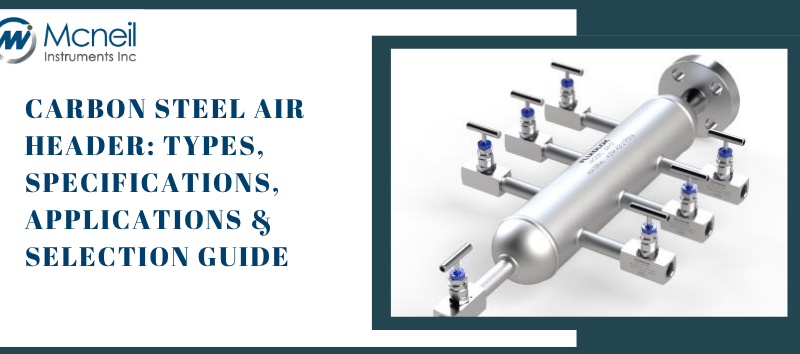
Compressed air is essential for instrumentation, pneumatic control systems, automation equipment, and process operations across modern industrial facilities. A reliable distribution system is therefore critical for maintaining consistent airflow to multiple instruments and pneumatic devices.
A Carbon Steel Air Header provides a centralized solution for distributing compressed air from a single inlet to multiple outlet connections. Mcneil Air Header manufactures, supplies, and exports carbon steel air headers for applications across oil & gas, refineries, petrochemical plants, power generation, fertilizer plants, chemical processing, offshore facilities, and industrial automation.
What Is a Carbon Steel Air Header?
A Carbon Steel Air Header is a compressed-air distribution manifold designed to receive air from one primary inlet and distribute it through multiple outlet connections.
Instead of running separate lines from the compressor or main air source to every instrument, an air header creates a centralized distribution point. This can simplify piping arrangements, improve accessibility, and make maintenance easier.
Carbon steel air headers are also commonly referred to as:
- Carbon Steel Instrument Air Header
- Carbon Steel Air Distribution Header
- Carbon Steel Air Distribution Manifold
- Carbon Steel Air Manifold
- Carbon Steel Pneumatic Air Header
- Carbon Steel Instrumentation Air Header
- Carbon Steel Multi-Port Air Header
Mcneil Air Header offers standard and customized configurations according to industrial requirements.
Why Choose Carbon Steel for Air Headers?
Carbon steel is widely used for industrial air distribution because it combines mechanical strength with cost-effective fabrication.
Key advantages include:
- Excellent mechanical strength
- High pressure-handling capability
- Robust construction
- Reliable compressed-air distribution
- Cost-effective performance
- Easy fabrication and welding
- Long operational life
- Easy maintenance
When an appropriate protective coating is used, carbon steel air headers can provide dependable performance in a wide range of industrial environments.
Carbon Steel Air Header Grades
Mcneil Air Header lists several carbon steel material options for its air header systems.
ASTM A105 Carbon Steel Air Header
ASTM A105 is a forged carbon steel material commonly used for pressure-containing components. It provides good strength and pressure-handling capability for industrial air distribution applications.
ASTM A106 Carbon Steel Air Header
ASTM A106 is used for applications involving high-pressure and high-temperature service. Mcneil Air Header specifically lists ASTM A106 Grade B for its carbon steel instrument air header applications.
Carbon Steel Bar Stock Air Header
Bar stock construction provides a compact and robust configuration for applications requiring high-pressure instrumentation connections.
Carbon Steel Air Header Configurations
Air headers are available in different numbers of outlet connections depending on the number of instruments or pneumatic devices that need compressed air.
Mcneil Air Header offers configurations including:
- 2 Way
- 4 Way
- 6 Way
- 8 Way
- 10 Way
- 12 Way
- 14 Way
- 16 Way
Customized multi-way configurations can also be manufactured according to project requirements.
4 Way Carbon Steel Air Header
A 4-way configuration is suitable for smaller instrumentation and pneumatic systems requiring only a few outlet connections.
6 Way Carbon Steel Air Header
A 6-way header allows compressed air to be distributed to several instruments from one centralized point.
8 Way Carbon Steel Air Header
An 8-way configuration is suitable for medium-sized instrumentation and pneumatic networks.
10 Way Carbon Steel Air Header
A 10-way header can support larger process-control and automation systems.
12 Way Carbon Steel Air Header
A 12-way configuration is useful for industrial plants requiring numerous compressed-air connections.
14 Way and 16 Way Air Headers
These higher-capacity configurations are designed for larger instrumentation networks and industrial installations requiring multiple air outlets.
Carbon Steel Air Header Specifications
Mcneil Air Header’s published product specifications include:
| Parameter | Specification |
| Material | Carbon Steel |
| Grades | ASTM A105, ASTM A106 |
| Size Range | 1/2″ to 4″ |
| Outlet Configurations | 4, 6, 8, 10, 12, 14, 16 Way |
| Pressure Rating | Up to 6000 PSI |
| End Connections | NPT, BSPT, Socket Weld, Flanged |
| Testing | Hydrostatic & Pneumatic Testing |
| Surface Finish | Painted, Pickled, Passivated |
Specific dimensions, pressure ratings, materials, and connection configurations should be confirmed against the individual project specification.
End Connection Options
The connection type is an important part of air header selection.
NPT Connections
NPT threaded connections are commonly used for instrumentation and pneumatic applications.
BSPT Connections
BSPT connections can be specified where the project requires British Standard tapered pipe threads.
Socket Weld Connections
Socket weld connections provide a compact welded connection for appropriate high-pressure applications.
Flanged Connections
Flanged ends can be used where the air header needs to connect to larger piping or equipment using bolted connections.
Applications of Carbon Steel Air Headers
Oil & Gas Industry
Carbon steel air headers are used for distributing compressed air to pneumatic instruments, control valves, and process-control equipment.
Refineries
Refineries use instrument air for pneumatic valves, automation equipment, and process-control systems. Air headers provide a centralized distribution point.
Petrochemical Plants
Air headers can distribute compressed air across multiple process units and instrumentation systems.
Power Plants
They can be used in instrumentation and pneumatic control applications, including systems associated with plant automation and turbine control.
Fertilizer Plants
Fertilizer facilities use pneumatic instrumentation and control systems throughout their processing operations.
Chemical Processing
A centralized air distribution header can supply multiple pneumatic instruments and process-control devices.
Offshore and Marine Facilities
Carbon steel air headers can be used in appropriate offshore instrumentation applications, subject to the required environmental protection and material selection.
Water Treatment Plants
Compressed air distribution is used for automation, pneumatic equipment, and process-control systems.
Carbon Steel Air Header for Instrumentation Systems
An Instrument Air Header is particularly important in process plants because pneumatic instruments depend on a consistent compressed-air supply.
It can distribute air to equipment such as:
- Control valves
- Pneumatic actuators
- Regulators
- Transmitters
- Instrumentation panels
- Pneumatic controllers
- Automation equipment
By centralizing distribution, the header can reduce the complexity of individual supply lines and make isolation and maintenance more manageable.
Pressure Rating of Carbon Steel Air Headers
Mcneil Air Header’s published specifications indicate pressure ratings of up to 6000 PSI for its carbon steel air header range. One listed carbon steel instrument air header configuration specifies 6000 psi / 413 bar pressure and ASTM A106 Grade B material.
However, the maximum allowable working pressure for an individual air header should always be verified against its:
- Material grade
- Wall thickness
- Design
- Connection type
- Temperature
- Valve configuration
- Applicable engineering code
The published maximum should not be treated as a universal rating for every configuration.
Testing of Carbon Steel Air Headers
Pressure-containing air distribution components require appropriate inspection and testing before installation.
Mcneil Air Header lists:
- Hydrostatic testing
- Pneumatic testing
- Material verification
- Positive Material Identification
- Dimensional inspection
- Thread inspection
- Visual inspection
- Surface-finish inspection
- Material traceability verification
Additional inspection requirements can be specified for critical industrial projects.
Surface Finishing and Corrosion Protection
Carbon steel is mechanically strong and economical, but unlike stainless steel it requires appropriate protection when exposed to corrosive environments.
Mcneil Air Header lists surface-finishing options including:
- Painted finish
- Epoxy coating
- Zinc coating
- Pickled finish
- Passivated finish
- Customized protective coatings
The appropriate finish depends on the installation environment and project specification.
Carbon Steel vs Stainless Steel Air Headers
The choice between carbon steel and stainless steel depends on the operating environment.
| Factor | Carbon Steel | Stainless Steel |
| Mechanical Strength | Excellent | Excellent |
| Corrosion Resistance | Requires protection | Higher |
| Cost | Generally economical | Generally higher |
| Fabrication | Easy | Good |
| Harsh/Corrosive Environment | Requires suitable coating | Better suited |
| General Industrial Air | Excellent choice | Also suitable |
| Offshore/Marine | Application dependent | Often preferred |
Mcneil Air Header offers both carbon steel and stainless steel air headers, including SS 304, 304L, 316, and 316L grades.
How to Select the Right Carbon Steel Air Header
Before ordering an air header, consider the following:
1. Number of Outlets
Determine how many instruments or pneumatic devices require air.
2. Inlet and Outlet Size
Confirm the required inlet and outlet dimensions.
3. Operating Pressure
Specify the normal and design pressure.
4. Operating Temperature
Temperature affects material and pressure capability.
5. Connection Type
Choose NPT, BSPT, socket weld, butt weld, or flanged connections according to the installation.
6. Material Grade
Select the appropriate carbon steel grade based on the project specification.
7. Surface Protection
For outdoor, humid, marine, or corrosive environments, specify an appropriate protective coating.
8. Testing and Certification
Define requirements for hydrostatic testing, pneumatic testing, PMI, MTCs, NDT, and third-party inspection where applicable.
Why Choose Mcneil Air Header?
Mcneil Air Header manufactures, supplies, and exports Carbon Steel Air Headers for industrial instrumentation and compressed-air distribution applications.
Its published capabilities include:
- Multiple outlet configurations
- Custom dimensions
- High-pressure designs
- Multiple connection types
- ASTM A105 and A106 materials
- Hydrostatic and pneumatic testing
- Export-quality packaging
- Customized engineering solutions
- Technical support
The company supplies air headers for oil & gas, refineries, petrochemical plants, power generation, fertilizer, chemical processing, offshore, marine, and other industrial applications.
Conclusion
A Carbon Steel Air Header provides a practical and robust method of distributing compressed air from one central source to multiple pneumatic and instrumentation connections.
With options ranging from 2-way to 16-way configurations, pressure ratings up to 6000 PSI, and connections such as NPT, BSPT, socket weld, and flanged ends, carbon steel air headers can be configured for a wide variety of industrial applications.
For demanding applications, the selection should be based on pressure, temperature, number of outlets, material grade, connection type, environmental conditions, surface protection, and testing requirements.
Mcneil Air Header supplies carbon steel air headers designed for instrumentation, pneumatic control, process automation, and centralized compressed-air distribution systems worldwide.
FAQs
What is a Carbon Steel Air Header?
A Carbon Steel Air Header is a centralized manifold that distributes compressed air from one inlet to multiple outlets for pneumatic instruments and process equipment.
What grades are used for carbon steel air headers?
Mcneil Air Header lists ASTM A105 and ASTM A106 carbon steel grades, including A106 Grade B configurations.
What pressure can a Carbon Steel Air Header handle?
Mcneil Air Header publishes ratings of up to 6000 PSI, depending on the configuration and design.
How many outlets are available?
Configurations include 2, 4, 6, 8, 10, 12, 14, and 16 ways, with customized configurations also available.
Where are Carbon Steel Air Headers used?
They are used in oil & gas, refineries, petrochemical plants, power plants, fertilizer facilities, chemical processing, offshore systems, water treatment, and industrial automation.
What connections are available?
Common options include NPT, BSPT, socket weld, and flanged connections.