
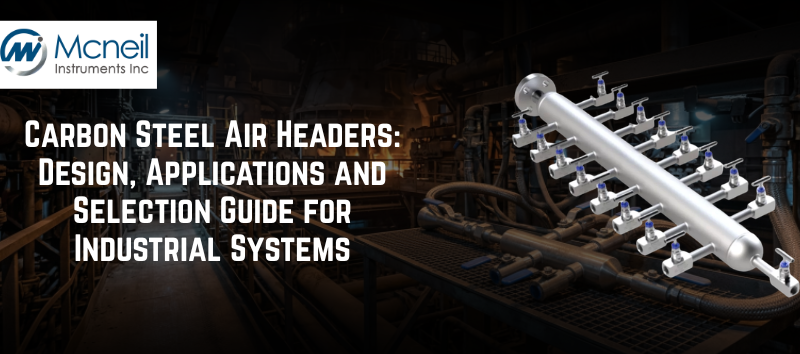
An air header is an important component in industrial compressed-air and gas distribution systems. It receives compressed air from a main source and distributes it through multiple branch connections to different equipment, instruments, or process areas.
Carbon steel is widely used for air header construction where the material provides the required combination of strength, durability, fabrication flexibility, and cost effectiveness.
Mcneil Air Header manufactures and supplies carbon steel air headers for industrial applications, with configurations designed for distributing compressed air and other gases across process facilities. These industrial air headers can be engineered with multiple outlet arrangements, connection types, drain provisions, and mounting configurations to suit specific piping and instrumentation requirements.
What Is a Carbon Steel Air Header?
A carbon steel air header is essentially a distribution manifold used to collect and distribute compressed air through multiple outlet connections.
Instead of connecting every individual user directly to the compressor or main pipeline, the air header creates a centralized distribution point.
A carbon steel air header therefore functions as a centralized compressed-air distribution manifold, helping route air from one primary supply line to several downstream users while providing convenient access for isolation and maintenance.
A typical arrangement includes:
- Main inlet connection
- Header body
- Multiple branch outlets
- Isolation valves
- Drain connection
- Mounting or support arrangement
The number and configuration of outlets can be selected according to the requirements of the installation. Outlet spacing, branch orientation, connection size, and overall dimensions can also be customized according to the plant layout and downstream equipment requirements.
How Does an Air Header Work?
Compressed air enters the main header through the inlet connection.
The larger header body acts as a distribution chamber, allowing compressed air to be supplied to multiple downstream branches.
Each outlet can then be connected to:
- Pneumatic instruments
- Control valves
- Air-operated equipment
- Maintenance connections
- Process equipment
- Utility air lines
Individual outlet valves can be used to isolate specific branches when maintenance or servicing is required.
This centralized arrangement can make compressed-air distribution more organized and easier to manage. It can also provide a practical interface between the main air-supply piping and multiple point-of-use connections throughout an industrial facility.
Why Use Carbon Steel for Air Headers?
Carbon steel is commonly selected for industrial piping and header applications because of its mechanical strength and practical fabrication characteristics.
Depending on the application and design requirements, carbon steel can provide:
- Good mechanical strength
- Structural durability
- Good weldability
- Cost-effective fabrication
- Availability in different sizes
- Suitability for industrial environments
- Compatibility with various connection arrangements
Carbon steel is particularly practical for applications where the compressed-air service does not require the higher corrosion resistance associated with stainless steel or specialized alloys.
The final material selection should consider pressure, temperature, moisture, corrosion environment, and applicable design standards. Material grade, wall thickness, fabrication requirements, and corrosion-protection measures should be established from the applicable project specifications.
Carbon Steel Air Header Construction
The construction of an air header depends on the required operating conditions and installation configuration.
A typical carbon steel air header may consist of a cylindrical header pipe with several branch connections.
Main Header
The main body receives compressed air from the supply line and distributes it across the connected outlets.
The header diameter is selected based on the required flow capacity, number of outlets, operating pressure, and acceptable pressure drop within the distribution system.
Branch Connections
Multiple branches allow compressed air to reach different instruments or equipment.
Branch connections may be supplied in different sizes and orientations to match downstream piping, tubing, valves, or instrument connections.
Valves
Isolation valves can be installed at individual outlets to allow sections of the system to be shut off.
This arrangement allows individual users or sections to be isolated during inspection, maintenance, replacement, or troubleshooting without necessarily interrupting the entire air distribution network.
Drain
A drain connection can help remove accumulated moisture or condensate from the system.
Drain provisions are particularly important where compressed air contains moisture and where temperature changes can result in condensation inside the distribution piping.
End Connection
The header can be supplied with an appropriate inlet and outlet arrangement based on the piping design.
End connections may be configured according to the required piping class, connection standard, installation arrangement, and project specifications.
Applications of Carbon Steel Air Headers
Carbon steel air headers are used in a wide range of industrial facilities. They are commonly incorporated into centralized instrument-air, plant-air, utility-air, and pneumatic distribution networks.
Oil & Gas
Compressed air is used extensively for instrumentation, pneumatic control systems, and plant utilities.
Air headers can distribute compressed air to multiple equipment and instrument connections.
In oil and gas facilities, properly configured air headers can support pneumatic control systems, actuators, instrumentation, and utility-air requirements across process and utility areas.
Petrochemical Plants
Petrochemical facilities use instrument air for control valves, actuators, automation systems, and other equipment.
A centralized header can provide multiple instrument-air take-offs from a common source.
Carbon steel air headers can be specified for suitable services where the operating environment, corrosion conditions, and applicable engineering requirements support carbon steel construction.
Refineries
Refineries require reliable utility and instrument-air distribution throughout process units.
Carbon steel headers can be used for suitable air distribution applications where the material and design meet project requirements.
Multiple outlet configurations can help distribute instrument and utility air to different refinery equipment and process areas from a centralized supply arrangement.
Power Plants
Compressed air is used for:
- Instrumentation
- Pneumatic actuators
- Control systems
- Utility equipment
- Maintenance operations
Air headers can simplify distribution across different plant areas.
They may be integrated into instrument-air and service-air networks serving turbines, boilers, auxiliary systems, control equipment, and maintenance areas, subject to project-specific design requirements.
Chemical Plants
Chemical processing facilities often use compressed air for instrumentation and pneumatic equipment.
The air header material and surface protection should be selected according to the surrounding environmental conditions.
Where corrosive atmospheres, chemical exposure, or high moisture levels are present, additional material evaluation and corrosion-protection measures may be required.
Industrial Manufacturing
Manufacturing facilities can use compressed air for:
- Pneumatic tools
- Automation equipment
- Actuators
- Production machinery
- Cleaning systems
A centralized carbon steel air header can provide multiple point-of-use connections while helping organize compressed-air distribution around production lines and utility areas.
Instrument Air vs Plant Air
An air header may form part of either an instrument-air system or a plant-air system, depending on its application.
Instrument Air
Instrument air is used for sensitive pneumatic control and instrumentation equipment.
It generally requires appropriate air quality, moisture control, and filtration.
Applications include:
- Control valves
- Pneumatic actuators
- Positioners
- Instrumentation
- Automation systems
Because instrument air directly supports control and automation equipment, air cleanliness, pressure stability, moisture management, and appropriate filtration are important considerations when designing the distribution system.
Plant Air
Plant air is generally used for broader industrial utility applications.
Typical uses include:
- Pneumatic tools
- Cleaning
- Maintenance
- General utility equipment
The air quality requirements may differ from those of instrument air.
The air header configuration should therefore be selected according to the intended service rather than treating instrument air and plant air as identical applications.
Carbon Steel Air Header Design Considerations
Several factors should be evaluated before specifying an air header.
1. Operating Pressure
The header must be designed for the required operating and design pressure.
The pressure rating should account for the complete system rather than simply the compressor discharge pressure.
The design should also consider pressure fluctuations, upstream pressure conditions, downstream demand, and the pressure rating of connected valves and fittings.
2. Temperature
Although compressed-air systems generally operate at moderate temperatures, the maximum possible temperature should still be considered during design.
Temperature conditions can affect material selection, gasket and valve suitability, coating requirements, and the overall pressure-temperature design basis.
3. Header Size
The main header diameter should provide sufficient flow capacity while limiting excessive pressure drop.
Proper sizing should account for expected air consumption, simultaneous demand, future expansion, branch connections, and the required pressure at downstream users.
4. Number of Outlets
The required number of branch connections should be established based on current and anticipated downstream requirements.
Providing suitable allowance for future connections can help avoid extensive modifications to the distribution system during later plant expansion.
5. Outlet Size
Each outlet should be sized according to the equipment or instrument connected to it.
Incorrect outlet sizing can restrict airflow or create unnecessary pressure losses, so branch dimensions should be matched to the connected service.
6. Drainage
Moisture can accumulate in compressed-air systems. Proper drain provisions can help prevent water from entering downstream equipment.
Drain location and accessibility should be considered during the header layout so accumulated condensate can be removed efficiently during operation and maintenance.
7. Corrosion Protection
Carbon steel can be susceptible to corrosion, particularly where moisture is present.
Depending on the environment, protection may include:
- Painting
- Coating
- Proper drainage
- Corrosion-control measures
- Appropriate installation practices
The selected corrosion-protection system should be compatible with the operating environment, surface preparation requirements, expected exposure, and project coating specification.
Importance of Drainage in Air Headers
Moisture management is one of the important considerations in compressed-air distribution.
When compressed air cools, water can condense inside the piping system.
If this moisture accumulates within the header, it can potentially lead to:
- Internal corrosion
- Contamination
- Blocked instruments
- Valve problems
- Reduced air quality
- Maintenance issues
For this reason, an air header should be installed and configured with suitable drainage provisions.
Effective condensate management is particularly important for instrument-air systems because moisture can adversely affect pneumatic instruments, control valves, positioners, and other downstream components.
Air Header Outlet Configuration
The number and arrangement of outlets can be customized according to system requirements.
Common configurations may include multiple branch outlets arranged along the header.
This allows one centralized header to supply several downstream points.
For example:
Compressor → Main Air Line → Carbon Steel Air Header → Branch Valves → Instruments / Equipment
Depending on the plant layout, outlet orientation, spacing, valve arrangement, drain location, and mounting configuration can be engineered to simplify installation and maintenance.
This arrangement can reduce the need for multiple individual connections and make the distribution system easier to organize.
Advantages of Carbon Steel Air Headers
A properly designed carbon steel air header can provide several practical advantages.
Centralized Distribution
Multiple users can be supplied from one common header.
Easy Isolation
Individual branch valves can allow equipment or instruments to be isolated.
Simplified Piping
A header can reduce the complexity of multiple independent supply connections.
Mechanical Strength
Carbon steel provides good structural strength for many industrial applications.
Fabrication Flexibility
Carbon steel components can be fabricated in different sizes and configurations according to project requirements.
Cost Considerations
Carbon steel is generally more economical than many high-alloy materials when the service conditions do not require exotic corrosion-resistant alloys.
For suitable non-corrosive or controlled industrial environments, this combination of strength, fabrication flexibility, availability, and cost can make carbon steel an effective material choice for air-header construction.
Carbon Steel Air Headers vs Stainless Steel Air Headers
The choice between carbon steel and stainless steel depends largely on the operating environment.
| Factor | Carbon Steel | Stainless Steel |
| Mechanical Strength | Good | Good |
| Corrosion Resistance | Moderate | High |
| Cost | Generally lower | Generally higher |
| Fabrication | Widely used | Widely used |
| Moisture Exposure | Requires protection | Better resistance |
| Harsh Corrosive Environment | May require coating | Often preferred |
| General Industrial Air | Suitable for many applications | Suitable |
Carbon steel can be a practical choice for standard industrial compressed-air applications, while stainless steel may be more appropriate where corrosion exposure is significant.
The final selection should be based on actual service conditions, including moisture, atmospheric exposure, chemical environment, operating temperature, maintenance requirements, and applicable project specifications rather than material cost alone.
Carbon Steel Air Headers for Instrumentation
In instrumentation systems, compressed air may be required at numerous control points throughout a plant.
An air header can distribute instrument air to:
- Control valves
- Pneumatic actuators
- Pressure-control equipment
- Process instruments
- Automation equipment
Individual branch isolation makes it easier to maintain individual instruments without necessarily shutting down the entire distribution network.
For instrument-air applications, header design should also consider air cleanliness, condensate control, pressure stability, outlet accessibility, and compatibility with connected instrumentation.
Quality Considerations
For industrial air headers, quality control should cover both the material and fabrication.
Depending on project requirements, inspection can include:
- Material verification
- Dimensional inspection
- Weld inspection
- Pressure testing
- Visual inspection
- Leak testing
- Surface inspection
- Documentation and traceability
Material certificates, weld records, inspection reports, dimensional checks, and test documentation can provide important traceability for critical industrial projects.
The exact inspection requirements should be established according to the applicable project specification and engineering standard.
Where required, third-party inspection and additional non-destructive examination can also be incorporated into the quality-control plan.
Choosing a Carbon Steel Air Header
Before ordering a carbon steel air header, provide the supplier with as much technical information as possible.
Important details include:
- Header size
- Inlet size
- Outlet size
- Number of outlets
- Operating pressure
- Design pressure
- Operating temperature
- Connection type
- Drain requirement
- Material specification
- Coating requirements
- Applicable standard
- Installation orientation
It is also useful to specify the required outlet spacing, valve arrangement, support requirements, testing requirements, documentation requirements, and expected service environment where applicable.
This information helps ensure the supplied header matches the actual piping and instrumentation system.
Mcneil Air Header Carbon Steel Air Headers
Mcneil Air Header manufactures and supplies carbon steel air headers for industrial compressed-air and gas distribution systems.
Its product range is intended for applications where multiple outlets are required from a centralized air or gas supply.
Carbon steel construction can provide a practical combination of mechanical strength, fabrication flexibility, and cost effectiveness for suitable industrial environments.
Mcneil Air Header can provide configurations based on project-specific requirements such as header dimensions, inlet and outlet connections, number of branches, drain arrangements, mounting requirements, and material specifications.
The appropriate configuration should be selected according to the project’s pressure, temperature, outlet requirements, material specification, and installation conditions.
Conclusion
Carbon steel air headers provide a practical way to distribute compressed air from a centralized source to multiple instruments, valves, tools, and industrial equipment.
Their use can simplify piping layouts, provide convenient branch connections, and make individual outlets easier to isolate and maintain.
For oil and gas, petrochemical, refinery, power-generation, chemical, and general manufacturing facilities, the right air header should be selected based on pressure, temperature, header size, number of outlets, connection configuration, drainage, corrosion protection, and applicable engineering requirements.
Proper material selection, header sizing, outlet configuration, condensate management, corrosion protection, inspection, and documentation are important for achieving a reliable and maintainable compressed-air distribution system.
Mcneil Air Header supplies carbon steel air header solutions for industrial applications where reliable compressed-air and gas distribution is required.
Frequently Asked Questions
What is a carbon steel air header?
A carbon steel air header is a centralized distribution manifold used to supply compressed air or gas to multiple downstream connections.
It typically consists of a main header body, inlet connection, multiple branch outlets, isolation valves, and suitable drainage and mounting provisions.
What are carbon steel air headers used for?
They are commonly used for instrument air, plant air, pneumatic equipment, control valves, actuators, and industrial utility systems.
They are widely applicable in facilities such as oil and gas plants, refineries, petrochemical facilities, power plants, chemical plants, and industrial manufacturing units.
Why is carbon steel used for air headers?
Carbon steel offers good mechanical strength, fabrication flexibility, availability, and cost effectiveness for many industrial applications.
It can be particularly suitable where corrosion conditions are controlled and the service does not require the enhanced corrosion resistance of stainless steel or specialty alloys.
Can an air header have multiple outlets?
Yes. Air headers are designed with multiple branch connections so that compressed air can be distributed to several instruments or equipment from one centralized source.
The number, size, spacing, and orientation of these outlets can be configured according to the plant’s piping and instrumentation requirements.
Why is drainage important in an air header?
Compressed air can contain moisture that may condense as the system cools. Suitable drainage helps reduce moisture accumulation, corrosion, and downstream contamination.
Effective drainage is especially important for instrument-air systems because accumulated moisture can affect pneumatic instruments, valves, actuators, and other downstream equipment.
How do I select the right carbon steel air header?
Consider operating pressure, design pressure, temperature, header diameter, number and size of outlets, connection type, drainage, corrosion protection, and applicable project standards.
Also consider air demand, pressure-drop requirements, material specification, coating requirements, installation orientation, support arrangement, inspection requirements, and future expansion needs.
Who supplies carbon steel air headers?
Mcneil Air Header manufactures and supplies carbon steel air headers for industrial compressed-air and gas distribution applications.
The appropriate air-header configuration can be selected according to the required dimensions, outlet arrangement, pressure and temperature conditions, material requirements, drainage provisions, and project specifications.