
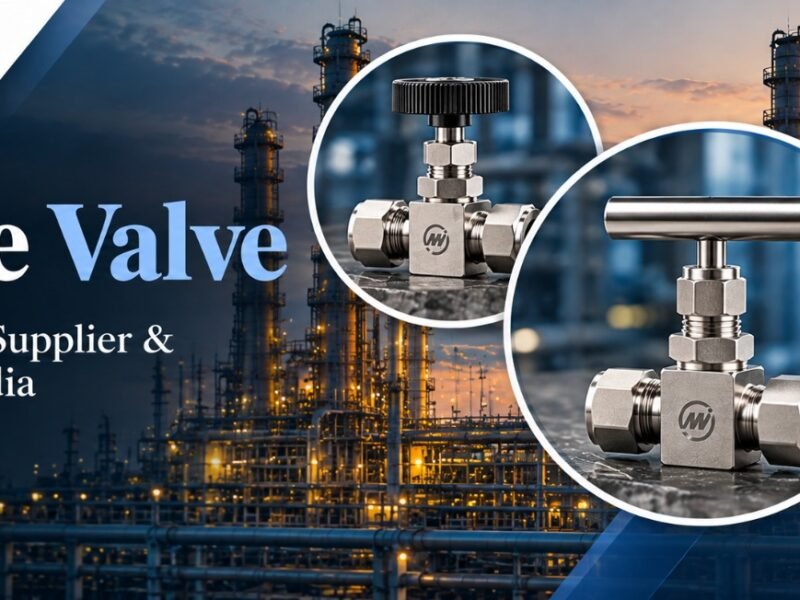
Needle valves are essential components in industrial flow control systems where precise adjustment of liquid or gas flow is required. Their tapered needle-shaped stem enables gradual flow regulation, making them suitable for instrumentation, hydraulic systems, pneumatic equipment, and high-pressure process applications.
Mcneil Air Header manufactures, supplies, and exports industrial needle valves designed for instrumentation and process control applications. Its product range includes high-pressure needle valves, straight and angle-pattern valves, multi-port configurations, and valves manufactured using stainless steel, alloy steel, and specialty alloys.
With connection options and pressure ratings suited to different industrial requirements, Mcneil Air Header supports applications across oil and gas, petrochemical processing, power generation, refineries, chemical plants, offshore installations, and industrial automation. The appropriate valve should be selected according to the operating pressure, temperature, process medium, flow requirements, and connection specification.
What Is a Needle Valve?
A needle valve is a precision-engineered valve used to regulate the flow of liquids or gases through a piping or instrumentation system. It operates using a tapered needle-shaped stem that moves toward or away from a valve seat.
As the stem moves toward the seat, the available flow passage decreases. Moving it away from the seat increases the opening and allows more fluid or gas to pass through. This design enables controlled adjustments where gradual flow regulation is more important than rapid opening and closing.
Key Functions of Needle Valves
Regulate liquid and gas flow with precision.
Control flow in instrumentation systems.
Isolate selected process lines and equipment.
Support pressure measurement and monitoring assemblies.
Control flow in hydraulic and pneumatic circuits.
Provide compact flow control for industrial applications.
Needle valves are primarily designed for precise flow adjustment. They should not automatically be treated as substitutes for valves specifically designed for rapid isolation or for applications requiring continuous throttling beyond the valve’s rated capabilities.
Types of Needle Valves Offered by Mcneil Air Header
Different valve configurations are suitable for different flow paths, installation arrangements, and instrumentation requirements.
- High Pressure Needle Valves
High Pressure Needle Valves are designed for applications that require controlled flow regulation under elevated pressure conditions. They are commonly used in instrumentation and process systems where dependable sealing and pressure containment are important.
Mcneil Air Header lists high-pressure configurations with pressure ratings of up to 10,000 PSI, depending on the selected valve design.
Typical applications:
High-pressure instrumentation
Oil and gas processing
Pressure testing systems
Hydraulic circuits
Industrial process control - Straight Needle Valves
Straight Needle Valves provide a direct flow path through the valve body. They are suitable for conventional piping and instrumentation arrangements where the inlet and outlet connections follow a straight configuration.
Key features:
Direct flow path
Controlled flow adjustment
Compact installation arrangement
Suitability for instrumentation applications - Angle Needle Valves
Angle Needle Valves use an angled flow path, commonly changing direction by 90 degrees. This design can simplify installations where the inlet and outlet piping cannot be arranged in a straight line.
Typical applications:
Compact instrumentation assemblies
Industrial pressure control systems
Piping layouts requiring directional changes
Selected high-pressure process applications - Multi-Port Needle Valves
Multi-Port Needle Valves provide additional ports for specific instrumentation and flow-control arrangements. Depending on the design, they can support venting, draining, gauge connections, or other specified functions.
Typical applications:
Pressure gauge installations
Instrumentation panels
Pressure transmitter assemblies
Process monitoring systems - Two-Way Needle Valves
Two-Way Needle Valves have an inlet and an outlet and are commonly used for controlled flow regulation or isolation in a single flow path. - Three-Way Needle Valves
Three-Way Needle Valves provide an additional port for applications requiring flow diversion, selection, or other specified flow arrangements. The exact operating function depends on the internal design. - Gauge Needle Valves
Gauge Needle Valves are used to connect pressure gauges, manometers, pressure transducers, and transmitters to instrumentation systems. Certain designs incorporate vent or drain facilities for specific measurement and maintenance requirements.
Specialized Needle Valve Series
Mcneil Air Header’s product page identifies several specialized valve series for different industrial applications.
Series Design characteristics Typical connection size
Type N / UN Metal-to-metal seat and non-rotating hardened tip 1/4″ to 1″
Type PV Rising-plug design with soft seat 1/4″ to 1″
Type AV 90-degree angle-pattern design 1/4″ to 1″
Type OB Nearly straight bore designed to reduce flow restriction 1/4″ to 3/4″
Type GV / UGV Multi-port gauge valve with vent and drain facilities 1/4″ to 3/4″
Type UN-V Metal-to-metal sealing for specified high-pressure service 1/4″ to 1″
The published specifications for these series include pressure ratings between 6,000 and 10,000 PSI and a temperature range of -40°C to 230°C, depending on the design. Confirm the allowable operating limits for the exact model before specifying or purchasing a valve.
Materials Used in Needle Valve Manufacturing
Material selection directly affects corrosion resistance, mechanical strength, temperature capability, and compatibility with the process medium.
Mcneil Air Header lists stainless steel, alloy steel, and specialty alloy options for its needle valve range.
Stainless Steel Needle Valves
Stainless steel is commonly selected for instrumentation systems requiring a combination of strength and corrosion resistance.
SS 316 is particularly relevant to many industrial applications because its molybdenum content improves resistance to pitting and crevice corrosion in numerous chloride-containing environments compared with SS 304.
Typical applications include:
Instrumentation systems
Chemical processing
Oil and gas facilities
Hydraulic and pneumatic systems
Marine and offshore installations
Alloy Steel Needle Valves
Alloy steel grades are used in applications where the specified material properties are suitable for demanding pressure and temperature conditions.
Published options include:
ASTM A182 F5
ASTM A182 F11
ASTM A182 F22
ASTM A182 F91
These grades have different chemical compositions and mechanical properties. The correct grade depends on the design conditions and applicable material specification.
Specialty Alloy Needle Valves
Specialty alloys may be considered where corrosion resistance or other material properties exceed the capabilities of conventional stainless steel.
Mcneil Air Header lists the following options:
Alloy family Published grades
Monel Monel 400, Monel K500
Inconel Inconel 600, Inconel 625
Incoloy Incoloy 825
Hastelloy Hastelloy C276
Availability and suitability should be confirmed for the required valve configuration and operating environment.
Technical Specifications of Needle Valves
The following specifications summarize the product information published by Mcneil Air Header. Actual ratings depend on the selected valve design, material, connection, and operating conditions.
Parameter Published specification
Product Industrial Needle Valves
Common connection size 1/4″ to 1″ for several listed series
Broader published size range 1/8″ to 2″
Pressure rating Up to 10,000 PSI for specified configurations
Valve configurations Straight, angle, and multi-port
Flow arrangements Two-way and three-way, depending on design
Thread types NPT, BSPP, BSPT, JIC, metric, and UNF
Connection options Threaded, tube end, butt weld, socket weld, and flanged
Body construction Bar stock and forged designs
Materials Stainless steel, alloy steel, and specialty alloys
Testing Hydrostatic and pneumatic testing, as specified
The product page also lists broader pressure and temperature ranges for certain configurations. These values should not be combined into one universal rating. The applicable pressure-temperature limits must be confirmed for the specific valve model.
Applications of Industrial Needle Valves
Oil and Gas Industry
Needle valves are used in instrumentation lines, pressure monitoring systems, sampling arrangements, and selected process control applications. Material and pressure ratings must be compatible with the operating medium and system requirements.
Petrochemical Industry
Petrochemical facilities use needle valves in instrumentation and process systems where gradual flow adjustment and controlled isolation are required.
Power Generation Plants
Needle valves can be used in selected pressure measurement, instrumentation, and auxiliary process systems within power plants.
Chemical Processing Industry
Chemical processing systems may require valves manufactured from corrosion-resistant materials. Material selection should consider the chemical composition, concentration, temperature, and pressure of the process medium.
Offshore and Marine Industry
Marine and offshore environments can expose equipment to moisture and chloride-containing atmospheres. Suitable stainless steel or specialty alloy grades may be required according to the actual exposure conditions.
Hydraulic Systems
Needle valves regulate fluid flow in suitable hydraulic circuits. The selected valve must meet the system’s pressure rating and fluid compatibility requirements.
Pneumatic Systems
Needle valves provide controlled gas or compressed air flow in pneumatic circuits and instrumentation arrangements.
Refineries
Refineries use instrumentation valves in selected process monitoring and control applications. The valve design and material must comply with the relevant piping and process specifications.
Benefits of Industrial Needle Valves
Precise Flow Regulation
The tapered stem allows gradual adjustment of the available flow passage, helping operators regulate flow in applications requiring fine control.
Controlled Shut-Off
A properly selected and installed needle valve can provide dependable shut-off within its specified service conditions.
High-Pressure Options
Certain valve designs are rated for high-pressure instrumentation applications, subject to the manufacturer’s specified operating limits.
Material Versatility
Stainless steel, alloy steel, and specialty alloy options allow the valve material to be matched to different operating environments.
Compact Design
Needle valves are useful in instrumentation panels and compact piping arrangements where space is limited.
Multiple Connection Options
Threaded, tube-end, socket-weld, butt-weld, and flanged connections allow integration into different systems, depending on the valve design.
How to Select the Right Needle Valve
Choosing a suitable needle valve requires a review of the complete application rather than the nominal valve size alone.
- Determine the operating pressure. Confirm the normal operating pressure, maximum design pressure, and any pressure surges.
- Check the operating temperature. Temperature influences the suitability of the body material, seat, packing, and other components.
- Identify the process medium. Verify material compatibility with the liquid or gas, including any corrosive constituents.
- Choose the valve configuration. Select a straight, angle, two-way, three-way, or multi-port arrangement according to the required flow path.
- Specify the connections. Confirm thread type, tube-end dimensions, welding connections, or flange requirements.
- Evaluate flow requirements. The orifice size and valve design affect flow capacity and pressure drop. Needle valves should be selected according to the required flow-control duty.
- Confirm material requirements. Choose stainless steel, alloy steel, or a specialty alloy based on service conditions and project specifications.
- Define inspection and testing. Confirm the required pressure testing, leakage acceptance criteria, material documentation, and traceability requirements.
Quality Testing and Inspection
Quality testing helps verify that needle valves meet the specified performance and manufacturing requirements.
Depending on the selected design and purchase specification, inspection may include:
Visual inspection: Checks workmanship and external condition.
Dimensional inspection: Verifies valve dimensions and connection details.
Material verification: Confirms the specified material grade.
Pressure testing: Evaluates pressure integrity according to the applicable procedure.
Seat leakage testing: Checks sealing performance against the specified acceptance criteria.
Packing leakage testing: Evaluates leakage around the stem packing where applicable.
Documentation review: Confirms that required inspection and material records are available.
Mcneil Air Header’s product information describes nitrogen testing for seat and packing leakage at 1,000 PSI, with a stated maximum allowable leak rate of 0.1 standard cm³/min, and hydrostatic testing using pure water at 1.5 times working pressure. These procedures should be confirmed for the specific product and order before being treated as applicable acceptance requirements.
Why Choose Mcneil Air Header?
Mcneil Air Header positions itself as a manufacturer, supplier, and exporter of industrial needle valves and other instrumentation products. Its published product range includes high-pressure valves, instrumentation valves, multiple valve configurations, and stainless steel, alloy steel, and specialty alloy materials.
When sourcing a needle valve, customers should confirm:
The required valve series and configuration
Material grade and compatibility
Pressure and temperature requirements
Connection type and size
Flow and orifice requirements
Testing and inspection criteria
Required documentation and delivery schedule
Providing these details helps ensure the selected valve is appropriate for the intended application.
Frequently Asked Questions
What is a needle valve used for?
A needle valve is used to regulate liquid or gas flow gradually in instrumentation, hydraulic, pneumatic, and industrial process systems.
What pressure ratings are available?
Mcneil Air Header lists needle valve configurations rated up to 10,000 PSI. The applicable rating depends on the valve model, material, connections, and operating conditions.
Which materials are available for needle valves?
Published options include SS 316 configurations, alloy steel grades F5, F11, F22 and F91, and specialty alloys such as Monel 400, Monel K500, Inconel 600, Inconel 625, Incoloy 825, and Hastelloy C276.
What is the difference between a straight and an angle needle valve?
A straight needle valve has a direct inlet-to-outlet flow path. An angle needle valve changes the flow direction, commonly by 90 degrees, which can help accommodate different piping layouts.
What connection types are available?
The published product information lists NPT, BSPP, BSPT, JIC, metric, UNF, tube-end, butt-weld, socket-weld, and flanged options, depending on the selected model.
Are needle valves suitable for corrosive fluids?
They can be suitable when manufactured from a material compatible with the process medium. The correct grade must be selected after evaluating the fluid chemistry, concentration, temperature, and other service conditions.
How can I request a quotation?
Provide the required valve type, material, size, connection, operating pressure, temperature, process medium, quantity, testing requirements, and delivery location.
Conclusion
Needle valves are essential components in industrial systems that require precise flow regulation and controlled shut-off. Their tapered-stem design makes them suitable for instrumentation, pressure control, hydraulic, pneumatic, and process applications.
Mcneil Air Header offers industrial needle valve solutions in multiple configurations, connection types, and material options. By confirming the required valve design, operating conditions, material grade, pressure rating, and inspection requirements, buyers can select a product that matches their application’s engineering specifications.
For companies seeking a Needle Valve Manufacturer, Supplier & Exporter in India, Mcneil Air Header provides a published range of industrial and high-pressure needle valve solutions for different instrumentation and process-control requirements.