
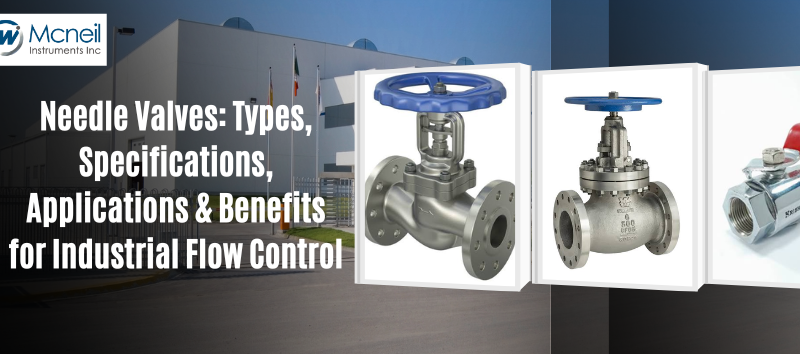
Needle valves are precision flow-control components used where accurate regulation, pressure control, and reliable shut-off are required. Their tapered needle-shaped stem allows operators to make controlled adjustments to the flow of liquids and gases, making them particularly useful in instrumentation, hydraulic, pneumatic, process, and high-pressure systems.
Mcneil Air Header manufactures and supplies industrial needle valves for applications across oil & gas, petrochemical, chemical processing, power generation, refineries, offshore, marine, hydraulic, and pneumatic systems. Its published range includes straight, angle, multi-port, instrumentation, high-pressure, threaded, and socket-weld configurations.
What Is a Needle Valve?
A needle valve is a precision flow-control valve that uses a tapered needle-shaped stem to regulate the passage of fluid or gas through a small orifice.
Unlike valves primarily designed for rapid isolation, needle valves are particularly useful when gradual and precise flow adjustment is required.
They can be used for:
- Precise flow regulation
- Pressure control
- Instrument isolation
- Gas flow control
- Hydraulic systems
- Pneumatic systems
- Sampling systems
- Process instrumentation
- High-pressure applications
The compact construction of a needle valve also makes it suitable for instrumentation panels and systems where installation space is limited.
How Does a Needle Valve Work?
The operating principle of a needle valve is based on the movement of a tapered stem into or away from the valve seat.
When the valve is closed, the tapered needle moves toward the seat and restricts the flow passage. As the handwheel is turned, the needle gradually moves away from the seat, increasing the available flow area.
This provides controlled adjustment rather than the relatively abrupt flow changes associated with many conventional isolation valves.
Basic Operating Sequence
- The valve is connected to the tubing or piping system.
- The handwheel controls the movement of the stem.
- The tapered needle moves toward or away from the seat.
- The flow passage changes progressively.
- The operator can regulate the flow or isolate the line.
This controlled movement makes needle valves useful in instrumentation and process-control applications where precise adjustment is important.
Types of Needle Valves
Mcneil Air Header offers several needle valve configurations designed for different industrial requirements.
Straight Needle Valve
A straight needle valve has an inlet and outlet arranged along the same flow axis.
It is commonly selected for:
- Instrumentation lines
- Process control
- Hydraulic systems
- Pneumatic systems
- General flow regulation
Angle Needle Valve
An angle needle valve changes the direction of flow through the valve, typically by 90 degrees.
It can be useful where piping layout or installation space requires a directional change.
Mcneil Air Header’s Type AV angle needle valve is published with connection sizes from 1/4″ to 1″ and pressure ratings of 6,000–10,000 psi, with the published temperature range extending from −40°C to 230°C.
High-Pressure Needle Valve
High-pressure needle valves are designed for demanding applications where precise flow control is required under elevated pressure.
Mcneil Air Header publishes needle valve designs rated up to 10,000 PSI, depending on configuration.
Typical applications include:
- Oil & gas
- Hydraulic systems
- Pressure instrumentation
- High-pressure process lines
- Offshore systems
Instrumentation Needle Valve
Instrumentation needle valves are used in compact control and measurement systems.
They can be installed with:
- Pressure gauges
- Pressure transmitters
- Instrument tubing
- Sampling lines
- Process instrumentation
Multi-Port Needle Valve
Multi-port designs provide multiple flow paths from a single valve body and can be useful in more complex instrumentation arrangements.
Mcneil Air Header publishes 2-way, 3-way, and multi-port needle valve configurations.
Mcneil Air Header Needle Valve Types
The company’s published range includes several specific designs.
| Type | Connection Size | Pressure Rating | Published Temperature Range |
| Type N / UN | 1/4″–1″ | 6,000–10,000 psi | −40°C to 230°C |
| Type PV | 1/4″–1″ | 6,000–10,000 psi | −40°C to 230°C |
| Type AV | 1/4″–1″ | 6,000–10,000 psi | −40°C to 230°C |
| Type OB | 1/4″–3/4″ | 6,000–10,000 psi | −40°C to 230°C |
| Type GV / UGV | 1/4″–3/4″ | 6,000–10,000 psi | −40°C to 230°C |
| Type UN-V | 1/4″–1″ | 6,000–10,000 psi | −40°C to 230°C |
These ratings are configuration-dependent and should be confirmed against the exact valve design, material, seal arrangement, and service conditions before specification.
Materials Used for Needle Valves
Material selection is important because the valve must withstand the pressure, temperature, and chemical environment of the application.
Mcneil Air Header publishes needle valves in alloy steel and several nickel-based and corrosion-resistant alloys.
Alloy Steel Needle Valves
Available alloy steel materials include:
- ASTM A182 F5
- ASTM A182 F11
- ASTM A182 F22
- ASTM A182 F91
These materials can be selected for demanding temperature and pressure applications where alloy steel construction is appropriate.
Exotic Alloy Needle Valves
Mcneil Air Header also lists:
- Monel 400
- Monel K500
- Inconel 600
- Inconel 625
- Incoloy 825
- Hastelloy C276
These materials are particularly relevant when resistance to corrosion, temperature, or aggressive process environments is required.
Needle Valve Specifications
Mcneil Air Header’s published general technical specifications include:
| Parameter | Published Specification |
| Valve Type | Straight, Angle, Multi-Port |
| General Size Range | 1/4″ to 1″ |
| Other Published Range | 1/8″ to 2″ depending on configuration |
| Pressure Rating | Up to 10,000 PSI in the published range |
| Connections | NPT, BSPT, Socket Weld |
| Other Connection Options | Tube End, Butt Weld, Flanged |
| Materials | Alloy Steel & Exotic Alloys |
| Testing | Hydrostatic & Pneumatic |
| Flow Patterns | Straight, Angle, Cross |
| Configurations | 2-Way, 3-Way and Multi-Port |
The exact pressure, temperature, size, or connection capability depends on the specific valve configuration selected.
End Connection Options
Needle valves can be supplied with different connection arrangements depending on the piping or tubing system.
NPT Connection
NPT connections provide a threaded connection commonly used in industrial instrumentation and process systems.
BSPT Connection
BSPT connections are suitable for systems designed around British Standard Pipe Taper threads.
Socket Weld
Socket-weld needle valves are useful where a permanent welded connection is required.
Tube End
Tube-end configurations allow the valve to be integrated directly into instrumentation tubing systems.
Butt Weld
Butt-weld configurations can be selected for appropriate permanent piping or tubing connections.
Flanged Connection
Flanged needle valve configurations can be used where a bolted connection is preferred for installation or maintenance.
Mcneil Air Header lists these connection options across its published needle valve specifications.
Applications of Needle Valves
Oil & Gas Industry
Needle valves are widely used in oil and gas instrumentation systems for controlled flow and pressure management.
Applications include:
- Pressure instrumentation
- Process control
- Sampling systems
- Hydraulic circuits
- High-pressure lines
- Offshore equipment
Petrochemical Plants
Petrochemical facilities require precise control of process fluids and gases.
Needle valves can be used for:
- Instrumentation
- Process sampling
- Pressure control
- Flow adjustment
- Isolation applications
Chemical Processing
Chemical processing systems may involve corrosive or aggressive media. Selecting an appropriate valve material is therefore essential.
Nickel-based materials such as Inconel, Monel, and Hastelloy can be considered for applications where their specific corrosion-resistance characteristics are required.
Power Generation
Needle valves can be used in power-generation instrumentation and auxiliary systems for controlled flow and pressure management.
Applications can include:
- Instrumentation lines
- Pressure gauges
- Steam-related instrumentation
- Hydraulic systems
- Process control
Hydraulic Systems
Hydraulic systems require controlled fluid movement and pressure management.
Needle valves can provide precise adjustment where gradual flow control is required.
Pneumatic Systems
Needle valves can also be used with compressed-air and gas systems where controlled flow adjustment is needed.
Applications include:
- Pneumatic equipment
- Instrument air
- Gas distribution
- Control systems
- Process automation
Offshore & Marine Applications
Offshore and marine environments can expose equipment to moisture, saltwater, pressure, and corrosive conditions.
Appropriate corrosion-resistant needle valve materials can therefore be selected according to the application requirements.
Needle Valve vs Ball Valve
Needle valves and ball valves perform different functions and should not automatically be treated as interchangeable.
| Feature | Needle Valve | Ball Valve |
| Primary Function | Precise flow regulation | Fast isolation |
| Flow Adjustment | Excellent | Limited for precise throttling |
| Operation | Gradual adjustment | Quarter-turn |
| Typical Use | Instrumentation & control | Isolation & shut-off |
| Compact Designs | Yes | Yes |
| High-Pressure Options | Available | Available |
Mcneil Air Header manufactures both needle and ball valves as part of its industrial valve portfolio.
For applications requiring fine adjustment, a needle valve is generally the more appropriate valve type. For rapid isolation, a ball valve may be more suitable.
Advantages of Industrial Needle Valves
Precise Flow Control
The tapered stem allows gradual adjustment of the flow passage.
High-Pressure Capability
Mcneil Air Header publishes needle valve designs with pressure ratings up to 10,000 PSI, depending on configuration.
Compact Construction
Their compact design makes needle valves suitable for instrumentation panels and restricted installation spaces.
Reliable Shut-Off
Properly designed sealing arrangements can provide dependable isolation and controlled shut-off.
Material Flexibility
The availability of alloy steel and exotic alloy materials allows valves to be selected for different process environments.
Long Service Life
Features such as precision-machined components and robust construction can support long-term industrial operation.
Design Features of Mcneil Air Header Needle Valves
Mcneil Air Header’s published high-pressure needle valve information includes a one-piece SS316 body construction for specified models, along with a ground and thread-rolled spindle and a 17-4PH stem tip for long service life.
Other published features include:
- Metal-to-metal seating on selected designs
- Bubble-tight sealing
- Compact construction
- High-pressure capability
- Precision flow regulation
- Multiple connection options
- Custom configurations
The exact construction varies by valve series and material of construction.
Needle Valve Testing
Reliable testing is particularly important for valves used in high-pressure instrumentation systems.
Mcneil Air Header states that its valves undergo factory testing. Its published testing information includes nitrogen testing for seat and packing leakage and hydrostatic testing using water at 1.5 times the working pressure.
Testing can help verify:
- Pressure integrity
- Seat sealing
- Packing performance
- Leak resistance
- Mechanical integrity
Project-specific testing requirements should always be confirmed before ordering.
How to Select the Right Needle Valve
Choosing a needle valve requires evaluating the complete operating environment.
1. Determine the Pressure
Identify the normal operating pressure and maximum design pressure.
2. Check Temperature
Confirm the required temperature range and select a material and seal arrangement suitable for the application.
3. Identify the Process Medium
Consider whether the valve will handle:
- Water
- Oil
- Gas
- Steam
- Chemicals
- Compressed air
- Hydraulic fluid
4. Select the Valve Material
Choose between stainless steel, alloy steel, Monel, Inconel, Incoloy, Hastelloy, or another specified material according to corrosion and mechanical requirements.
5. Select the Connection
Determine whether the system requires:
- NPT
- BSPT
- Socket weld
- Tube end
- Butt weld
- Flanged connection
6. Select the Configuration
Choose between:
- Straight
- Angle
- 2-way
- 3-way
- Multi-port
- High-pressure
- Instrumentation
7. Confirm Testing Requirements
For critical applications, specify the required hydrostatic, pneumatic, leakage, inspection, and documentation requirements.
Why Choose Mcneil Air Header for Needle Valves?
Mcneil Air Header manufactures and supplies needle valves for industrial flow control, instrumentation, hydraulic, pneumatic, and process applications. Its published portfolio covers multiple valve designs, materials, pressure ratings, and connection options.
Key advantages include:
- Precision-engineered valve designs
- High-pressure needle valve options
- Multiple material choices
- Multiple connection configurations
- Hydrostatic and pneumatic testing
- Custom engineering support
- International supply capability
- Industrial application expertise
- Quality inspection and documentation support
Mcneil Air Header also manufactures other industrial valve types, including ball valves, check valves, manifold valves, double block and bleed valves, monoflange valves, bleed valves, and purge valves.
Frequently Asked Questions
What is a needle valve used for?
A needle valve is primarily used for precise regulation of liquid or gas flow and controlled pressure management in instrumentation and industrial systems.
What pressure can Mcneil Air Header needle valves handle?
Mcneil Air Header publishes needle valve designs rated up to 10,000 PSI, although the exact rating depends on the selected model and configuration.
What materials are available?
Published materials include ASTM A182 F5, F11, F22 and F91 alloy steels, as well as Monel 400, Monel K500, Inconel 600, Inconel 625, Incoloy 825 and Hastelloy C276.
What sizes are available?
The published needle valve range includes 1/4″ to 1″ for several high-pressure designs, while a broader specification section lists 1/8″ to 2″ depending on configuration.
What connection types are available?
Mcneil Air Header lists NPT, BSPT, socket weld, tube end, butt weld, and flanged connection options across its published range.
Are needle valves suitable for high-pressure applications?
Yes. High-pressure needle valve designs are specifically manufactured for demanding pressure-control and instrumentation applications, with Mcneil Air Header publishing ratings up to 10,000 PSI for its range.
What industries use needle valves?
Needle valves are used in oil & gas, petrochemical, chemical processing, power generation, offshore, marine, hydraulic, pneumatic, refinery, and instrumentation applications.
Conclusion
Needle valves provide precise flow regulation and controlled shut-off for instrumentation and industrial process systems. Their tapered-stem design makes them particularly valuable when accurate adjustment of liquid or gas flow is required.
Mcneil Air Header offers a broad range of straight, angle, high-pressure, instrumentation, 2-way, 3-way, and multi-port needle valves, with materials including alloy steel, Monel, Inconel, Incoloy, and Hastelloy. The published range supports pressure ratings up to 10,000 PSI, with multiple connection and testing options.
These valves can be used across oil & gas, petrochemical, chemical processing, power generation, hydraulic, pneumatic, offshore, marine, and instrumentation systems where controlled flow and reliable performance are essential.