
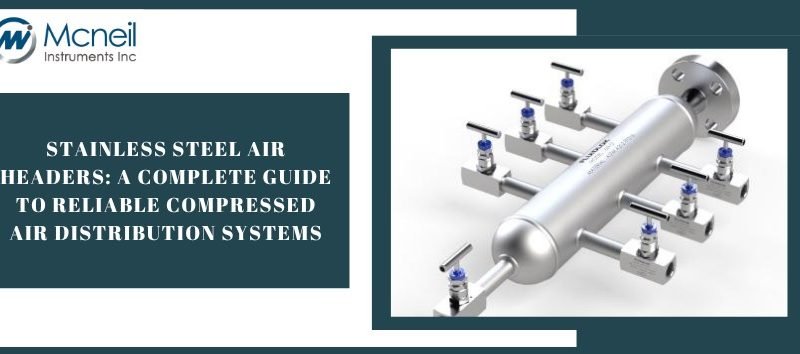
Industrial pneumatic and instrumentation systems depend on a reliable supply of clean and controlled compressed air. As the number of instruments, pneumatic valves and process-control devices increases, managing individual air connections can make piping systems complicated and difficult to maintain.
A Stainless Steel Air Header provides a practical solution by receiving compressed air through a common inlet and distributing it through multiple outlet connections. This centralized arrangement simplifies air distribution, improves accessibility and helps create a more organized instrumentation system.
Stainless steel construction makes these air headers particularly useful where corrosion resistance, durability, cleanliness and long-term performance are important.
Mcneil Air Header manufactures and supplies SS 304, SS 304L, SS 316 and SS 316L Air Headers in different outlet configurations, connection types and customized designs for instrumentation, pneumatic, process-control and industrial applications. The published product range includes 4-way through 16-way configurations, sizes from 1/2″ to 4″, and pressure ratings up to 6000 PSI.
What Is a Stainless Steel Air Header?
A Stainless Steel Air Header is a centralized compressed-air distribution manifold designed to distribute air from one inlet to multiple outlet ports.
Instead of connecting every instrument individually to a main compressed-air line, an air header creates a central distribution point. Individual outlets can then supply air to pneumatic instruments, control valves, actuators and other process-control equipment.
Stainless Steel Air Headers are also commonly known as:
Stainless Steel Instrument Air Header
Stainless Steel Air Distribution Header
Stainless Steel Air Distribution Manifold
Stainless Steel Air Manifold
Stainless Steel Pneumatic Air Header
Stainless Steel Instrumentation Air Header
Stainless Steel Multi-Port Air Header
Stainless Steel Pneumatic Distribution Manifold
A properly designed header can help simplify piping layouts while making individual instrument connections easier to access for inspection and maintenance.
How Does a Stainless Steel Air Header Work?
The operating principle is relatively simple.
Compressed air enters the air header through a central inlet connection. Inside the header, the air is distributed through the main body to several outlet ports.
Each outlet can then be connected to a separate:
Pneumatic instrument
Control valve
Actuator
Instrumentation panel
Process-control device
Pneumatic system
This creates a centralized distribution arrangement instead of requiring multiple independent connections from the primary compressed-air source.
Basic Air Distribution Flow
Compressed Air Source → Main Inlet → Stainless Steel Air Header → Multiple Outlet Ports → Instruments & Pneumatic Equipment
This arrangement can make compressed-air distribution more organized and accessible in industrial instrumentation systems.
Why Use Stainless Steel for an Air Header?
Material selection is an important part of air-header design.
Stainless steel is widely selected when the installation requires corrosion resistance, durability and reliable performance in demanding environments.
Key Advantages of Stainless Steel Air Headers
Excellent corrosion resistance
Good resistance to oxidation
Long operational life
High mechanical durability
Reliable compressed-air distribution
Leak-resistant construction
Low maintenance requirements
Hygienic surface finish
Suitable for aggressive environments
Multiple grade options
Easy integration with instrumentation systems
Mcneil Air Header specifically identifies corrosion resistance, high-pressure capability, hygienic surface finish, long service life and low maintenance among the benefits of its stainless steel air-header range.
Stainless Steel Air Header Grades
Different stainless steel grades can be selected depending on the operating environment and project requirements.
Mcneil Air Header’s stainless steel range includes:
SS 304
SS 304L
SS 316
SS 316L
SS 304 Air Header
SS 304 Air Headers are suitable for general industrial applications where good corrosion resistance, strength and durability are required.
Typical applications include:
General manufacturing
Instrumentation systems
Utility air systems
Process industries
Pneumatic systems
SS 304 can provide a practical balance between performance and material cost for many general-purpose installations.
SS 304L Air Header
SS 304L Air Headers are the low-carbon version of 304 stainless steel.
The lower carbon content makes 304L particularly useful for fabricated and welded assemblies where welding-related corrosion considerations need to be addressed.
Potential applications include:
Process plants
Instrumentation systems
Welded air-header assemblies
Utility systems
Chemical-processing environments
SS 316 Air Header
SS 316 Air Headers provide enhanced corrosion resistance compared with SS 304, particularly in environments involving chemicals, moisture and chlorides.
They can be considered for applications such as:
Offshore installations
Marine systems
Petrochemical facilities
Chemical plants
Pharmaceutical systems
Process-control applications
Mcneil Air Header identifies SS 316 as a suitable option for demanding environments involving chemicals, moisture and corrosive conditions.
SS 316L Air Header
SS 316L Air Headers combine the corrosion resistance characteristics of 316 stainless steel with a low-carbon composition.
They are particularly useful where corrosion resistance, fabrication and clean surface requirements are important.
Potential applications include:
Chemical processing
Pharmaceutical facilities
Food-processing systems
Water-treatment plants
Offshore oil & gas
Marine environments
Mcneil Air Header identifies SS 316L for aggressive operating environments and applications including chemical processing, food processing, water treatment and offshore systems.
Stainless Steel Air Header Configurations
One of the main advantages of an air-header system is the ability to provide multiple outlet connections from one centralized body.
Mcneil Air Header manufactures several configurations, including:
4 Way Air Header
6 Way Air Header
8 Way Air Header
10 Way Air Header
12 Way Air Header
14 Way Air Header
16 Way Air Header
Custom outlet configurations can also be manufactured according to project requirements.
4 Way Stainless Steel Air Header
A 4 Way Air Header provides four outlet connections from a common compressed-air source.
It can be suitable for smaller instrumentation arrangements and compact pneumatic systems.
6 Way Stainless Steel Air Header
A 6 Way Air Header provides six independent outlet connections.
It can be used for medium-sized instrumentation and pneumatic distribution systems. Mcneil’s published 6-way specifications list sizes from 1/2″ to 2″ and pressure ratings up to 6000 PSI.
8 Way Stainless Steel Air Header
An 8 Way Air Header is designed for systems requiring additional instrument connections while maintaining a centralized distribution arrangement.
It can be used in process-control and industrial instrumentation applications.
10 Way Stainless Steel Air Header
A 10 Way Air Header provides ten outlet connections and can support larger instrumentation networks.
It can help reduce the need for multiple individual distribution arrangements.
12 Way Stainless Steel Air Header
A 12 Way Air Header can be used when a larger number of pneumatic or instrumentation devices need to be supplied from a common source.
14 Way Stainless Steel Air Header
A 14 Way Air Header is suitable for larger instrumentation installations requiring multiple outlet points.
16 Way Stainless Steel Air Header
A 16 Way Air Header provides sixteen outlet connections for high-capacity compressed-air distribution.
It can be used across larger industrial instrumentation, process automation and pneumatic systems. Mcneil’s published 16-way range includes stainless steel configurations in SS 304, 304L, 316 and 316L.
Types of Stainless Steel Air Headers
The configuration of an air header is not determined only by the number of outlets. Connection design and construction also influence how the header integrates with the overall system.
Threaded Stainless Steel Air Header
Threaded air headers can provide convenient connections for instrumentation and pneumatic tubing or piping where threaded connections are specified.
Common connection options can include NPT and BSPT.
Socket Weld Stainless Steel Air Header
Socket weld configurations can provide compact and robust connections for suitable piping and instrumentation applications.
Flanged Stainless Steel Air Header
Flanged air headers are useful where the header needs to connect to flanged piping, valves or other equipment.
Bar Stock Stainless Steel Air Header
Bar stock air headers are machined from solid material and can provide a robust construction for demanding instrumentation applications.
Customized Stainless Steel Air Header
Custom air headers can be designed according to requirements such as:
Number of outlets
Outlet spacing
Inlet size
Outlet size
Connection type
Pressure rating
Material grade
Mounting arrangement
Overall dimensions
Mcneil Air Header states that customized outlet configurations, dimensions and connection types are available according to project requirements.
Stainless Steel Air Header Technical Specifications
The published Mcneil Air Header specifications include the following range:
Parameter Specification
Product Stainless Steel Air Header
Material SS 304, SS 304L, SS 316, SS 316L
Size Range 1/2″ to 4″
Outlet Configurations 4, 6, 8, 10, 12, 14 & 16 Way
Pressure Rating Up to 6000 PSI
End Connections NPT, BSPT, Socket Weld, Flanged
Surface Finish Pickled, Passivated, Polished
Testing Hydrostatic & Pneumatic Testing
Exact specifications should be confirmed according to the particular project, service conditions and required configuration.
Stainless Steel Air Header Applications
Stainless Steel Air Headers are used across a broad range of industrial sectors where centralized compressed-air distribution is required.
Oil & Gas Industry
Oil & gas facilities use compressed air for instrumentation, pneumatic valves, actuators and process-control systems.
Stainless steel construction can be advantageous in environments where corrosion resistance and long service life are important.
Typical applications include:
Refineries
Process plants
Offshore installations
Instrumentation systems
Pneumatic valve systems
Petrochemical Industry
Petrochemical facilities contain numerous instruments and pneumatic control devices.
A centralized stainless steel air header can provide organized compressed-air distribution across instrumentation networks.
Applications include:
Process automation
Instrument air systems
Pneumatic controls
Process equipment
Chemical Processing
Chemical plants can expose equipment to corrosive environments.
SS 316 and SS 316L air headers can be considered when improved resistance to chemicals and moisture is required.
Pharmaceutical Industry
Pharmaceutical facilities can require clean and reliable compressed-air distribution systems.
Stainless steel construction and hygienic surface finishes make stainless steel air headers suitable for selected pharmaceutical applications. Mcneil specifically lists pharmaceutical applications for its stainless steel air-header products.
Food Processing
Food-processing facilities can require corrosion-resistant and easy-to-maintain components.
Stainless steel air headers can support pneumatic equipment and instrumentation while providing a suitable material surface for applications where cleanliness is important.
Power Generation
Power plants use instrumentation and pneumatic systems for process control and equipment operation.
Stainless steel air headers can be incorporated into:
Instrument air networks
Pneumatic control systems
Process automation
Equipment control systems
Water Treatment
Water-treatment facilities use pneumatic instruments, automated valves and process-control equipment.
Stainless steel air headers can help provide centralized air distribution while resisting moisture-related corrosion.
Marine and Offshore Applications
Marine and offshore installations can expose components to moisture, salt and chloride-rich environments.
SS 316 and SS 316L can be considered for applications where enhanced corrosion resistance is required.
Stainless Steel Instrument Air Header vs Air Distribution Manifold
The terms Stainless Steel Instrument Air Header, Stainless Steel Air Distribution Manifold and Stainless Steel Air Manifold are often used to describe closely related equipment.
Their fundamental purpose is centralized distribution of compressed air.
However, the exact design can vary depending on:
Number of outlets
Pressure requirements
Instrument type
Connection style
Installation arrangement
Material
Project specifications
For instrumentation systems, the header should be designed around the actual number and type of connected devices.
How to Select the Right Stainless Steel Air Header
Choosing an air header involves more than selecting SS 304 or SS 316.
Several factors should be evaluated.
- Determine the Number of Outlets
Count the number of instruments, valves and pneumatic devices that require air.
Allowing for future expansion can also be useful when designing a new installation. - Determine Operating Pressure
Confirm the normal and maximum operating pressure of the compressed-air system.
Mcneil Air Header publishes air-header configurations with pressure ratings up to 6000 PSI. - Select the Stainless Steel Grade
SS 304 can be suitable for many general industrial environments.
SS 316 or 316L may be preferable where chemicals, moisture, chlorides or aggressive environments are involved. - Select the Connection Type
Consider whether the installation requires:
NPT
BSPT
Socket weld
Flanged connections
The connection type should match the existing piping and instrumentation arrangement. - Consider Surface Finish
Depending on the application, the header may require:
Pickled finish
Passivated finish
Polished finish
Surface-finish requirements are particularly important in applications where cleanliness or corrosion resistance is a priority. - Verify Dimensions
Check:
Header diameter
Inlet size
Outlet size
Outlet spacing
Overall length
Mounting arrangement - Review Testing Requirements
Industrial projects may require pressure and leak testing before installation.
Mcneil Air Header identifies hydrostatic testing, pneumatic testing, leak detection, dimensional inspection, material verification, thread inspection, surface-finish inspection and visual examination within its quality-control procedures.
Stainless Steel Air Header Quality and Testing
Reliable compressed-air distribution depends on the mechanical integrity of the header and its connections.
Mcneil Air Header’s published quality procedures include:
Hydrostatic Testing
Used to verify pressure-holding capability and structural integrity.
Pneumatic Testing
Used to evaluate performance under compressed-air or gas conditions.
Leak Detection
Helps identify potential leakage points in the header and connections.
Dimensional Inspection
Checks dimensions against specified requirements.
Material Verification
Confirms the material used in manufacturing.
Thread Inspection
Ensures threaded connections conform to specified requirements.
Surface-Finish Inspection
Verifies the specified finish of the stainless steel component.
Visual Examination
Provides an additional check of manufacturing quality and surface condition.
Common Features of Stainless Steel Air Headers
A well-designed stainless steel air header can provide several operational benefits.
Corrosion-Resistant Construction
Stainless steel provides resistance to many corrosive environments, making it suitable for demanding industrial installations.
Centralized Air Distribution
One inlet can supply multiple instruments through dedicated outlet connections.
Compact Installation
A multi-port header can reduce complicated individual piping arrangements.
High-Pressure Capability
Appropriately designed headers can be used for demanding compressed-air applications.
Leak-Resistant Construction
Precision manufacturing and appropriate testing help support reliable air distribution.
Easy Maintenance
Centralized outlet arrangements make individual connections easier to access.
Long Service Life
Proper material selection and manufacturing can provide durable performance over extended service.
Mcneil Air Header Stainless Steel Air Header
Mcneil Air Header manufactures Stainless Steel Air Headers, Stainless Steel Instrument Air Headers, Air Distribution Headers, Air Distribution Manifolds and Stainless Steel Air Manifolds for industrial applications.
Its published stainless steel range covers SS 304, SS 304L, SS 316 and SS 316L, with multiple outlet configurations and connection options.
The company also provides customized air-header configurations based on requirements such as outlet arrangement, dimensions, connection type and pressure rating.
For applications requiring centralized compressed-air distribution, the appropriate air header can be selected based on the operating environment, number of outlets, material requirements and system pressure.
Conclusion
A Stainless Steel Air Header provides a centralized and organized method of distributing compressed air to multiple instruments, pneumatic devices and process-control systems.
The choice of stainless steel grade, number of outlets, pressure rating, connection type, surface finish and overall dimensions should be based on the requirements of the application.
For general industrial environments, SS 304 and SS 304L Air Headers can provide a practical combination of corrosion resistance and durability. For more aggressive environments involving chemicals, moisture, chlorides or marine exposure, SS 316 and SS 316L Air Headers can offer enhanced corrosion resistance.
Mcneil Air Header provides stainless steel air headers in multiple configurations, including 4-way, 6-way, 8-way, 10-way, 12-way, 14-way and 16-way designs, as well as customized solutions for industrial instrumentation and pneumatic systems.
Frequently Asked Questions About Stainless Steel Air Headers
What is a stainless steel air header?
A stainless steel air header is a centralized compressed-air distribution manifold that receives air through an inlet and distributes it to multiple outlet connections serving instruments and pneumatic equipment.
What stainless steel grades are available?
Mcneil Air Header’s published range includes SS 304, SS 304L, SS 316 and SS 316L.
What is the difference between SS 304 and SS 316 air headers?
SS 316 generally provides enhanced resistance to chemicals, chlorides and moisture compared with SS 304. The appropriate grade should be selected according to the actual operating environment.
What is an instrument air header?
An instrument air header is a centralized distribution system designed to supply compressed air to instrumentation and pneumatic control equipment.
How many outlets can a stainless steel air header have?
Mcneil Air Header lists 4-way, 6-way, 8-way, 10-way, 12-way, 14-way and 16-way configurations, with customized configurations also available.
What connections are available?
Published connection options include NPT, BSPT, socket weld and flanged connections.
What pressure can a stainless steel air header handle?
Mcneil Air Header’s published specifications state pressure ratings of up to 6000 PSI, depending on the configuration and design.
Where are stainless steel air headers used?
They are used in oil & gas, petrochemical, chemical processing, pharmaceutical, food processing, power generation, water treatment, marine, offshore and other industrial applications.
Can stainless steel air headers be customized?
Yes. Custom outlet configurations, connection types, dimensions and other design requirements can be accommodated according to project specifications.
Are stainless steel air headers tested?
Mcneil Air Header lists hydrostatic, pneumatic, leak-detection, dimensional, material, thread, surface-finish and visual inspections as part of its quality procedures.