
Introduction: Why Stainless Steel Air Headers Matter
Here’s the thing—industrial systems don’t fail because of complex machinery, they fail when flow, pressure, or control becomes inconsistent.
That’s where stainless steel air headers step in. They act as a central distribution unit for compressed air, ensuring multiple instruments receive a steady, clean, and controlled air supply.
In industries where precision, hygiene, and corrosion resistance matter, stainless steel air headers aren’t just useful—they’re essential.
What Is a Stainless Steel Air Header?
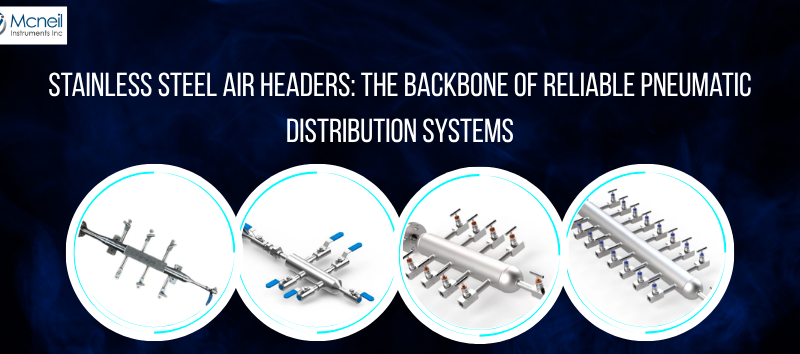
A stainless steel air header is a distribution manifold that delivers compressed air from a single source to multiple outlets or instruments.
Instead of using multiple pipelines, a single air header simplifies the system by acting as a central air distribution hub.
Core Function
• Distributes compressed air to multiple instruments
• Maintains uniform pressure across outlets
• Reduces piping complexity and installation cost
• Ensures efficient pneumatic control systems
Why Stainless Steel Is Used
Material choice is everything in industrial systems. Stainless steel stands out because of its corrosion resistance and durability.
Key Benefits of Stainless Steel
• Resistant to rust and corrosion due to chromium content
• Suitable for harsh and humid environments
• Maintains strength under temperature and pressure variations
• Provides clean and contamination-free air flow
This makes stainless steel air headers ideal for sensitive and corrosive environments.
How a Stainless Steel Air Header Works
The working principle is simple but powerful.
Step-by-Step Process
- Compressed air enters through the main inlet
- Air is distributed across the header body
- Multiple outlet valves supply air to different instruments
- Each outlet maintains consistent pressure and flow
This ensures all connected devices operate efficiently and reliably.
Key Features of Stainless Steel Air Headers
Centralized Air Distribution
Acts as a single source for multiple connections
Multiple Outlet Ports
Supports several instruments simultaneously
Pressure Stability
Maintains equal pressure across all outlets
Compact Design
Reduces space and piping complexity
Corrosion Resistance
Ensures long service life even in harsh conditions
Types of Stainless Steel Air Headers
Air headers can be classified based on design and application.
Single Line Air Header
• One main distribution line
• Suitable for standard applications
Dual Line Air Header
• Separate lines for high and low pressure
• Ensures balanced distribution across systems
Vertical Air Header
• Installed vertically
• Ideal for space-saving setups
Horizontal Air Header
• Installed horizontally
• Common in large industrial layouts
Custom Multi-Port Air Header
• Designed with multiple outlets
• Used in complex instrumentation systems
Applications of Stainless Steel Air Headers
Stainless steel air headers are widely used across industries where precision and reliability are critical.
Oil & Gas Industry
Used to operate control valves and pneumatic systems
Chemical & Petrochemical Plants
Handles corrosive environments safely
Power Plants
Used for instrumentation and control systems
Pharmaceutical Industry
Ensures clean and contamination-free air supply
Food & Beverage Industry
Maintains hygiene standards and safe operations
Manufacturing & Automation
Supports pneumatic tools, actuators, and machinery
Advantages of Stainless Steel Air Headers
Corrosion Resistance
Performs well in harsh and chemical environments
Improved Efficiency
Provides consistent air distribution across systems
Reduced Maintenance
Long service life with minimal breakdown
Space Optimization
Replaces multiple pipelines with one system
Reliable Performance
Ensures stable operation of instruments and equipment
Basic Technical Overview (Simplified)
• Material: Stainless Steel (SS 304 / SS 316)
• Connections: Threaded / Flanged / Welded
• Outlet Ports: Multiple (customizable)
• Pressure Range: Medium to High
• Mounting: Vertical / Horizontal
Air headers are often customized based on system requirements and application needs.
Design Considerations
Before selecting a stainless steel air header, consider:
• Number of outlet connections
• Operating pressure and flow rate
• Type of industry and environment
• Installation space and layout
• Maintenance accessibility
Choosing the right design improves efficiency and system reliability.
Quality Testing and Inspection
To ensure performance and safety, air headers undergo:
• Pressure testing
• Leak testing
• Material verification
• Dimensional inspection
• Functional testing
These checks ensure consistent and safe operation in industrial systems.
Conclusion
A stainless steel air header is more than just a distribution pipe—it’s the control center of pneumatic systems.
With its ability to provide uniform air distribution, corrosion resistance, and long-term reliability, it plays a critical role in modern industrial operations.
If your system depends on precision, efficiency, and durability, a stainless steel air header isn’t optional—it’s essential.