
Introduction: Industrial Automation Depends on Reliable Air Distribution
Let’s get straight to it — modern industries cannot function efficiently without stable pneumatic and instrumentation systems.
Across sectors like:
• Oil & gas
• Petrochemical processing
• Power generation
• Chemical industries
• Offshore engineering
• Manufacturing plants
compressed air systems control critical industrial operations every second.
From operating pneumatic valves to maintaining instrumentation accuracy, industrial facilities rely heavily on uninterrupted and balanced air distribution systems.
That’s exactly where Air Headers become essential.
An air header may appear like a simple manifold system, but in reality, it acts as the central control hub for compressed air distribution across industrial operations.
Without properly engineered air headers, industries face:
• Pressure imbalance
• Air leakage
• Instrument malfunction
• Operational downtime
• Maintenance complications
That’s why Air Headers have become one of the most important components in modern industrial infrastructure.
What Is an Air Header?
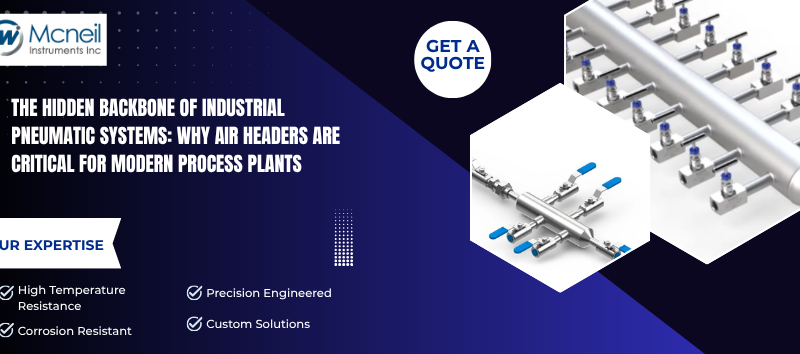
An Air Header is a centralized compressed air distribution manifold designed to distribute air from one inlet source to multiple outlet connections.
Instead of running separate pipelines for every instrument or pneumatic device, industries use air headers to simplify and centralize compressed air distribution.
Air headers are commonly equipped with:
• Ball valves
• Needle valves
• Drain valves
• Multiple outlet ports
• Mounting arrangements
These systems ensure stable and controlled airflow across instrumentation and pneumatic systems.
Why Air Headers Are Important in Industrial Systems
Modern process plants operate hundreds of pneumatic and instrumentation devices simultaneously.
Managing these systems individually would create:
• Complex piping layouts
• Higher installation costs
• Increased leakage risks
• Difficult maintenance operations
Air headers solve these problems by creating a centralized and organized compressed air distribution system.
This improves:
• Operational efficiency
• Airflow control
• Maintenance accessibility
• Process reliability
• Industrial safety
Key Advantages of Air Headers
Centralized Air Distribution
Air headers simplify compressed air management by distributing air from one source to multiple systems efficiently.
This reduces unnecessary pipeline complexity within industrial plants.
Leak-Proof Performance
Precision-engineered air headers help maintain stable pressure distribution while minimizing air leakage risks.
Reduced Installation Costs
Instead of multiple individual pipelines, industries can use a single air header manifold to distribute compressed air across several systems.
This significantly reduces:
• Piping costs
• Installation time
• Space requirements
Easier Maintenance
Air headers allow easier isolation and maintenance of instrumentation systems without shutting down the entire operation.
Long Operational Reliability
High-quality air headers provide:
• Stable pressure control
• Reduced downtime
• Improved operational efficiency
• Long service life
This improves overall industrial productivity.
Technical Specifications Table
| Parameter | Specification |
| Product Type | Air Header |
| Material Options | Stainless Steel / Carbon Steel / Alloy Steel |
| Outlet Configuration | 4-Way to 20-Way |
| Connection Type | Threaded / Flanged / Socket Weld |
| Valve Type | Ball Valve / Needle Valve |
| Pressure Rating | Up to 6000 PSI |
| Applications | Pneumatic & Instrumentation Systems |
Main Components of an Air Header
Header Body
The header body acts as the main compressed air distribution chamber.
It is designed to maintain stable pressure and distribute airflow evenly across multiple outlets.
Inlet Connection
The inlet connection receives compressed air from the primary air supply source.
Outlet Valves
Each outlet port contains a valve system used to regulate airflow toward individual instruments or pneumatic systems.
Drain Valve
Drain valves help remove accumulated moisture and condensate from the air header system.
This prevents:
• Corrosion
• Moisture damage
• Instrument malfunction
Mounting Arrangement
Air headers include mounting systems for secure installation within industrial environments.
Types of Air Headers
Ball Valve Air Header
Ball valve air headers provide fast on/off airflow control.
Advantages
• Quick operation
• Strong shut-off capability
• Reliable industrial performance
Applications
• Utility systems
• General pneumatic operations
• Industrial air distribution systems
Needle Valve Air Header
Needle valve air headers provide precise airflow regulation for sensitive instrumentation systems.
Key Benefits
• Accurate flow control
• Better pressure regulation
• Smooth airflow adjustment
Applications
• Instrumentation systems
• Process control systems
• Pneumatic calibration operations
Stainless Steel Air Headers
Stainless steel air headers provide excellent corrosion resistance for aggressive industrial environments.
Features
• Strong corrosion resistance
• Hygienic surface finish
• Excellent durability
• Long operational life
Used In
• Offshore systems
• Chemical plants
• Marine environments
• Pharmaceutical industries
Carbon Steel Air Headers
Carbon steel air headers provide strong mechanical performance and economical industrial operation.
Advantages
• High structural strength
• Excellent pressure capability
• Cost-effective solution
Applications
• Utility systems
• Manufacturing plants
• General industrial operations
Air Header Configuration Comparison Table
| Type | Main Advantage | Best Application |
| Ball Valve Air Header | Fast operation | Utility systems |
| Needle Valve Air Header | Precise control | Instrumentation systems |
| Stainless Steel Air Header | Corrosion resistance | Chemical & offshore |
| Carbon Steel Air Header | Economical strength | General industries |
Air Header vs Conventional Air Distribution Systems
| Feature | Air Header System | Conventional Piping |
| Installation Complexity | Lower | Higher |
| Air Distribution Efficiency | Excellent | Moderate |
| Maintenance Access | Easier | Difficult |
| Leakage Risk | Lower | Higher |
| Space Requirement | Compact | Larger |
That’s why industries increasingly prefer centralized air header systems.
Industrial Applications of Air Headers
Oil & Gas Industry
Used in:
• Instrument air systems
• Offshore platforms
• Pipeline pressure systems
• Gas processing units
Petrochemical Plants
Provide centralized compressed air distribution across instrumentation and control systems.
Power Generation Plants
Used in pneumatic control systems and steam process instrumentation.
Chemical Processing Industry
Maintain reliable compressed air management for process automation systems.
Marine & Offshore Industry
Require corrosion-resistant air headers for offshore pneumatic operations.
Manufacturing Industry
Support pneumatic automation systems and industrial machinery operations.
Manufacturing Process of Air Headers
Production Steps
• Raw material selection
• Pipe cutting and fabrication
• Welding and machining
• Valve integration
• Surface finishing
• Pressure testing
• Final inspection
This ensures dimensional accuracy, leak-proof operation, and long-term industrial durability.
Quality Testing & Inspection
Every Air Header undergoes extensive testing including:
• Hydrostatic testing
• Pneumatic testing
• Leak testing
• Pressure testing
• Dimensional verification
• Material inspection
These tests ensure compliance with international industrial standards.
Why Air Headers Are Critical for Future Industrial Automation
As industries increasingly depend on automation and pneumatic control systems, the importance of centralized compressed air management continues growing rapidly.
Air headers provide:
• Stable pressure distribution
• Better instrumentation control
• Reduced leakage risks
• Simplified maintenance
• Improved operational safety
That’s exactly why air headers remain one of the most important components in modern industrial infrastructure.
Conclusion
Air Headers play a critical role in maintaining safe, stable, and efficient compressed air distribution across industrial operations.
From offshore oil platforms and petrochemical facilities to power generation plants and manufacturing industries, these systems support reliable instrumentation and pneumatic control.
Their ability to simplify compressed air management while improving operational efficiency makes air headers one of the most essential components in modern industrial automation systems.