
Introduction
Industrial infrastructure in the Gulf supports some of the world’s most important oil & gas, refinery, petrochemical, power generation, and process industries. These facilities depend on complex steam, vapor, pressure, and instrumentation systems that must operate reliably under demanding conditions.
When critical infrastructure is damaged or disrupted, the obvious priority is restoring major equipment and production capacity. But process reliability also depends on hundreds of smaller components that protect instruments and maintain accurate measurements.
One such component is the Condensate Pot.
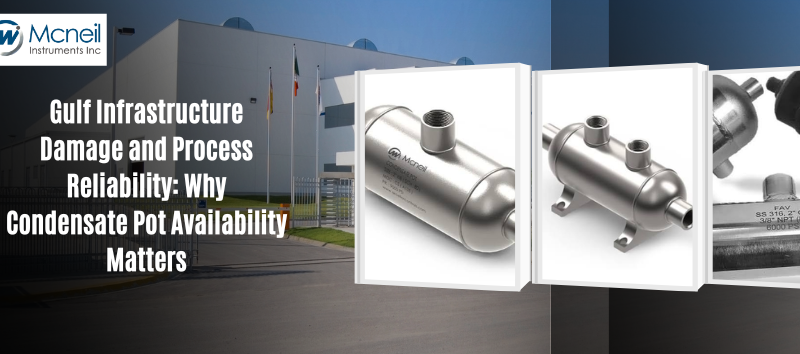
A condensate pot may be relatively small compared with a boiler, refinery unit, or steam pipeline, but its role in instrumentation systems is significant. It collects and holds condensate between the primary steam line and pressure measurement equipment, helping protect sensitive instruments from high-temperature steam and supporting stable differential-pressure measurement.
With Gulf energy infrastructure facing continuing operational and logistics uncertainty, maintaining access to critical instrumentation components such as condensate pots can become an important part of maintenance and recovery planning.
Why Process Reliability Matters After Infrastructure Damage
Infrastructure damage does not necessarily end when the physical repair is completed.
After equipment or piping has been repaired, facilities still need to:
- Re-establish process conditions
- Verify pressure systems
- Inspect instrumentation
- Test control systems
- Confirm steam distribution
- Validate measurement accuracy
- Restart equipment safely
This means process instrumentation becomes particularly important during recovery.
A pressure measurement system that is not functioning correctly can affect the ability of operators and engineers to understand what is happening inside a process system.
In steam applications, condensate management is an important part of maintaining reliable pressure measurement.
What Is a Condensate Pot?
A Condensate Pot, also known as a seal pot in certain applications, is an instrumentation component installed between a steam or vapor process line and pressure-measurement equipment.
Its primary function is to collect condensate and establish a stable liquid column between the process line and the instrument.
According to Mcneil Air Header, condensate pots can protect:
- Differential pressure transmitters
- Pressure gauges
- Flow meters
- Instrumentation systems
They are particularly relevant to steam and vapor applications where high-temperature process media could otherwise reach sensitive instruments directly.
Why Condensate Forms in Steam Systems
Steam systems naturally experience temperature changes.
As steam travels through a pipeline, heat can be transferred to the surrounding environment. Some of the steam can therefore condense into liquid water.
This condensate can become a concern when pressure measurement equipment is connected directly to the process system.
Without appropriate condensate management, systems can experience:
- Measurement instability
- Pressure imbalance
- Instrument thermal exposure
- Unreliable flow readings
- Increased maintenance requirements
A condensate pot provides a controlled location for condensate to collect before it reaches sensitive instrumentation.
How a Condensate Pot Supports Process Reliability
The value of a condensate pot becomes clearer when looking at the complete measurement system.
Step 1: Steam Travels Through the Process Line
High-temperature steam moves through the primary process pipeline.
Step 2: Condensation Occurs
As the steam experiences temperature changes, condensate can form.
Step 3: Condensate Enters the Pot
The condensate collects within the condensate pot.
Step 4: A Stable Liquid Column Is Maintained
The collected condensate provides a consistent barrier between the steam and the connected instrumentation.
Step 5: Pressure Is Transmitted to the Instrument
The pressure measurement system receives a more stable process signal while the instrument is protected from direct high-temperature steam exposure.
This is one reason condensate pots are important in steam-based pressure and differential-pressure measurement systems.
Why Availability Matters During Gulf Infrastructure Recovery
Under normal operating conditions, a condensate pot can be treated as a standard instrumentation component.
During infrastructure recovery, however, procurement priorities can change.
A damaged steam or process system may require replacement of multiple connected components.
For example:
Infrastructure Damage → Inspection → Engineering Assessment → Component Identification → Procurement → Installation → Testing → Restart
If the required condensate pot is unavailable, the instrumentation portion of the repair can become another dependency in the restart process.
The component itself may not be the largest or most expensive part of the system, but its availability can still matter when it is required for completing an instrumentation connection.
The Hidden Procurement Risk of Small Components
Large industrial projects often receive significant attention during procurement planning.
Pipes, valves, pumps, compressors, turbines, boilers, and pressure vessels are typically identified as critical equipment.
Smaller components can receive less attention.
Yet a project may still require:
- Condensate pots
- Needle valves
- Ball valves
- Instrument manifolds
- Tube fittings
- Compression fittings
- Impulse-line components
- Pressure gauges
- Transmitter connections
If one of these components is unavailable, installation or commissioning work may have to wait.
This is why component availability should be considered alongside equipment availability.
Condensate Pots and Steam Measurement
One of the important applications of condensate pots is supporting differential-pressure measurement in steam and vapor systems.
Differential-pressure measurement is commonly used for monitoring and calculating process variables such as flow.
A stable impulse-line condition is therefore important to measurement reliability.
Mcneil Air Header describes condensate pots as components used to improve the accuracy of differential-pressure flow measurement in steam and vapor applications.
This makes the condensate pot more than simply a collection chamber.
It forms part of the measurement infrastructure.
Condensate Pot Applications
Condensate pots are used across several industrial environments.
Power Generation
Steam systems are fundamental to many power-generation facilities.
Condensate pots can be used in:
- Boiler instrumentation
- Steam pipelines
- Differential-pressure systems
- Turbine-related instrumentation
Oil & Gas
Oil & gas facilities frequently use steam and process instrumentation systems.
Condensate pots can help protect pressure measurement equipment connected to high-temperature steam service.
Refineries
Refineries contain extensive steam and process utility networks.
Reliable instrumentation is essential for monitoring operating conditions throughout these systems.
Petrochemical Plants
Petrochemical facilities use high-temperature process systems where stable pressure measurement can be important for process control.
Chemical Processing
Chemical plants may use steam and vapor systems alongside process instrumentation.
The appropriate condensate pot material should be selected according to the process environment.
Marine and Offshore Systems
Marine and offshore facilities can have demanding environmental and operating conditions, making durable instrumentation components particularly important.
Materials Available for Condensate Pots
Material selection depends on the operating environment.
Mcneil Air Header’s published condensate pot information identifies several material options:
- Stainless Steel 304
- Stainless Steel 316
- Carbon Steel
- Alloy Steel
The appropriate material depends on factors such as process temperature, pressure, corrosion environment, and project specifications.
Stainless Steel Condensate Pots
Stainless steel can be selected when corrosion resistance and durability are important.
Common options include:
SS 304
Suitable for a broad range of general industrial applications.
SS 316
Offers enhanced corrosion resistance and can be considered for more demanding environments.
Carbon Steel Condensate Pots
Carbon steel provides a combination of strength and cost efficiency.
It can be suitable for general industrial steam applications where the process environment does not require a higher corrosion-resistant alloy.
Alloy Steel Condensate Pots
Alloy steel options can be considered for applications involving elevated temperatures and demanding pressure conditions.
They may be particularly relevant to:
- Thermal power plants
- Refineries
- Petrochemical systems
Condensate Pot Configurations
Different process and instrumentation arrangements may require different port configurations.
Mcneil Air Header identifies condensate pots in configurations including:
- Two-Port Condensate Pots
- Three-Port Condensate Pots
- Four-Port Condensate Pots
The broader Mcneil Air Header product information also indicates that condensate pots can be available with different numbers of ports depending on system requirements.
Two-Port Condensate Pots
Two-port configurations are suitable for simpler instrumentation arrangements where basic condensate collection and pressure measurement are required.
Typical applications can include:
- Pressure gauges
- Steam lines
- Basic instrumentation systems
Three-Port Condensate Pots
Three-port configurations provide additional connection flexibility for instrumentation systems.
They can be used in applications involving:
- Differential-pressure systems
- Process instrumentation
- Steam measurement
Four-Port Condensate Pots
Four-port configurations can support more complex instrumentation arrangements requiring additional connections.
They may be used in:
- Power plants
- Petrochemical facilities
- Large steam systems
- Complex process instrumentation
Connection Options
The connection method is another important procurement consideration.
Mcneil Air Header identifies connection options including:
- Threaded
- Socket weld
- Flanged
The appropriate connection should match the piping and instrumentation design of the project.
Condensate Pots and Maintenance Planning
Maintenance teams should not wait until an instrumentation failure occurs before considering condensate pot availability.
A better approach is to identify condensate pots as part of the facility’s critical instrumentation inventory.
This can include:
Reviewing Existing Systems
Identify the condensate pot type, material, size, and connection configuration installed at the facility.
Recording Spare Requirements
Maintain records of the condensate pots required for critical steam and measurement systems.
Identifying Long-Lead Configurations
Special materials or unusual configurations may require additional procurement time.
Maintaining Strategic Spares
Where process-critical instrumentation depends on a specific condensate pot configuration, maintaining a suitable spare can reduce repair delays.
Why Material Traceability Matters
For industrial applications, physical availability is only one part of procurement readiness.
A replacement condensate pot may also require:
- Material certificates
- Material identification
- Dimensional verification
- Pressure testing
- Inspection documentation
- Third-party inspection where specified
For critical projects, documentation requirements should be confirmed before procurement.
This prevents a situation where a component is physically available but cannot be approved for installation.
Condensate Pot Availability During Supply-Chain Disruptions
The Gulf’s current operating environment adds another consideration.
Recent reporting indicates that Gulf oil exports in July 2026 remained substantially below pre-war levels, while tanker traffic through strategic maritime routes remained disrupted.
Separately, recent warnings involving Gulf infrastructure have highlighted the vulnerability of oil fields, power systems, water systems, and transportation networks to further disruption.
For industrial procurement teams, this does not mean every instrumentation component will automatically become difficult to obtain.
The practical lesson is different:
When logistics become less predictable, critical maintenance components should be identified before they become urgent requirements.
Condensate pots can be included in that planning where they form part of critical steam measurement systems.
Building a Strategic Condensate Pot Inventory
A practical inventory strategy can include five steps.
1. Identify Critical Steam Systems
Determine which steam and vapor systems are essential to production or safe operation.
2. Map Instrumentation Components
Record the condensate pot configuration associated with each critical measurement point.
3. Identify Replacement Requirements
Document:
- Material
- Size
- Number of ports
- Connection type
- Pressure requirements
- Applicable specifications
4. Establish Spare Levels
Determine whether one or more spare units should be maintained based on operational criticality and replacement lead time.
5. Verify Supplier Capability
Confirm that the supplier can manufacture or supply the required configuration and provide the necessary documentation.
Why Choose Mcneil Air Header?
Mcneil Air Header manufactures and supplies condensate pots for industrial steam and instrumentation applications. Its published product information covers:
- Stainless steel condensate pots
- Carbon steel condensate pots
- Alloy steel condensate pots
- Two-port configurations
- Three-port configurations
- Four-port configurations
- Threaded connections
- Socket-weld connections
- Flanged connections
The company positions its condensate pots for applications including power generation, oil & gas, petrochemical, chemical processing, and other industrial systems.
Process Reliability Is Built From Small Components
Large infrastructure projects naturally receive the most attention when damage occurs.
But process reliability depends on an entire chain of interconnected components.
A boiler cannot operate reliably without its instrumentation.
A pressure transmitter cannot provide useful information if its impulse system is compromised.
And a steam measurement system may require appropriate condensate management to maintain stable measurement conditions.
This is why smaller instrumentation components should not be overlooked when developing industrial recovery and maintenance strategies.
Conclusion
Gulf infrastructure damage and continuing logistics uncertainty have made process reliability and procurement resilience increasingly important considerations for industrial operators.
A Condensate Pot is a relatively small component, but it performs an important function in steam and vapor instrumentation systems. By collecting condensate and maintaining a stable liquid barrier between the process line and pressure instruments, it helps protect instrumentation and support reliable differential-pressure measurement.
For power plants, refineries, petrochemical facilities, oil & gas operations, chemical plants, and other process industries, condensate pot availability should therefore be considered as part of maintenance and recovery planning.
Maintaining accurate specifications, verified suppliers, appropriate documentation, and strategic spare inventory can help reduce procurement uncertainty when industrial systems need to be restored quickly.
Mcneil Air Header provides condensate pots in multiple materials, port configurations, and connection types for demanding industrial instrumentation applications, giving maintenance and procurement teams a reliable sourcing option when process reliability matters most.
Frequently Asked Questions
What is the purpose of a condensate pot?
A condensate pot collects and holds condensate in steam systems, helping protect pressure instruments from high-temperature steam and supporting stable pressure measurement.
Where is a condensate pot installed?
It is installed between the primary steam or vapor process line and the associated impulse lines leading to the measurement instrument.
What materials are available?
Mcneil Air Header identifies SS 304, SS 316, carbon steel, and alloy steel options.
What condensate pot configurations are available?
The published product information includes two-port, three-port, and four-port configurations, with broader product information indicating configurations can vary according to system requirements.
What industries use condensate pots?
They are used in power generation, oil & gas, refineries, petrochemical plants, chemical processing, marine, and other steam and vapor instrumentation systems.