
Introduction
Steam and vapor systems are widely used across industries such as power generation, oil & gas, petrochemicals, chemical processing, marine engineering, and manufacturing. These systems operate under high temperatures and pressures, making accurate pressure measurement essential for safe and efficient operations. However, direct exposure of pressure instruments to steam can lead to thermal damage, inaccurate readings, and frequent maintenance.
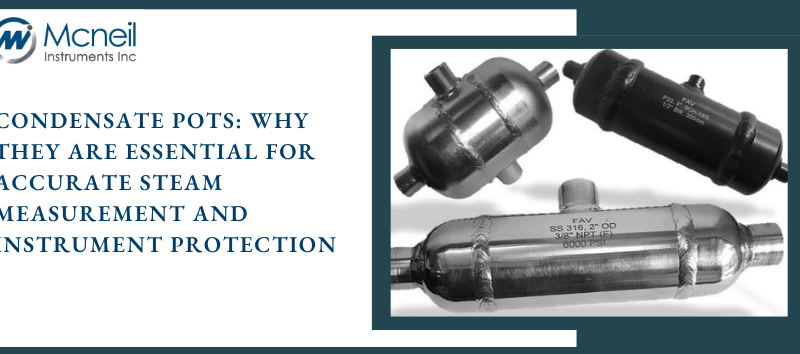
A Condensate Pot is a critical instrumentation accessory that acts as a protective chamber between the process line and measuring instruments. It collects condensate, traps moisture and contaminants, and maintains a stable liquid seal, ensuring accurate pressure measurement while extending the life of pressure transmitters, gauges, and flow meters.
In steam service, maintaining a consistent condensate level in the impulse lines is important because variations in the liquid column can affect the pressure signal reaching the instrument. A properly selected and installed condensate pot helps establish a repeatable measurement condition while reducing direct exposure of instrumentation to high-temperature steam.
Mcneil Air Header is a trusted manufacturer, supplier, and exporter of Condensate Pots, offering precision-engineered solutions manufactured from stainless steel, carbon steel, and alloy steel for high-pressure industrial applications. Its product range includes two-port, three-port, and four-port condensate pots designed for reliable performance in demanding industrial environments.
Depending on the application, condensate pots can be configured with different materials, connection types, port arrangements, dimensions, and pressure requirements to suit specific steam and instrumentation systems.
What Is a Condensate Pot?
A Condensate Pot, also known as a Seal Pot, is installed between the primary steam process line and pressure measuring instruments. It collects condensate formed inside steam lines and prevents high-temperature steam from directly reaching sensitive instrumentation.
The condensate pot traps:
• Condensed steam
• Moisture
• Foreign particles
• Process impurities
By maintaining a constant liquid column inside the impulse lines, condensate pots ensure stable pressure transmission and improve the accuracy of differential pressure measurements.
In differential pressure applications, maintaining similar and stable condensate conditions in the impulse lines is particularly important because differences in liquid head can introduce measurement errors. Condensate pots therefore form an important part of the overall impulse piping arrangement.
They are commonly used with pressure transmitters, differential pressure transmitters, pressure gauges, and other instrumentation connected to steam services.
How Does a Condensate Pot Work?
The working principle of a condensate pot is simple but highly effective.
- Steam flows through the main process pipeline.
- As the steam cools, condensate naturally forms.
- The condensate enters the condensate pot chamber.
- Moisture and contaminants settle inside the pot.
- A stable liquid barrier is maintained between the steam line and the pressure instrument.
- The liquid-filled impulse lines transmit the process pressure to the connected instrument while reducing direct exposure to high-temperature steam.
This prevents thermal shock, pressure fluctuations, and measurement errors while protecting sensitive instrumentation.
Before commissioning, the impulse lines and condensate pots should be correctly installed and filled according to the applicable instrumentation design. Maintaining the intended condensate level is important for reliable pressure measurement.
Benefits of Condensate Pots
Using condensate pots offers numerous operational advantages.
• Protects pressure transmitters and gauges
• Improves differential pressure measurement accuracy
• Prevents thermal shock
• Collects condensate and foreign particles
• Maintains balanced impulse lines
• Reduces maintenance frequency
• Extends instrumentation life
• Suitable for high-temperature and high-pressure applications
• Improves process safety and reliability
• Reduces direct thermal exposure of pressure instruments
• Supports stable pressure signal transmission
• Helps maintain consistent impulse-line conditions
• Improves reliability of steam pressure measurement systems
The condensate pot does not replace correct instrument installation, impulse-line design, insulation, or temperature management. Instead, it works as part of the complete steam measurement system to create more suitable conditions for the connected instrument.
Mcneil Air Header – Leading Manufacturer of Condensate Pots
Mcneil Air Header manufactures a comprehensive range of condensate pots designed for industrial steam and instrumentation systems.
The product portfolio includes:
• Two-Port Condensate Pots
• Three-Port Condensate Pots
• Four-Port Condensate Pots
• Stainless Steel Condensate Pots
• Carbon Steel Condensate Pots
• Alloy Steel Condensate Pots
• Threaded Condensate Pots
• Socket Weld Condensate Pots
• Flanged Condensate Pots
• Custom Condensate Pots
• High-Pressure Condensate Pots
• Steam Instrumentation Condensate Pots
Every condensate pot is manufactured using premium materials and tested for leak-free performance, dimensional accuracy, and long-term durability.
Custom configurations can be developed according to process conditions, port arrangement, connection type, material grade, pressure rating, and project-specific engineering requirements.
Types of Condensate Pots
Two-Port Condensate Pot
Designed for standard steam pressure measurement systems where simple condensate collection is required.
Common Applications
• Pressure gauges
• Steam pipelines
• Boiler instrumentation
• Small process systems
• Basic steam pressure measurement installations
Two-port configurations can provide a compact solution for applications requiring a straightforward connection between the process side and the instrument impulse line.
Three-Port Condensate Pot
Provides additional flexibility for instrumentation systems requiring multiple process connections.
Common Applications
• Differential pressure transmitters
• Steam flow measurement
• Industrial instrumentation
• Steam pressure monitoring systems
Three-port configurations can be selected when the instrumentation arrangement requires an additional connection for the specific measurement or piping configuration.
Four-Port Condensate Pot
Designed for complex industrial systems with multiple impulse line connections.
Common Applications
• Power plants
• Petrochemical facilities
• Refinery process units
• Large steam distribution networks
• Complex differential-pressure measurement systems
Four-port condensate pots can support more complex instrumentation arrangements where multiple connections are required within the steam measurement assembly.
Materials Used in Condensate Pots
Mcneil Air Header manufactures condensate pots in various material grades to meet different industrial requirements.
Material selection is important because condensate pots operate in environments where temperature, pressure, moisture, process chemistry, and corrosion exposure can vary significantly.
Stainless Steel Condensate Pots
Ideal for corrosive environments requiring excellent corrosion resistance and long service life.
Typical Grades:
• SS 304
• SS 316
• SS 304L
• SS 316L
Stainless steel condensate pots are particularly suitable for applications where moisture, chemical exposure, or demanding atmospheric conditions require enhanced corrosion resistance.
Carbon Steel Condensate Pots
Suitable for general industrial applications where high strength and cost-effectiveness are required.
Carbon steel can be an economical option for compatible steam and process services where the operating environment does not require the additional corrosion resistance provided by stainless steel.
Alloy Steel Condensate Pots
Designed for high-temperature and high-pressure services commonly found in:
• Thermal power plants
• Refineries
• Petrochemical industries
• High-temperature steam systems
• Industrial boiler applications
Alloy steel grades can provide enhanced elevated-temperature mechanical performance where the application requires properties beyond those of conventional carbon steel.
Technical Specifications
| Parameter | Specification |
| Product | Condensate Pot |
| Material | Stainless Steel, Carbon Steel, Alloy Steel |
| Port Configuration | 2 Port, 3 Port, 4 Port |
| Connection Type | Threaded, Socket Weld, Flanged |
| Size Range | 2″, 3″, 4″ |
| Application | Steam & Vapor Instrumentation Systems |
| Pressure Rating | Suitable for High-Pressure Service |
| Service | Steam, vapor, and pressure measurement applications |
| Customization | Available according to project requirements |
Actual pressure-temperature ratings, dimensions, wall thickness, connection specifications, and material requirements should be confirmed against the applicable design standard and project specification before ordering.
Industrial Applications
Mcneil Air Header Condensate Pots are extensively used in:
Power Generation
• Boilers
• Steam turbines
• Differential pressure measurement
• Superheaters
• Steam pressure measurement systems
• Boiler instrumentation
Oil & Gas
• Refineries
• Steam utility systems
• Offshore platforms
• Process pressure measurement
• High-temperature instrumentation systems
Petrochemical Industry
• Process instrumentation
• Reactor systems
• Steam service lines
• High-temperature process units
Chemical Processing
• Vapor handling systems
• Pressure monitoring
• Instrument protection
• Process measurement systems
Marine & Offshore
• Shipboard steam systems
• Process control equipment
• Instrumentation systems
• Corrosive marine environments
Industrial Manufacturing
• Heat exchangers
• Utility pipelines
• Process automation systems
• Steam distribution systems
• Industrial boiler instrumentation
Across these applications, condensate pots help separate sensitive pressure instrumentation from direct high-temperature steam exposure while supporting stable measurement conditions.
Why Condensate Pots Are Important for Differential Pressure Measurement
Differential pressure measurement in steam systems can be affected by differences in condensate levels, impulse-line temperature, trapped gases, and installation conditions. A properly designed condensate pot helps establish a consistent liquid seal between the process and the differential-pressure instrument.
For reliable measurement, both impulse lines should be installed and maintained in accordance with the instrumentation design so that the condensate conditions remain as consistent as possible.
This is especially important for applications involving steam flow measurement, where a differential pressure transmitter may be used with primary flow elements such as orifice plates.
Condensate Pot vs Direct Steam Instrument Connection
Connecting a pressure instrument directly to a high-temperature steam line can expose the instrument to temperatures beyond its preferred operating range. A condensate pot provides a controlled interface by allowing condensate to form and remain in the impulse connection.
| Feature | Direct Steam Connection | With Condensate Pot |
| Instrument Exposure to Steam | Higher | Reduced |
| Liquid Seal | Not specifically maintained | Maintained through condensate |
| Thermal Protection | Limited | Improved |
| Measurement Stability | Can be affected by installation conditions | Can be improved with proper installation |
| Instrument Protection | Lower | Higher |
The condensate pot is therefore an important component where the pressure instrument requires protection from direct high-temperature steam exposure.
Quality Assurance
Every Condensate Pot manufactured by Mcneil Air Header undergoes rigorous quality inspections, including:
• Hydrostatic Testing
• Pressure Testing
• Leak Testing
• Positive Material Identification (PMI)
• Dimensional Inspection
• Material Verification
• Visual Inspection
• Third-Party Inspection
• Connection and thread verification
• Material traceability checks
These comprehensive quality procedures ensure reliable, leak-free operation and compliance with international industrial standards.
Inspection requirements can be customized according to customer specifications, applicable standards, and project quality plans. Material Test Certificates and third-party inspection documentation can also be provided where required.
Why Choose Mcneil Air Header?
Industries worldwide choose Mcneil Air Header because of:
• Complete range of condensate pot configurations
• Premium stainless steel, carbon steel, and alloy steel options
• Precision engineering and manufacturing
• Customized solutions for project requirements
• Strict quality control procedures
• Competitive pricing
• Fast worldwide delivery
• Dedicated technical support
• Material traceability and quality documentation
• Application-specific configuration support
With decades of experience in industrial instrumentation products, Mcneil Air Header delivers condensate pots that improve measurement accuracy, protect expensive instruments, and ensure dependable long-term performance.
Our team can support customers in selecting the appropriate material, port configuration, connection type, dimensions, and testing requirements for their intended steam measurement application.
How to Select the Right Condensate Pot
Selecting the correct condensate pot requires consideration of the complete process and instrumentation arrangement. Key factors include:
• Operating temperature
• Operating and design pressure
• Steam or vapor service conditions
• Required material grade
• Number of ports
• Connection type and size
• Impulse-line configuration
• Instrument type
• Applicable piping and instrumentation standards
• Project-specific inspection requirements
Providing these details to the manufacturer helps ensure that the condensate pot is compatible with the intended application and connected instrumentation.
Conclusion
A Condensate Pot is an essential component in steam and vapor instrumentation systems, helping maintain accurate pressure measurement while protecting sensitive instruments from moisture, condensate, and high-temperature steam. Its ability to create a stable liquid seal makes it indispensable in industries where precision, reliability, and safety are critical.
By controlling the conditions between the steam process line and the measuring instrument, condensate pots can help reduce thermal exposure, support stable impulse-line pressure transmission, and improve the reliability of steam pressure and differential-pressure measurement systems.
Whether your application requires Two-Port Condensate Pots, Three-Port Condensate Pots, Four-Port Condensate Pots, Stainless Steel Condensate Pots, Carbon Steel Condensate Pots, Alloy Steel Condensate Pots, Threaded Condensate Pots, Socket Weld Condensate Pots, Flanged Condensate Pots, or Custom Condensate Pots, Mcneil Air Header delivers precision-engineered solutions manufactured to international standards for dependable performance across the most demanding industrial applications.
For project-specific requirements, contact Mcneil Air Header with your required material grade, port configuration, connection type, operating pressure, temperature, quantity, and applicable specifications to receive a suitable condensate pot solution.